 REMOTE FIRST
Finding and Choosing Global Talent
How to hire beyond your city: global sourcing, referrals, the signals that actually predict remote performance, and the red flags that cost companies months.
1. Talent scouting in a remote-first company
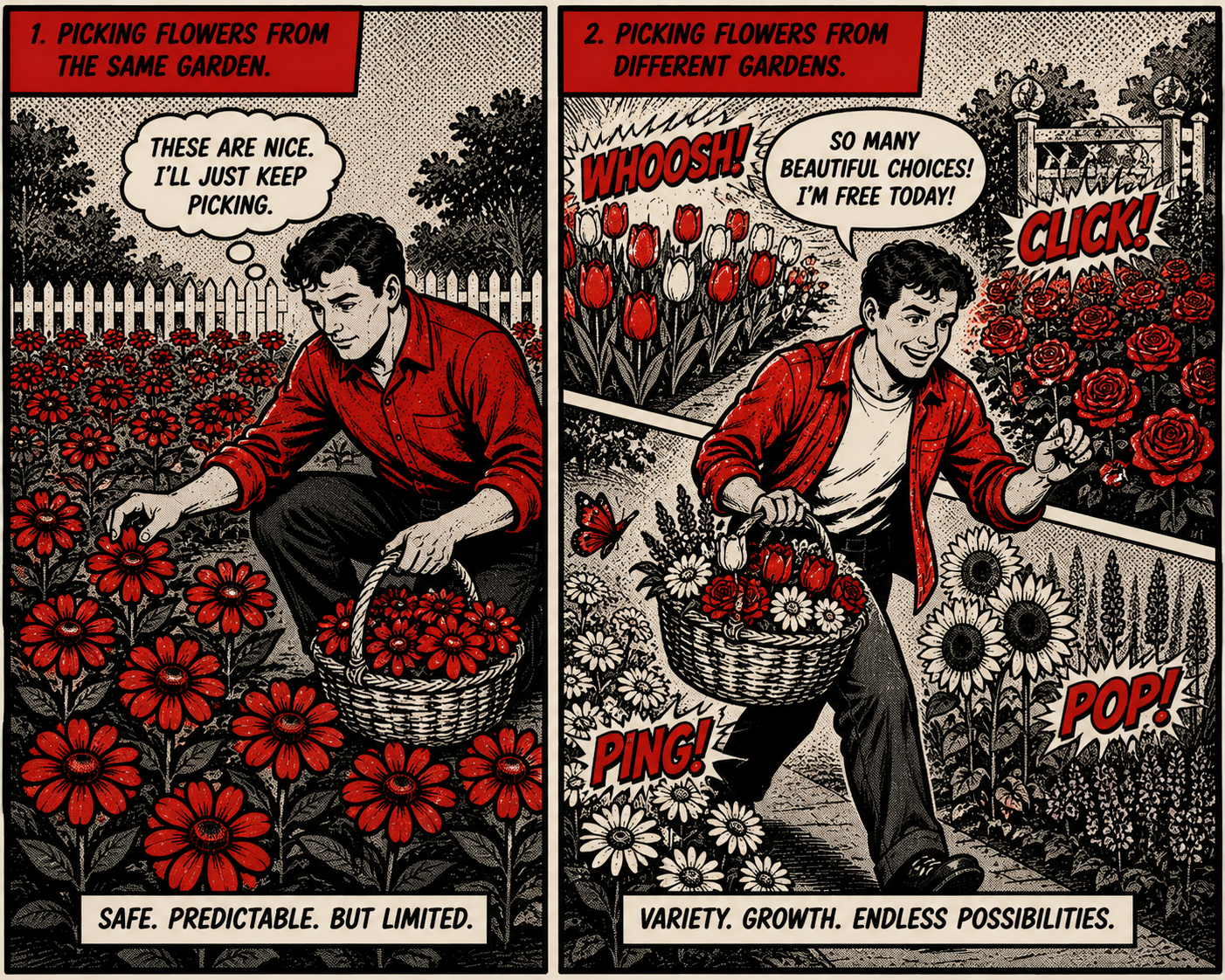
One of the most common mistakes companies make when hiring is assuming that talent must be found locally. In traditional organizations this assumption feels natural: recruitment happens in the same city, within the same cultural context, and the process unfolds among familiar candidates. Remote-first companies operate under a completely different logic.
When a company is built from the beginning to operate remotely, geography stops being the main constraint. Instead of competing for a small pool of local candidates, you search globally for the best person for each role. This shift changes the scale of the talent market: instead of evaluating ten candidates from a single city, you may receive applications from people in five different countries, coming from different educational systems, industries, and professional cultures.
The larger pool increases the probability of finding exceptional people, but it also introduces new complexity. Traditional signals become less reliable, because the reputation of a university or a previous employer may mean little across borders. This forces remote companies to rely on behavior rather than credentials: how the candidate communicates, whether they listen carefully, whether they understand what remote work really demands.
Another structural difference concerns the type of professional relationships remote companies build. Many collaborators live in different jurisdictions, so they are formally freelancers or independent contractors even when the collaboration is stable and long-term. On paper it is a contractor relationship; in practice they are fully part of the team. This model makes organizations flexible, but it also makes selection critical: a wrong hire can affect productivity, communication, and morale for months.
Reflective questions
- In my current hiring process, am I truly searching globally for each role, or am I still unconsciously limiting myself to familiar geographies?
- Looking at my last three hires, how many candidates from outside my usual sourcing area did I seriously evaluate, and what stopped me from going further?
- What one concrete change can I make to my next job posting to open the search to a wider talent market?
2. Why hiring mistakes are expensive
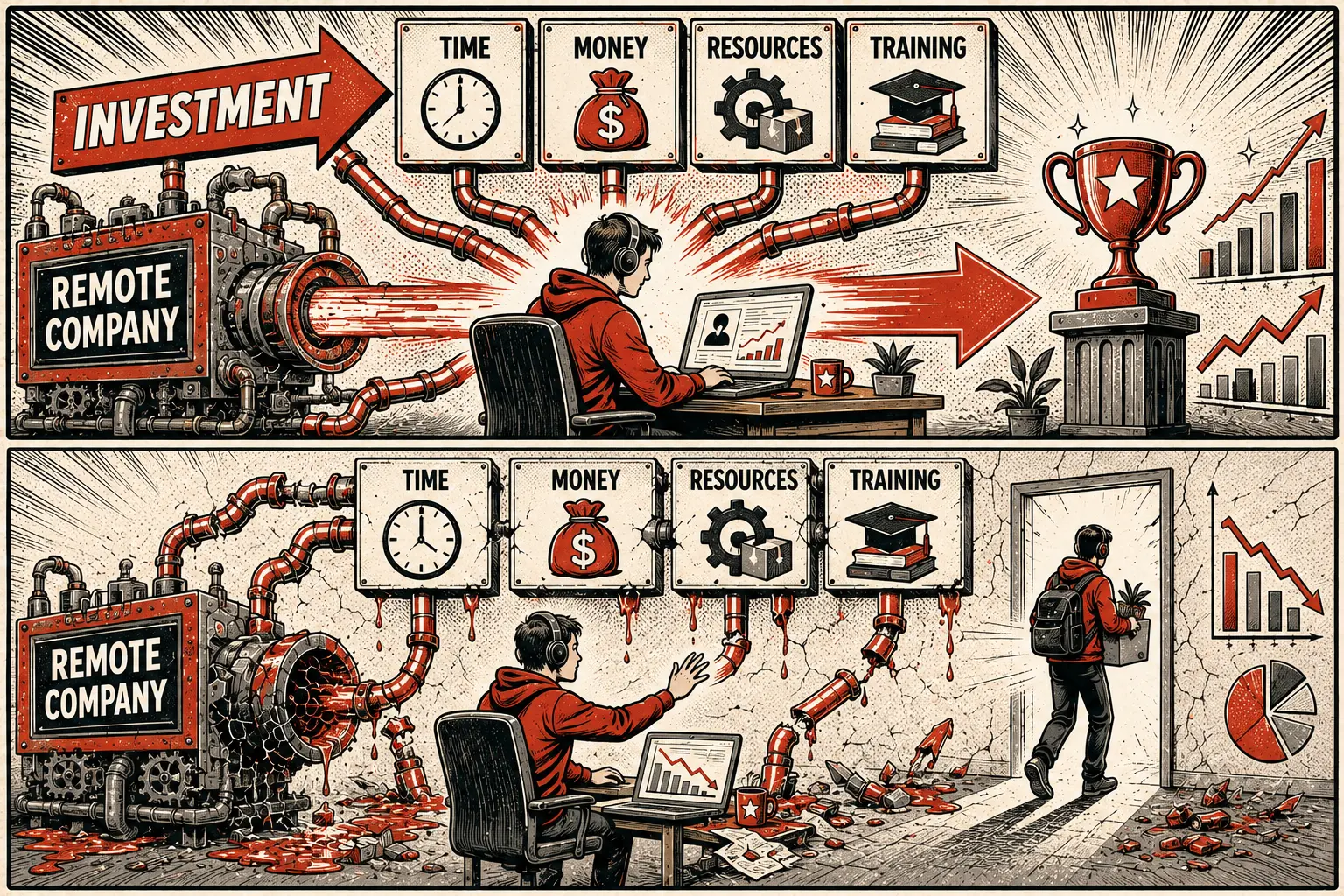
Hiring the wrong person is costly in any organization, but in remote companies the consequences are amplified. Many of the early warning signs that would surface naturally in an office simply do not appear until much later.
In a traditional office, new hires are surrounded by colleagues all day. Informal interactions surface problems quickly: someone notices confusion, misunderstandings, or collaboration friction. In remote teams these signals are far less visible, because people communicate mostly through digital tools. A person who is disengaged or lost may not show it for weeks, until deadlines start slipping.
The replacement cost is also higher than it looks. When a collaborator leaves, the company loses the time invested in recruiting, onboarding, and training. A new process must start, another candidate must be evaluated and integrated, and managers must explain everything again. Replacing a collaborator often means several months before the team returns to its previous level of efficiency.
This is why hiring decisions should never be rushed. Remote companies treat the interview process as an investment, not a formality, while accepting that no interview reveals everything about a candidate. For that reason, hiring is designed as a multi-stage evaluation that continues even after the person starts. The interview eliminates clear misfits; the real evaluation happens during the first weeks of collaboration, when both sides finally observe each other in real conditions.
Reflective questions
- In the last year, have I had a hiring mistake on my remote team, and do I have a clear picture of its real cost in time, morale, and client impact?
- How early am I typically noticing that a new hire is struggling, and what structured touchpoints do I have to catch problems before they escalate?
- What can I add to my first 30 days to make performance issues more visible, before the cost becomes too high to ignore?
3. Hard skills vs soft skills
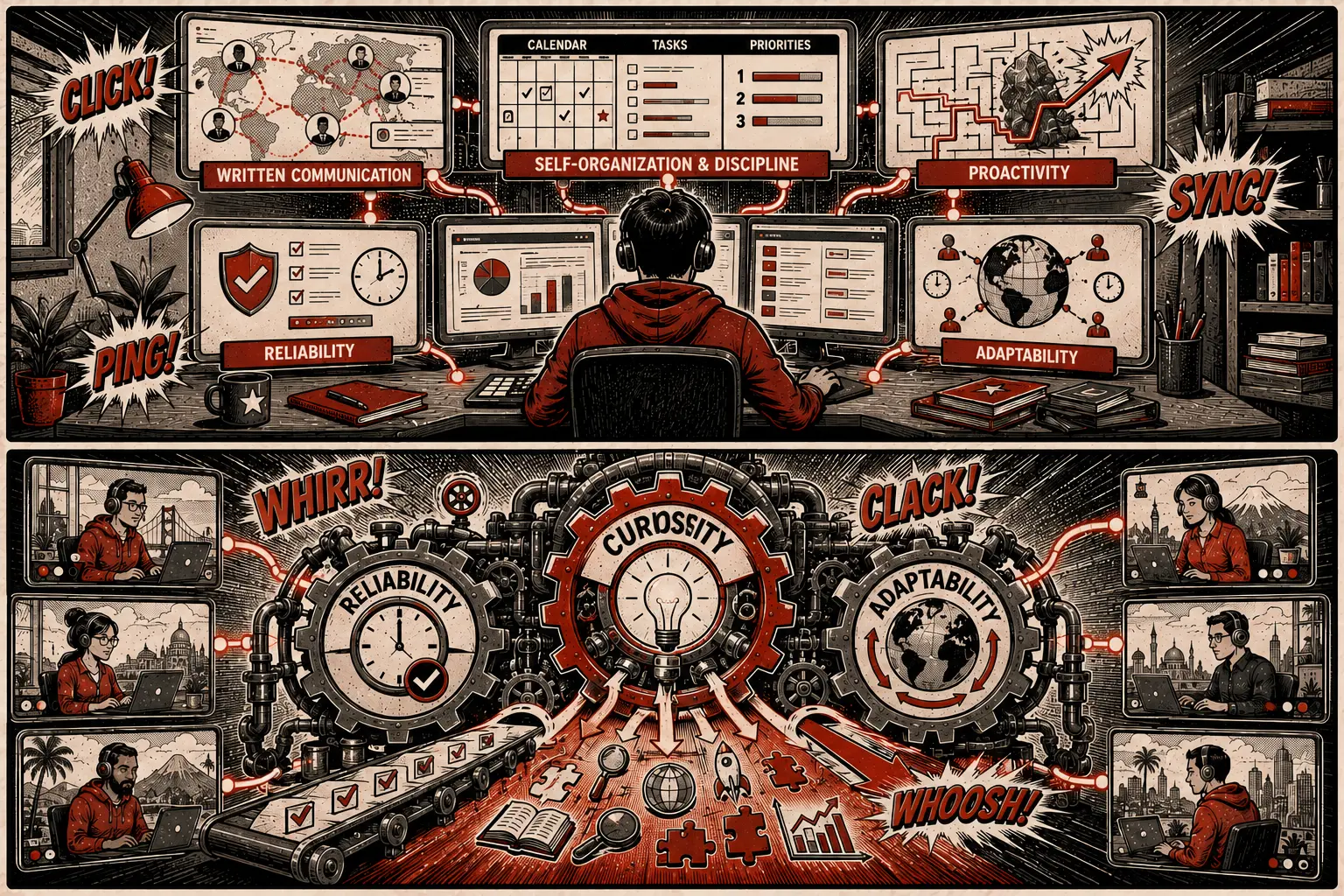
In a remote-first company, hard skills get you in, but soft skills keep you in. Both matter, one without the other rarely produces a strong long-term collaborator, but they play very different roles in the hiring decision.
Hard skills are the technical competences the role requires: using a specific tool, running advertising campaigns, writing code, analyzing data, managing a process. They are relatively easy to test and to measure. They are also the fastest way to filter candidates in a first phase, because a person who does not have the baseline technical foundation simply cannot deliver the work, no matter how strong their attitude is. In digital businesses hard skills also change constantly: tools evolve, especially in the AI area, entire platforms become obsolete in a short time. So hard skills matter, but they matter as a moving baseline rather than as the permanent core of someone’s value to the team.
Soft skills are the qualities that decide whether a person can actually operate inside a remote team over time. They tend to be more stable across years and technologies, and they are much harder to teach than a new software tool. In remote environments they carry double the weight they carry in an office, because remote work removes the physical structures that used to compensate for weak habits. The soft skills we look for most:
- Written communication, the ability to be clear, concise, and unambiguous in text, because most of the collaboration happens there.
- Self-organization and discipline, managing time, priorities, and focus without someone standing over your shoulder.
- Proactivity, asking questions, raising blockers, and moving forward without waiting for permission.
- Reliability, doing what you said you would do, in the timeframe you agreed, without needing to be chased.
- Adaptability, adjusting to different cultures, time zones, and ways of working without friction.
- Curiosity, genuinely wanting to understand the business, not just execute tickets.
A technically strong candidate with weak soft skills often creates friction inside a remote team: misunderstandings pile up, feedback becomes hard, collaboration slows down even when individual output looks fine. A candidate with strong soft skills and moderate technical knowledge tends to improve quickly, because someone who communicates well, listens, and is willing to learn can acquire technical competence relatively fast, and that combination is far more durable than technical skill alone.
In practice this means we use hard skills as the initial filter and soft skills as the deciding factor. A candidate has to clear a minimum technical bar to enter the conversation, but among those who clear it, the person who wins the role is almost always the one with the stronger remote soft skills.
Reflective questions
- For each role on my team, do I have an explicit breakdown of which hard skills are truly essential versus which soft skills will determine long-term success?
- In my recent hiring decisions, when a candidate had strong technical skills but weaker soft skills, how did I weigh that balance, and was it the right call?
- What can I change in my job descriptions and scorecards so soft skills are as visible and as scored as technical requirements?
4. Remote work mindset and environment

Working remotely requires a specific mindset that not everyone naturally possesses, and it is one of the hardest things to teach after someone has already started. Some candidates have impressive backgrounds but struggle with the practical realities of remote work because they have spent years in traditional offices where schedules and responsibilities were structured around them. When they move to a remote environment the sudden autonomy can feel disorienting.
Many candidates initially imagine remote work as freedom: flexibility, no commute, control over their day. Those aspects are real, but remote work also introduces responsibilities that are easy to underestimate. When someone works from home, the boundaries between personal life and professional responsibilities blur. Family members interrupt, household tasks compete for attention, distractions are harder to resist than in an office.
Closely connected to mindset is the physical environment the candidate actually works from. In a traditional office the environment is standardized for everyone; in remote work it is entirely personal, and it shapes productivity in ways that are invisible from the outside. Some candidates share apartments with roommates who create constant interruptions. Others live in noisy areas. Others do not yet have a dedicated workspace where they can concentrate for hours. None of this automatically disqualifies someone, but if it is not surfaced early it becomes a serious problem later.
Candidates who have already worked remotely usually understand these challenges because they have solved them: they have routines, dedicated workspaces, and a clear separation between work and personal life. Candidates who are new to remote work often underestimate them entirely. A simple question during the interview, “Have you worked remotely before, and what did your daily structure look like?”, can reveal a great deal. It is not an invasion of privacy; it is a practical conversation that helps both sides set realistic expectations before day one.
Reflective questions
- In my interviews, do I have two or three questions that reliably show whether a candidate has the discipline and autonomy to thrive without an office?
- Do I currently ask anything about the candidate’s home working environment, space, setup, separation between work and personal life, or do I avoid it as too personal?
- What is a respectful but direct way I can introduce a conversation about environment and daily routine, so both sides can assess fit before day one?
5. The interview process
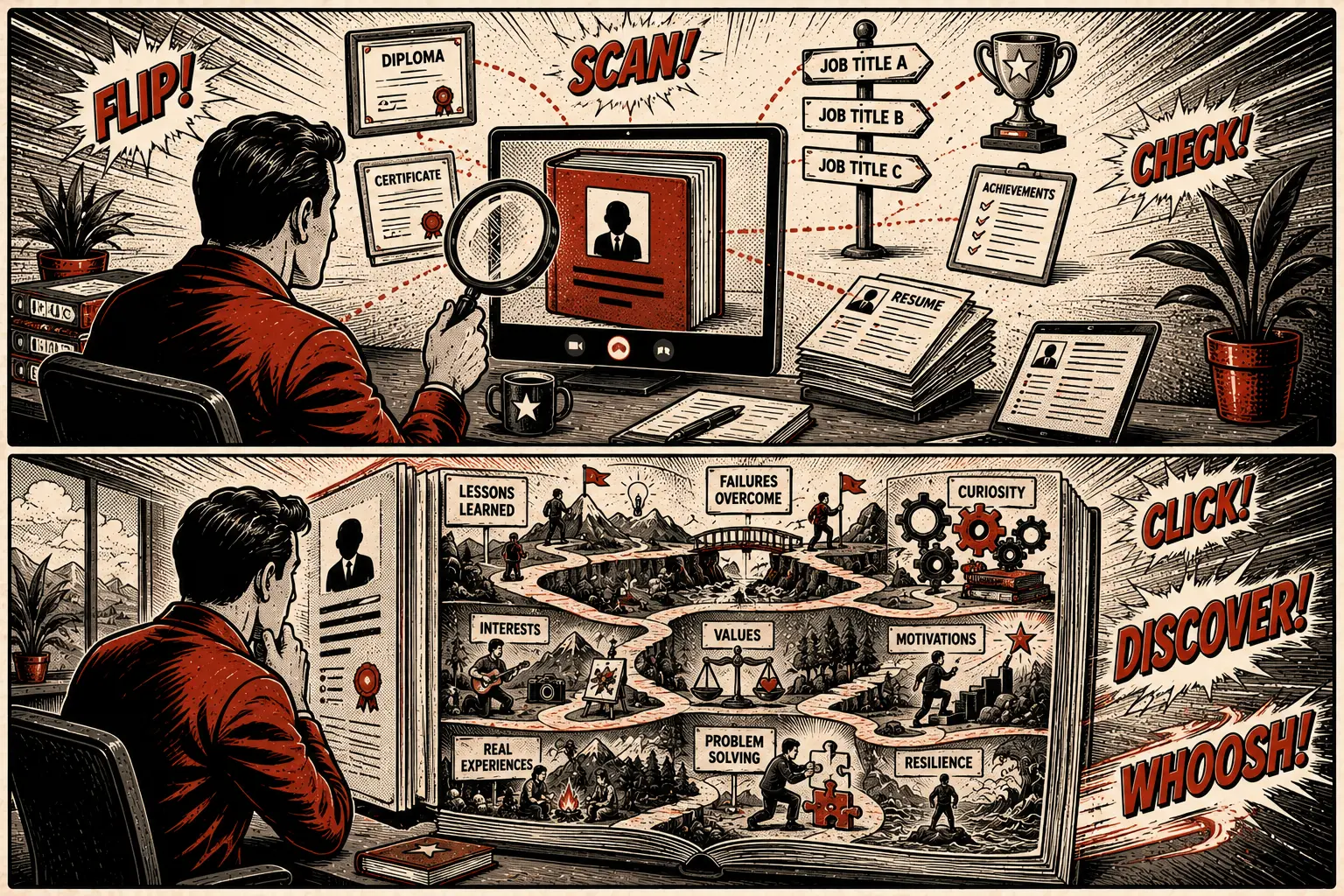
An interview is often perceived as a simple exchange of questions and answers, but in reality it is a much richer interaction. When designed well it lets both sides observe each other genuinely rather than perform for each other.
A well-designed interview process lets the company evaluate the candidate while the candidate also evaluates the company. It is important to structure the conversation so the candidate can express themselves naturally rather than recite prepared answers. Many interviews begin with a personal introduction: asking the candidate to describe their professional journey in their own words often reveals how they perceive their experience. Some focus on achievements, others on responsibilities, others on lessons learned along the way.
After this initial phase the conversation usually moves toward specific professional experiences. At some point it can be very useful to temporarily step away from purely technical questions and explore broader aspects of the candidate’s life or interests. These moments often allow the candidate to relax and respond more authentically. Once that more open conversation has happened, the interview can return to professional topics, at which point the candidate is usually more comfortable and more likely to give honest, unscripted answers.
Transparency matters too. Candidates should clearly understand what the company does, how the team works, and what is expected from the role. In remote companies, explaining the communication structure and the level of autonomy expected is particularly important, because many candidates have never worked in that kind of environment and may not fully understand what they are agreeing to until they are already in it.
Reflective questions
- In my current interview structure, am I giving candidates enough unscripted space to talk about their journey in their own words?
- When I observe how a candidate narrates their own experience, what patterns am I paying attention to, and which ones consistently predict how they perform on my team?
- What is one practical change I can make to my next interview to create a more genuine two-way conversation?
6. Red flags and real interview signals
Interviews often reveal problems through small behaviors that seem insignificant in the moment but turn out to be among the most reliable indicators of how someone will show up once they are on the team. Candidates come prepared: they know they are being evaluated and they try to present themselves in the best possible way. Despite that preparation, genuine signals still surface naturally throughout the conversation.
A candidate who appears distracted, checks their phone repeatedly, or responds with minimal engagement is often demonstrating the same behavior they will later show in team meetings. In remote environments, presence and attention during calls is not optional. Most collaboration happens through digital communication, so the ability to remain present and engaged is a key professional skill, not a personality bonus.
Another common signal appears when candidates focus almost exclusively on salary during the very first conversation. Compensation is obviously important, but a candidate who shows no curiosity about the role, the team, or the projects may be motivated primarily by the paycheck. Candidates who show genuine curiosity about the work itself tend to become far more engaged and reliable collaborators over time.

Some real examples make this concrete. We once interviewed a candidate who smoked during the call. From a purely technical perspective this does not affect their ability to do the job, but it reveals something about their professional awareness and how they read the context of a professional interaction. Others repeatedly ask about basic elements of the position, salary, KPIs, hours, responsibilities, even after those things have already been explained. These are legitimate questions, but asking the same ones several times often indicates lack of attention, which will matter a great deal once the person is operating remotely with real autonomy.
Over time you develop an intuitive ability to interpret these small behaviors, and what looks like a minor detail during a short conversation often reveals patterns that reappear consistently during daily collaboration. This is exactly why interviews should not focus only on the candidate’s answers, but also on how the candidate behaves throughout the entire interaction.
Reflective questions
- In my last five interviews, did I notice small behavioral signals, attention, tone, engagement, and did I factor them into the decision, or dismiss them?
- Looking at people who underperformed after joining, what behaviors during their interview were already hinting at the problems that emerged later?
- What specific observable behaviors during a video call, beyond what the candidate says, will I now track deliberately as part of my evaluation?
7. International mindset
One of the strongest indicators of adaptability in remote teams is international experience. Speaking multiple languages is already useful, but the most valuable factor is the experience of actually living in a different cultural environment, not just visiting one.
When someone lives abroad for an extended period they are exposed to different ways of thinking, communicating, and organizing work. They have to adapt to unfamiliar social norms and develop new strategies to navigate everyday situations. This experience often changes the way they approach problems at a fundamental level: they become more flexible, more curious, and more open to alternative perspectives. These qualities are extremely valuable in remote teams, where collaborators come from different countries and have to navigate constant differences together.
Communication styles, for example, differ widely between cultures. In some cultures communication is direct and explicit; in others it is more indirect and contextual. Learning to navigate these differences makes people more attentive and adaptable communicators, which is exactly the kind of skill that matters most in an international remote team where misunderstandings can accumulate quickly and silently.
Another important dimension is independence. Many people who move to another country must manage practical challenges on their own, accommodation, bureaucracy, social networks, unfamiliar systems. These experiences strengthen resilience and problem-solving in ways that classroom education or purely local work experience rarely replicate. This does not mean that only people with international experience can succeed in remote teams; many excellent collaborators have built strong careers within a single country. But when candidates have lived abroad for extended periods, that experience is often a strong indicator of the exact qualities you need them to bring to daily work with an international team.
Reflective questions
- In my hiring conversations, do I go beyond asking about languages and actually explore how someone has adapted their thinking in a different cultural environment?
- Which collaborators on my team demonstrate the flexibility that comes from real cross-cultural experience, and what patterns in their background explain it?
- What follow-up question can I use to distinguish candidates who have merely visited other countries from those who have genuinely lived and worked in another culture?
8. Where talent really comes from
When companies think about recruitment, they usually focus on formal channels: job boards, professional platforms, recruitment agencies. These channels remain useful, but they represent only part of the talent landscape, and sometimes not the most interesting part.
Some of the most compelling candidates appear through less conventional paths. Online communities, professional forums, and social networks sometimes surface people who are not actively looking for a new job but are open to an interesting opportunity. In remote environments this phenomenon becomes even more relevant, because professionals often participate in international communities related to their field, so they are reachable if you know where to look.
Some organizations experiment with alternative sourcing channels with real results. Social media platforms such as Facebook or Instagram can be used to promote job opportunities through targeted advertising campaigns that reach audiences who would never actively search for jobs on professional networks. A simple ad plus a short screening questionnaire can generate a large number of responses quickly, especially when the campaign is targeted to specific regions or language groups. Specialized online communities and niche forums often surface exactly the kind of curious, self-directed contributors who thrive in remote environments.
Alternative sourcing requires more filtering, because a broader audience means more applications that do not match the role. Structured questionnaires or a short initial screening make this manageable. The goal is not to replace traditional platforms but to complement them. And beyond channels, alignment matters as much as credentials: the best candidate for a role is not necessarily the one with the most impressive resume, but the one whose motivations match the company’s current stage of growth.
Reflective questions
- In my current sourcing, what percentage of candidates come from job boards versus less conventional channels like communities, forums, or recommendations?
- Thinking about the strongest people I have hired, how many came through unexpected paths, and what does that tell me about where to invest more attention?
- What is one new sourcing experiment I can run in the next hiring round to reach candidates who are talented but not actively searching?
9. Referrals and internal networks
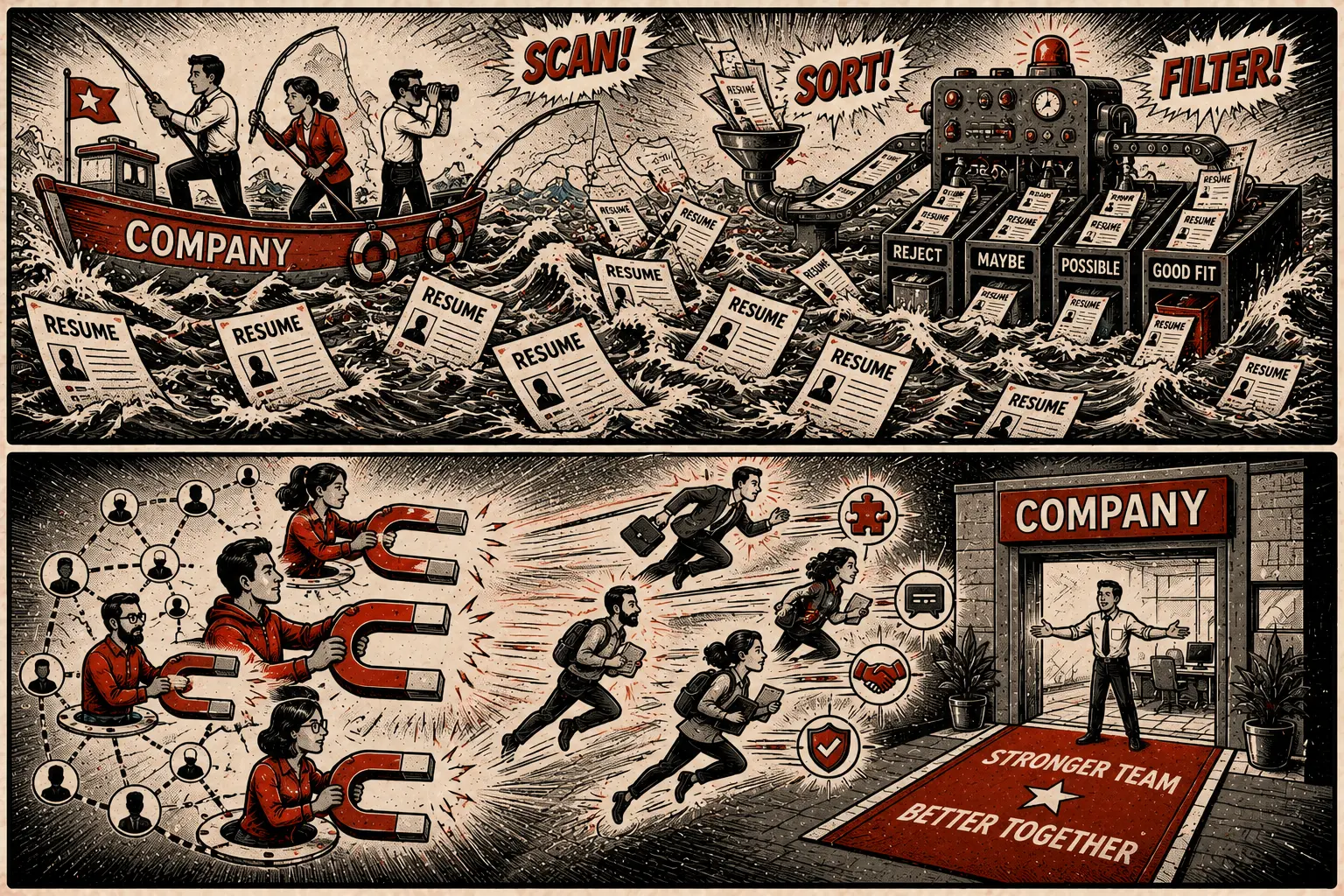
One of the most effective ways to find strong candidates is through internal referrals, and the reason goes deeper than convenience. People tend to build relationships with others who share similar professional attitudes and values. When someone inside the company recommends a candidate, there is already a layer of informal screening that no job board can replicate.
Team members care about their reputation within the organization, so recommending someone unreliable would reflect poorly on them. They are naturally motivated to suggest people they genuinely trust. Some companies formalize this through referral programs: if a collaborator recommends a candidate who joins and stays for a certain period, they receive a bonus. Even without formal incentives, actively encouraging the team to share potential candidates significantly improves the quality of the pipeline. Internal referrals also produce candidates who already have some understanding of the company’s culture and expectations, which makes integration smoother from day one.
Reflective questions
- In my team, do I have a clear referral process, and do collaborators genuinely know that their recommendations are valued and rewarded?
- Comparing hires from referrals with hires from job boards, what differences in performance, retention, or cultural fit have I actually observed?
- What can I do in the next 30 days to activate my team’s internal network more intentionally?
10. Employee mindset vs project mindset
One of the most important things we try to understand during interviews is the candidate’s relationship with work itself, and it is something that does not come through credentials or a resume. It is fundamentally about attitude.
Different people approach work in very different ways. Some see it mainly as a transaction: time in exchange for money. This mindset is common in traditional employment where the primary objective is stability and predictable income. There is nothing wrong with this perspective, and many organizations function well with exactly that structure. Remote-first companies, however, often operate differently. Because remote teams rely heavily on autonomy and initiative, you benefit far more from collaborators who see their work as part of a broader professional journey.
We describe this difference as the contrast between an employee mindset and a project mindset. Someone with an employee mindset focuses on the immediate exchange: the tasks they must perform and the compensation they receive in return. Someone with a project mindset sees the role as a phase within a longer learning process. They are interested in how the organization functions and how their contribution connects to the team’s broader results. They ask questions about the company’s direction rather than just their own responsibilities, and they propose improvements based on what they observe.
This does not mean everyone must aspire to become an entrepreneur or a manager. Many excellent professionals prefer to remain deep specialists within their field, and that is genuinely valuable. The difference lies in attitude, not in ambition. Most of the time, the collaborators who bring the most energy and creativity to a remote team are exactly the ones who came in with a project mindset from the beginning. You can often see it in the questions they ask during the interview, in whether they are genuinely curious about where the company is going, and in how they talk about what they have learned from past roles rather than just listing what they have done. In remote environments this matters even more, because you cannot supervise every detail of daily work.
Reflective questions
- In my interviews, do I have a reliable way to explore whether a candidate sees work as a time-for-money transaction or as something they are invested in beyond the contract?
- Which collaborators on my team contribute the most initiative, and what signals during their hiring process suggested a project mindset?
- What specific question or task can I introduce to observe whether a candidate approaches a challenge with ownership or with minimal compliance?
11. The interview continues after hiring
Many companies treat the interview as a single event. Once the candidate is selected and the contract is signed, the evaluation phase is considered complete. In reality the interview often continues after hiring, and in remote companies the first months of collaboration are where the most revealing information tends to emerge.
During the interview stage, candidates naturally present themselves in the best possible way: they prepare answers, choose a quiet environment, and focus carefully on the conversation. Once the collaboration begins, daily routines gradually reveal more authentic behaviors. Real deadlines, real feedback, and real accountability surface patterns that no amount of interview preparation can conceal for long.
In our experience, the first three months are the most informative period. The company evaluates how the collaborator communicates, manages responsibilities, and reacts to feedback. The collaborator evaluates whether the company’s culture, expectations, and rhythm match their personal goals. Both sides are forming an impression that will shape the long-term collaboration.
The structure you put in place during those first months determines how much useful information you actually collect. Weekly check-ins in the first month help identify potential issues before they become serious: what challenges the person encountered, how they organized their tasks, whether they feel comfortable with the tools and communication channels. In the following months the frequency can decrease to bi-weekly or monthly, but the important thing is that these conversations happen deliberately, with clear criteria in mind.
By the end of three months you usually have a much clearer picture of the collaborator’s working style, and the collaborator has experienced the company’s culture from the inside. This mutual evaluation lets both sides decide whether the long-term collaboration makes sense on the basis of real evidence rather than impressions. It also reduces the pressure on the initial interview: instead of expecting perfect predictions from a short conversation, you accept that understanding someone’s professional behavior requires time and observation, and you design a process that gives you that time deliberately.
Reflective questions
- In my current onboarding, do I have a structured way to keep evaluating a new hire’s real behaviors in the first weeks of actual work, or does assessment effectively stop at signature?
- Do I have a written evaluation framework for probation, defined criteria, scheduled check-ins, structured feedback, or is it mostly informal and reactive?
- What three observable behaviors will I define right now as the key criteria I will track during the next new hire’s probation?
12. Closing reflection

Talent scouting is not simply about filling positions. It is about identifying people who can grow with the company, contribute to its culture, and adapt to an environment that values autonomy, responsibility, and collaboration.
When you review your hiring process, the real questions are not about procedures but about patterns. Are you evaluating candidates based on observable behavior, or mainly on credentials? Are you creating space in interviews for genuine curiosity and real conversation to emerge? Are you paying attention to soft skills, remote work mindset, and the candidate’s environment, or only to what is on the resume? And are you treating the early months of collaboration as a continuation of the evaluation, or just as an onboarding formality?
In remote-first organizations, talent scouting becomes one of the most strategic activities in the entire company. Selecting the right people does not only influence productivity, it shapes the culture, the communication style, and the long-term evolution of the organization itself. Every improvement you make to how you hire is an investment that compounds over time.
Reflective questions
- What is one concrete change I can make to my hiring process in the very next role I open?
- Who on my team could benefit from being more involved in the interview process in a structured way, and what would I need to put in place to make that happen?
- If I could redesign the last onboarding I ran, what is the one thing I would add to the first 30 days to gather better evidence about the new hire’s working style?