 REMOTE FIRST
First Interview, Trial Period and Onboarding
From the first conversation to a productive team member: interview structure, expectations and KPIs, a trial period that actually evaluates, documentation and SOPs, and onboarding that scales.
1. The purpose of the first interview

The first interview is often misunderstood. Many companies treat it as a simple filtering step, verifying whether the candidate has the required experience or technical skills, and the conversation becomes a checklist of qualifications, previous roles, and formal competencies. In reality, the first interview should serve a much broader purpose. Its primary objective is not only to verify what the candidate knows, but to begin understanding how the person thinks, communicates, and approaches work.
In remote-first organizations this becomes particularly important, because when people work remotely, you cannot observe daily behavior in a shared office environment, collaboration happens through digital tools, meetings, written messages, and independent work, and because of this, communication style, curiosity, and motivation become essential indicators of long-term success. The first interview therefore becomes the starting point of a deeper evaluation process.
Rather than trying to extract as much information as possible in a short time, the goal is to create a conversation that allows the candidate to reveal their way of thinking. What a candidate chooses to talk about when presenting themselves can already reveal a lot: some people immediately focus on titles and achievements, while others talk about experiences, lessons learned, or challenges they faced, and both approaches provide valuable signals. The interview should not feel like an interrogation. It should resemble a structured conversation where both sides explore whether a collaboration could work, you evaluate the candidate, but the candidate also evaluates you, which is especially important in remote organizations, where collaboration relies heavily on trust and autonomy.
Reflective questions
- When I think about my last three interviews, was I genuinely trying to understand how each candidate thinks and communicates, or was I primarily verifying whether their CV matched a checklist of qualifications?
- How consistently do I use the first interview to assess soft dimensions, reasoning style, communication clarity, approach to ambiguity, rather than relying only on technical or experiential criteria that the CV already covers?
- What is one concrete change I can make to the opening of my next interview to signal from the start that I am interested in the person's thinking process, not just their credentials?
2. Preparing the interview: CV, questionnaire and role definition
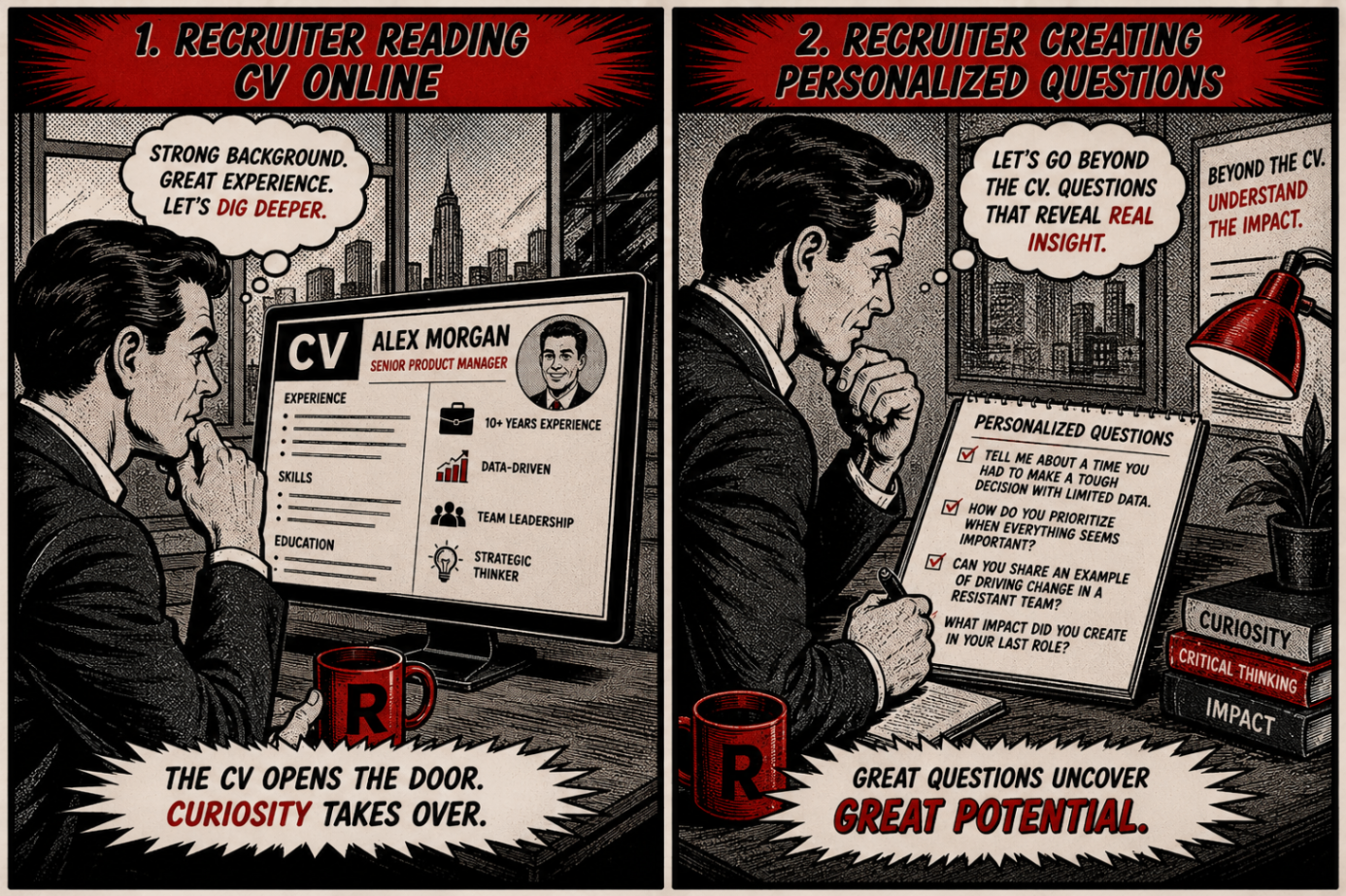
A good interview rarely starts at the moment the call begins, preparation shapes the quality of the questions you will actually ask. Before meeting the candidate, review the information already available: the CV, the questionnaire answers, and any previous communication exchanged with the person.
Each of these elements provides different types of information. The CV usually describes professional history, roles, companies, responsibilities, and sometimes achievements, but CVs are often written to present the candidate in the best possible light, emphasizing strengths while minimizing uncertainties or transitions. Questionnaires often reveal how the candidate interprets questions and expresses ideas in writing, and in some cases inconsistencies appear between the CV and the questionnaire responses that are worth exploring. Someone might describe themselves as having held a managerial position in the CV while the questionnaire answers suggest a much more operational role, these discrepancies are not necessarily negative, but they provide interesting topics to dig into during the interview.
Preparation also involves clarifying the role itself. Before evaluating candidates, you should already have a clear understanding of the position you want to fill, including the responsibilities, the expected outcomes, and the type of collaboration involved. When the role is vague, interviews become confusing for both sides, candidates struggle to understand what is expected from them, while you end up evaluating people based on subjective impressions rather than clear criteria. A well-prepared interview begins with clarity about the role and with a thoughtful review of the candidate's background.
Reflective questions
- Before my last interview, how much time did I actually dedicate to reading the candidate's CV and questionnaire answers, and did I arrive at the conversation with specific hypotheses or open questions I wanted to explore?
- When I review a candidate's pre-interview materials, do I actively look for inconsistencies, gaps, or patterns that deserve follow-up, or do I tend to skim and let the conversation unfold without a preparation-based agenda?
- What structured preparation routine can I build into my calendar before each first interview to ensure I show up with genuine, candidate-specific questions rather than a generic script?
3. The structure of the first interview
Although every conversation is unique, following a general structure during the interview helps create a more consistent and revealing experience for both sides. The conversation usually begins with the candidate presenting themselves, this initial moment is useful because it allows the person to choose what aspects of their background they consider most important, and what someone decides to highlight can reveal a lot about their priorities and professional identity. After this introduction, the discussion often moves toward the candidate's professional experiences, where questions about previous roles, challenges, and achievements help clarify skills and responsibilities.
After some time it can be very useful to introduce broader questions about the person's background, interests, or personal experiences, these topics create a more relaxed atmosphere and sometimes reveal aspects of the candidate's character that would not emerge from purely technical questions. Once the conversation becomes more natural, it is often productive to return to professional topics again, at which point candidates are usually more likely to answer honestly about their expectations, motivations, and concerns. This simple sequence, work, personal context, then work again, often creates a more balanced and revealing conversation than a purely structured Q&A.
Reflective questions
- Do I currently follow a consistent interview structure that gives every candidate a comparable experience, or does my approach vary significantly depending on the role, my mood, or the flow of conversation?
- When I give candidates space to present themselves at the opening of the interview, am I actively listening for what they choose to emphasize, and using that information later in the conversation, or am I mainly waiting for my turn to speak?
- What part of my current interview structure am I least satisfied with, and what one adjustment to the sequence or balance of speaking time would make the conversation more revealing and more fair?
4. Understanding the candidate's motivation
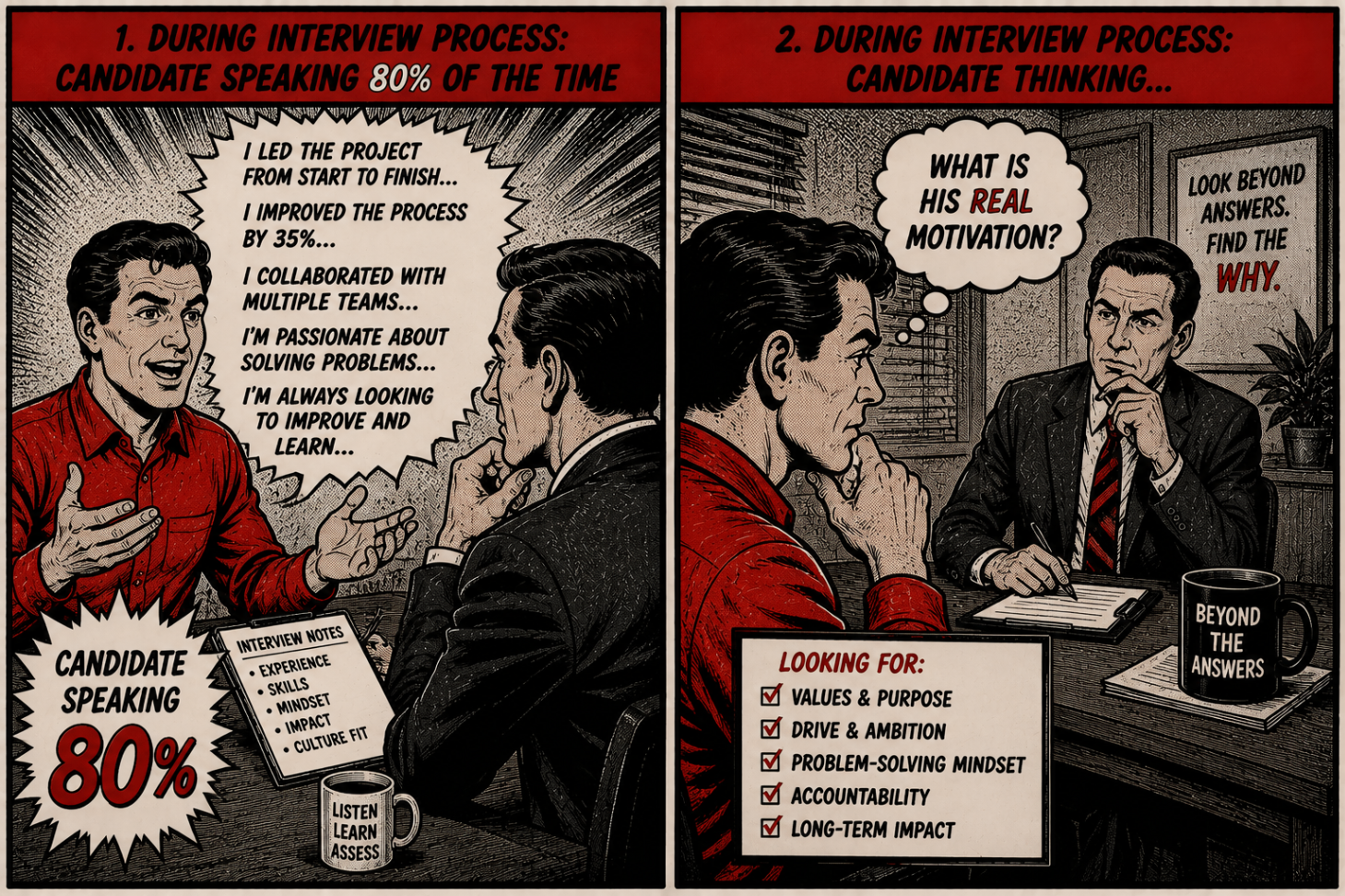
Motivation is one of the most difficult aspects to evaluate during an interview, yet it is also one of the most important, and the challenge is that direct questions rarely surface it accurately. Some candidates apply for a position simply because they are searching for any available opportunity, while others apply because they are genuinely interested in the company's mission, the industry, or the type of work involved. Direct questions such as "Why do you want this job?" often produce predictable answers, candidates naturally try to provide responses they believe the interviewer wants to hear.
For this reason, it is far more useful to observe motivation indirectly. Candidates who ask thoughtful questions about the company's projects or the team's workflow often reveal genuine curiosity, and people who speak enthusiastically about learning opportunities or professional development tend to show stronger intrinsic motivation. Another useful signal appears when candidates describe their previous experiences, do they simply list tasks they performed, or do they reflect on what they learned from those experiences? Candidates who emphasize learning and improvement often demonstrate a stronger growth mindset, and while motivation cannot be measured precisely, attentive listening during the interview can provide clues that are far more reliable than any direct question.
Reflective questions
- In my last few interviews, did I rely on direct questions like "Why do you want this job?", and if so, how confident am I that the answers I received reflected genuine motivation rather than well-rehearsed responses?
- What indirect or scenario-based questions do I currently use to test the depth and authenticity of a candidate's interest in the role, and how effectively do they surface real motivation compared to surface-level enthusiasm?
- Looking at collaborators who have thrived in my team versus those who left early, what motivational signals were already visible during the interview that I either noticed and acted on, or missed entirely?
5. Aligning expectations: responsibilities, compensation and KPIs
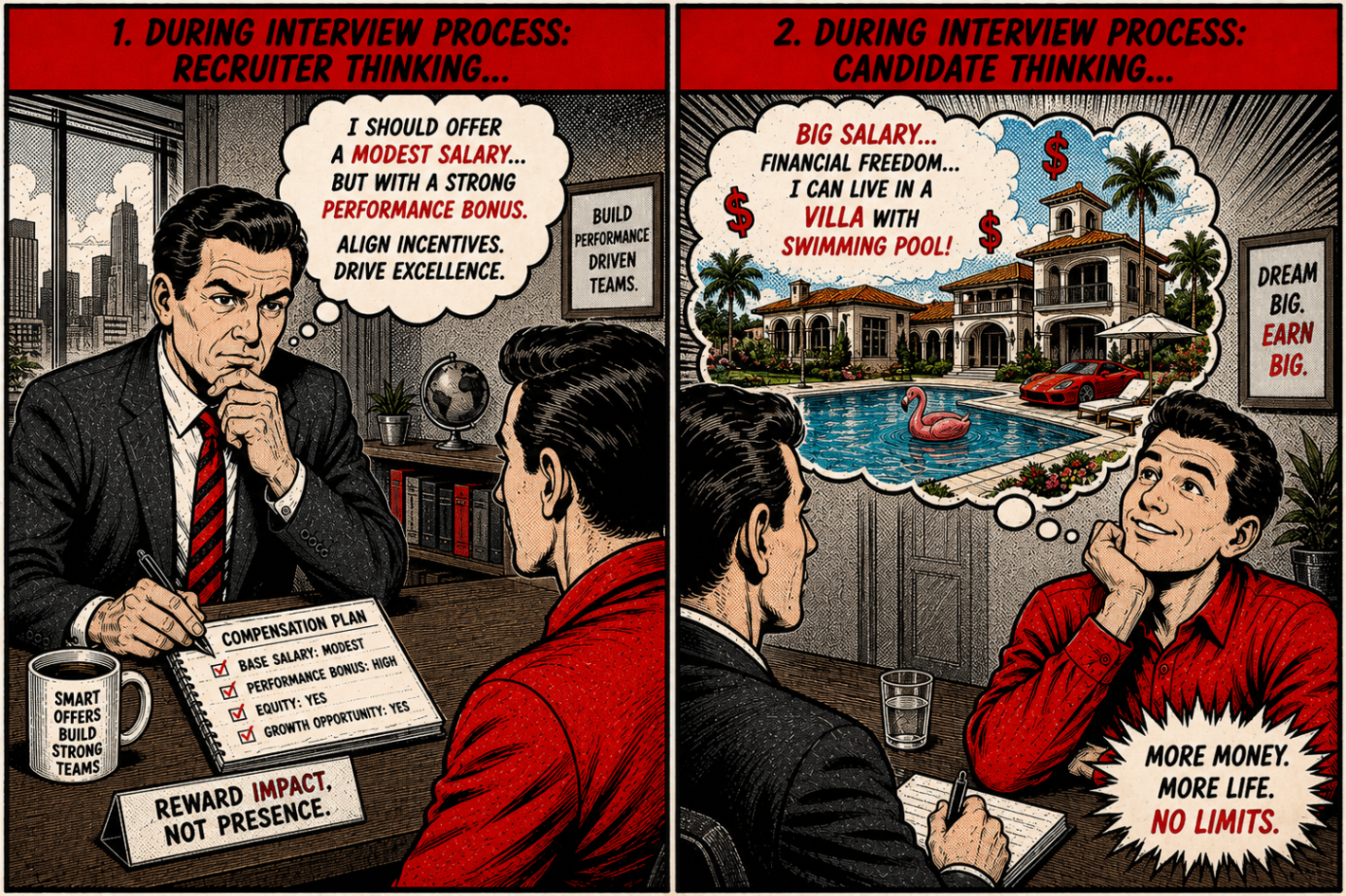
One of the most important objectives of the first interview is aligning expectations, and many hiring problems arise not because the candidate lacks ability, but because the expectations of the company and the candidate differ significantly from the very beginning. The interview should openly address three connected elements: the responsibilities of the role, the structure of compensation, and the indicators that will be used to evaluate performance.
Responsibilities come first. Many organizations start recruiting before they have clearly defined the role they want to fill: you know you need help, but the exact responsibilities of the position remain vague, and as a result, interviews become confusing conversations where expectations are not fully clear on either side. In remote-first companies this problem becomes even more critical, because collaborators cannot rely on the informal learning that happens organically in an office, they need clear responsibilities from the beginning, since much of their work will be performed independently. Before starting a hiring process, define the main responsibilities of the position, the expected outcomes, the tools and processes the person will use, and the team members they will interact with.
Compensation should not dominate the first conversation, but it should not be avoided either. Transparent discussion helps both sides determine whether the opportunity is realistic. Some positions include fixed compensation combined with performance-based components, while others involve project-based payments or flexible structures, explaining these elements clearly removes the guesswork that makes early-stage conversations feel uncertain. It is also worth observing how candidates react: some focus exclusively on the financial aspects, asking repeated questions about salary without showing interest in responsibilities or growth, while others approach the discussion in a more balanced way, and these reactions provide subtle insights into priorities.
Finally, define how success in the role will be evaluated. Because you cannot observe daily activity directly in a remote environment, evaluation must rely more on outcomes than on time spent working, and this is where Key Performance Indicators. KPIs, become useful. A sales role might be evaluated through the number of appointments booked or revenue generated, a marketing role through campaign performance or lead generation, a customer support role through response time or customer satisfaction. The objective is not to reduce every activity to numbers, but defining a few clear indicators helps both sides maintain alignment and transforms abstract expectations into concrete goals.
Reflective questions
- In my recent hires, how explicitly did I address responsibilities, compensation structure, and performance indicators during the first interview, and where did misalignments surface later that could have been avoided by more transparent early discussion?
- For each open or recently filled role on my team, can I name three to five specific, measurable indicators that define success in the first six months, and are those indicators written down and shared with the collaborator?
- What concrete language or framing can I prepare before my next interview to make the compensation discussion feel like a transparent alignment conversation rather than a negotiation or an afterthought?
6. Documentation and standard operating procedures
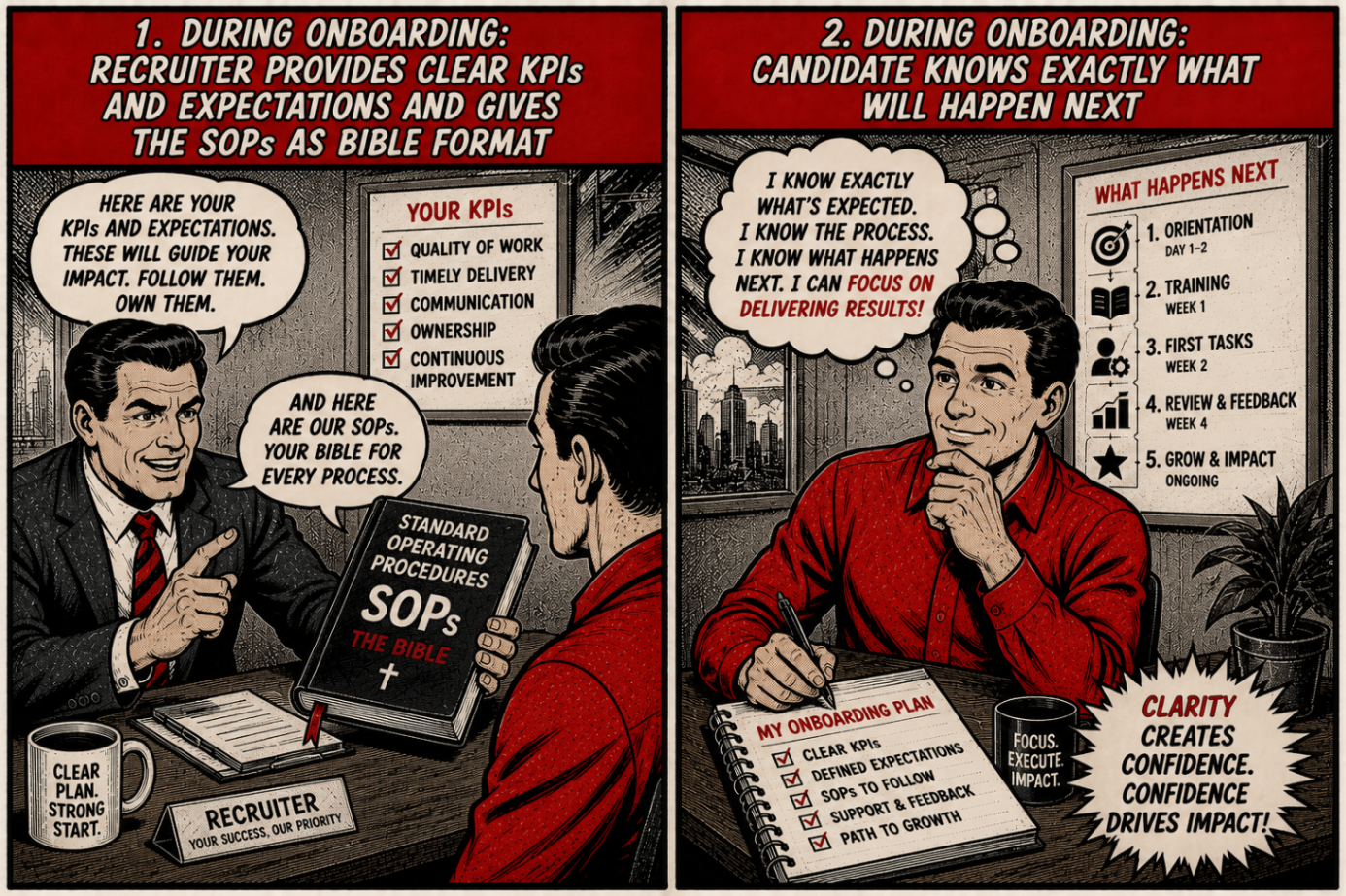
Documentation is consistently underestimated until its absence starts creating real problems. In traditional office environments, many processes remain informal: new employees ask colleagues for clarification, observe how tasks are performed, and learn through daily interaction. Remote teams cannot rely on this type of informal transmission of knowledge, which means information needs to be organized in accessible formats that people can find independently, without waiting for someone to be available.
Clear documentation helps explain how processes work, what standards are expected, and which tools and procedures are used. For new collaborators, it serves as a reference that complements conversations with managers and colleagues, allowing them to review information at their own pace and reducing the risk of misunderstandings. It also helps the company maintain consistency as the team grows, because without written processes, each new collaborator may develop slightly different ways of performing the same tasks.
In many remote organizations, documentation takes the form of Standard Operating Procedures, SOPs, which describe how specific tasks should be performed step by step. An SOP might explain how to handle a customer inquiry, how to prepare a marketing campaign, or how to manage internal reporting. These documents do not replace professional judgment, but they provide a starting framework that reduces the uncertainty of the first weeks and frees up both your attention and the collaborator's. Documentation also protects continuity when someone leaves or new collaborators join, because knowledge remains within the organization rather than being concentrated in the experience of a few individuals.
Reflective questions
- If a new collaborator joined my team today and I was unavailable for their first two weeks, how much of what they need to know to begin working effectively exists in written, accessible form, and how much lives only in colleagues' heads or informal channels?
- When I look at the SOPs that do exist on my team, how recently were they reviewed for accuracy, and how confident am I that they reflect how the work is actually done today rather than how it was done when the document was first written?
- Which two or three recurring tasks on my team generate the most confusion or repeated questions from collaborators, and would benefit most from a clear, step-by-step SOP that I could prioritize creating in the next month?
7. The trial period: a real evaluation phase
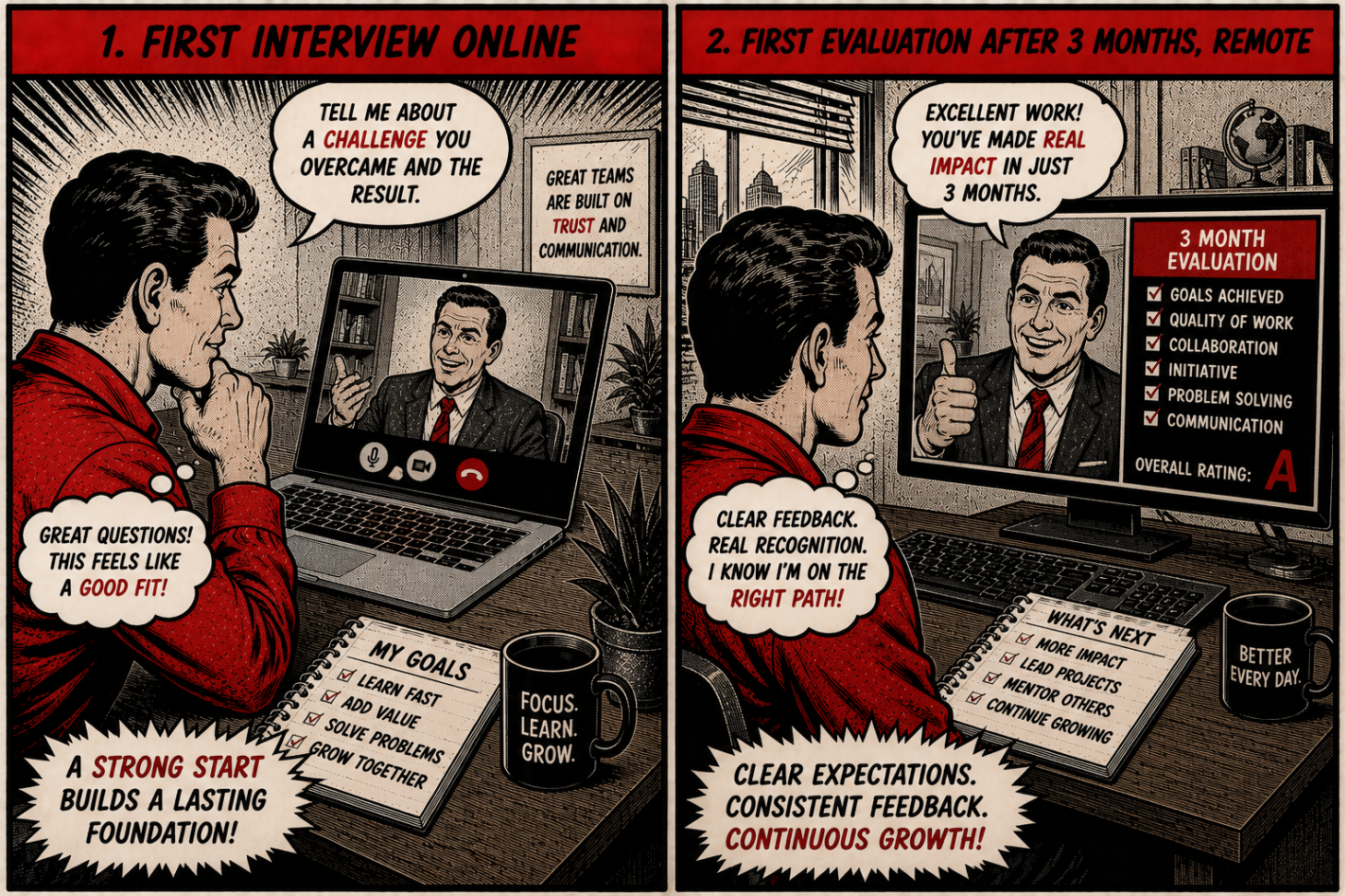
Many companies consider the interview process finished once the candidate signs the contract, but in practice, the real evaluation often begins only after the collaboration starts. Interviews cannot fully reveal how someone will behave in real working conditions: candidates are usually well prepared, focused, and motivated to present themselves positively, but once the collaboration begins, everyday routines start to reveal the person's natural working habits. In remote-first organizations this phase is particularly important, because you cannot observe daily behavior in a shared office environment, the first months become the most reliable window into how a collaborator actually approaches work.
During the first weeks it becomes clearer how the person manages time, communicates with colleagues, and reacts to unexpected challenges. Some collaborators quickly integrate into the team's rhythm, asking questions, taking initiative, gradually becoming more autonomous, while others may struggle with organization, communication, or motivation. Many companies define a structured trial period, often lasting around three months, because that length usually provides enough time to observe reliability, communication style, learning speed, and the ability to work independently. The trial period should not be seen as a bureaucratic formality, it is a real evaluation phase for both sides: you observe the collaborator, and the collaborator observes you.
Reflective questions
- In my current practice, do I treat the trial period as a structured evaluation phase with defined checkpoints and criteria, or does it function mainly as an administrative formality that ends with a default renewal unless something goes seriously wrong?
- How clearly do I communicate to a new collaborator at the start of the trial period exactly what I will be observing, what success looks like at thirty, sixty, and ninety days, and when and how I will share feedback with them?
- Looking back at trial periods that ended in a mismatch, whether the collaboration was extended when it should not have been, or ended when clearer early support might have helped, what pattern in my own behavior do I notice, and what would I do differently?
8. Why early feedback matters
One of the most common mistakes during the trial period is waiting too long before providing feedback. Early problems often feel small enough to hope they will resolve on their own, but in many cases early feedback can prevent misunderstandings from growing into larger problems that are much harder to address later. Regular conversations during the first weeks help create clarity, weekly check-ins during the first month allow you to observe how the new collaborator is adapting to the role, and these conversations do not need to be long or formal. Even short discussions can reveal valuable information: what challenges did you encounter this week? Is there anything that remains unclear about your tasks? Do you feel comfortable with the tools and processes used by the team?
These conversations help identify potential obstacles early, and at the same time they create a culture of open communication where feedback is seen as a normal part of professional development rather than as criticism. Early feedback also helps the collaborator adjust more quickly, when expectations are clearly explained and reinforced during the first weeks, new team members can adapt their behavior and improve their performance rather than continuing to repeat the same mistakes without realizing it. In remote environments, where spontaneous conversations are less frequent, intentional feedback becomes even more important, because there is no hallway conversation or visible tension to catch before it becomes a real issue.
Reflective questions
- When did you last give a new collaborator specific, behavioral feedback within their first two weeks of starting, and if you cannot recall a clear example, what does that tell you about how intentional your approach to early feedback currently is?
- Is there someone on your team right now, in a trial period or early in their role, who has received less direct feedback than the evidence of their performance would actually warrant, and what is stopping you from having that conversation?
- What is one concrete change you can put in place before your next hire, a recurring check-in, a shared feedback template, a committed first-week conversation, to make early feedback a structured part of your process rather than something you do only when there is already a problem?
9. When to end a collaboration early
Despite careful interviews and structured onboarding, not every collaboration works, and when a mismatch becomes visible during the trial period, it is usually better to address it promptly rather than to wait. Ending a collaboration early can feel uncomfortable, especially when the person is motivated and has invested time in learning the role, but delaying the decision often creates greater problems later. If fundamental issues appear during the first months, a collaborator who consistently struggles with communication, repeatedly fails to respect deadlines, shows limited engagement with the team, or lacks the autonomy required in a remote environment, continuing the collaboration indefinitely rarely benefits either side.
The trial period exists precisely to allow both sides to evaluate the collaboration honestly. If the fit is not right, ending it early can be a responsible decision, and when handled with transparency and respect, it can still lead to positive outcomes. Clear feedback helps the person understand the reasons behind the decision and may even guide them toward roles that better match their skills. In this sense, the trial period is not only a mechanism for protection, it is also a way to ensure that long-term collaborations are built on genuine compatibility rather than uncertain expectations.
Reflective questions
- When I look at cases where I delayed a difficult decision about a collaborator longer than the evidence warranted, what specific thoughts or discomforts led me to wait, and at what cost to the rest of the team or to the person themselves?
- Do I currently have clear, written criteria for what constitutes a fundamental mismatch during the trial period, or do I rely on a general sense of unease that makes it harder to act decisively and explain my reasoning to the collaborator and to HR?
- What is one concrete practice I can put in place before starting my next trial period, a checkpoint, a documented evaluation moment, or an agreed conversation, that would make it easier to act early and fairly if a fundamental issue becomes visible?
10. Onboarding: design, models and the role of managers
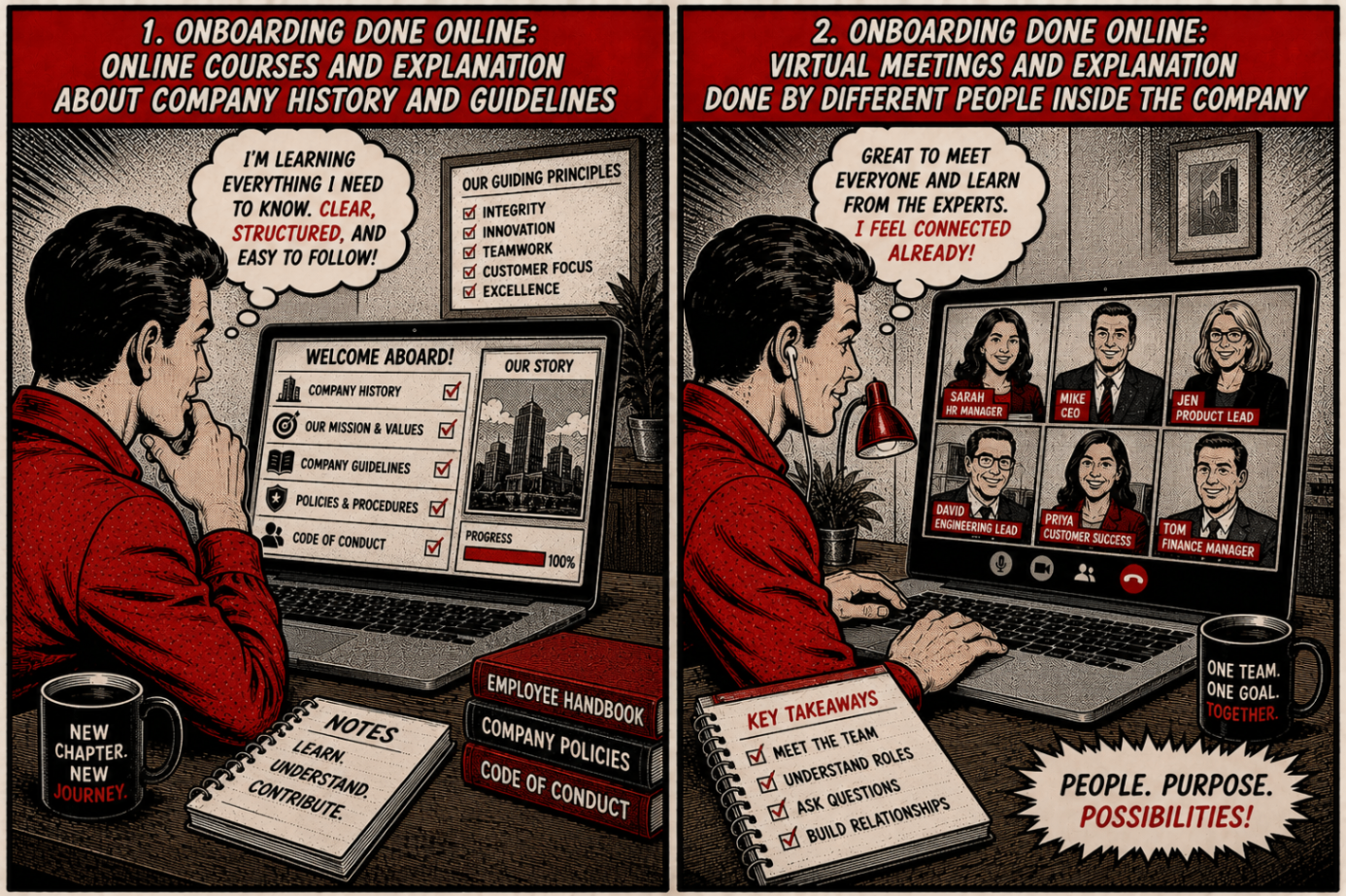
Once the candidate has accepted the role and the trial period begins, the next crucial phase is onboarding, and many companies significantly underestimate how much it matters. The assumption that learning will happen naturally through daily work may hold in small, informal environments, but in remote organizations the problem is compounded because collaborators do not share a physical workspace. New team members cannot simply observe colleagues or ask quick questions in the office, which means they cannot rely on the informal interactions that would otherwise fill in the gaps.
A structured onboarding process helps new collaborators understand the organization more quickly. It typically includes an introduction to the company's mission and values, an overview of the team and organizational structure, explanations of the main processes and tools, and initial training related to the specific role. This phase also helps new collaborators understand how communication works within the team, remote companies rely on digital platforms such as messaging tools, project management systems, and video meetings, and learning how these tools are used in practice, not just in theory, helps new hires become productive much more quickly.
Organizations approach onboarding in different ways. Formal training programs provide consistency, every new collaborator receives the same information and is introduced to the same processes, which is particularly useful in larger organizations. However, overly rigid programs can overwhelm new hires with excessive information, and when too much material is presented at once it becomes difficult to absorb what actually matters. Informal onboarding allows learning to occur gradually through real work situations, but it can create inconsistencies because different managers may introduce new hires to the company in very different ways. In remote companies, a balanced approach often works best: structured introductory materials, documentation, presentations, or short videos, create a common foundation, while practical experience and interaction with colleagues allow new collaborators to internalize that knowledge through real tasks.
While HR teams often design the onboarding structure, the manager is usually the person who interacts most frequently with the new collaborator during the first weeks, and your guidance is what translates general company principles into concrete daily work. Define clear objectives for the first weeks: during the first week the new collaborator might focus on understanding the main tools and workflows, and in the following weeks they gradually take on more responsibilities. Support this progression by assigning small tasks that allow the new collaborator to gain confidence without feeling overwhelmed. Short, regular meetings during the first weeks allow you to observe how the person is adapting, clarify expectations, and address potential difficulties before they become bigger issues. In remote teams, these intentional touchpoints need to carry more weight, because the spontaneous conversations of a physical office simply do not exist.
Reflective questions
- If I map out what a new collaborator on my team actually experiences in their first two weeks, how much of it is intentionally designed by me and HR versus left to chance, the collaborator's initiative, or the goodwill of colleagues who may or may not have time?
- Does my current onboarding approach lean more toward formal structured training or informal learning-by-doing, and have I made that choice intentionally based on what works for my team's context, or has it simply evolved by default?
- What is one concrete responsibility I currently leave to HR or to the new collaborator themselves during onboarding that I should be owning more actively as the direct manager, and what would it take for me to make that shift in my next hire?
11. Building a consistent HR structure in a remote company
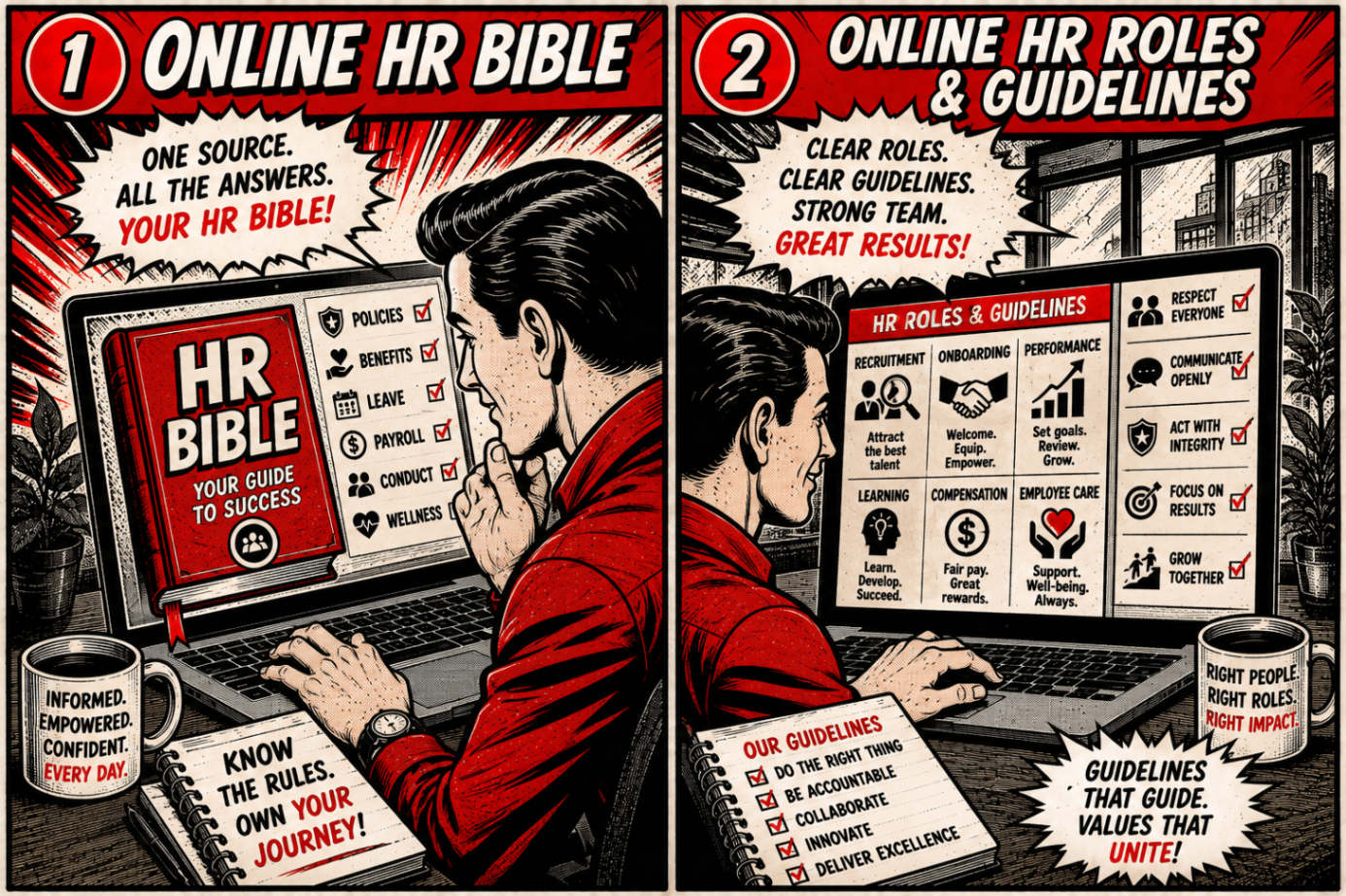
As remote organizations grow, the complexity of managing people increases, and the informal processes that work well in small teams tend to create real problems as the team expands. In small teams, you communicate directly with collaborators and decisions are made quickly, which feels efficient. But as the number of collaborators grows, the organization benefits more and more from structured HR processes: clear documentation, consistent onboarding procedures, and transparent communication channels help maintain stability and fairness as the team scales.
Effective people operations also depend on clear alignment between HR, managers, and team members. HR typically coordinates the administrative aspects of hiring and provides general information about the company's policies and culture. Managers focus on role-specific guidance, helping collaborators understand their responsibilities and priorities. Team members contribute by sharing practical knowledge about workflows and collaboration practices. When these roles are aligned and handoffs are documented, new hires stop falling through the gaps, and the organization can continuously adjust its hiring and integration practices based on real feedback.
When processes are clearly defined, collaborators understand how decisions are made, how performance is evaluated, and what opportunities for development exist within the organization. For remote companies, where collaborators may live in different countries and cultures, this clarity becomes even more important. Well-designed HR systems create a shared framework that supports collaboration across geographical and cultural boundaries, even when no one ever shares the same office.
Reflective questions
- As my team has grown, which HR processes that were once managed informally have begun to create problems, inconsistent feedback, unclear policies, unequal experiences between collaborators, because we have not yet formalized them?
- In my last onboarding process, was there a clear, documented handoff between HR and me that defined who was responsible for what at each stage, or did we operate in parallel without a shared structure, leaving gaps the new collaborator had to navigate alone?
- What is the single most urgent structural improvement I could make to my team's HR practices in the next quarter, not the most complex, but the one whose absence is most likely to create friction as the team continues to grow?