Chapter 01
Why Remote is Better
The shift from presence-based work to outcome-based organizations.
Introduction
For decades, companies treated the office as the natural center of work.
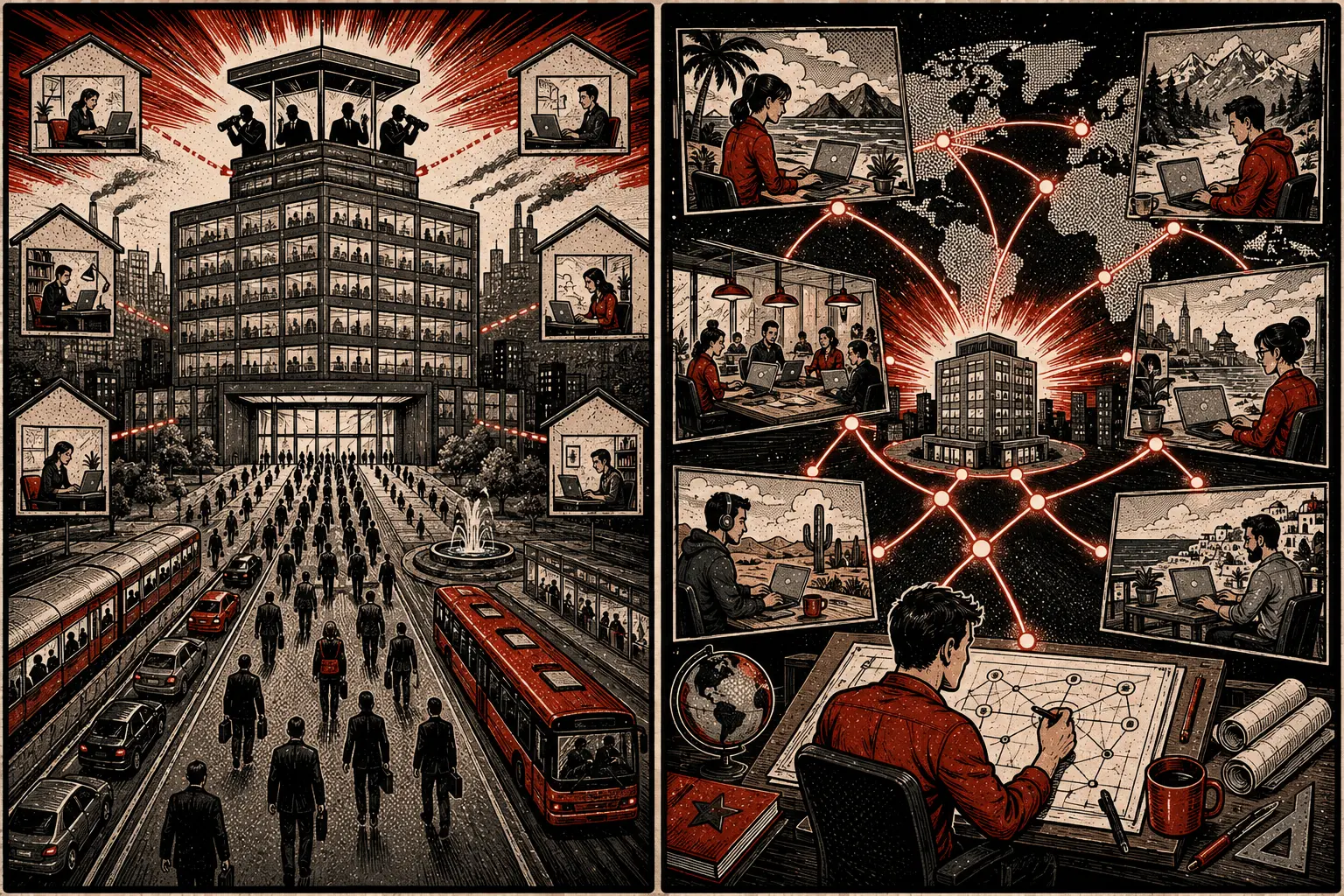
People woke up early, spent hours commuting through traffic, sat inside the same buildings for eight or nine hours, attended meetings, replied to emails, and then repeated the exact same routine the following day. This system became so normalized that very few stopped to question it.
But the modern office was not designed for the world we live in today.
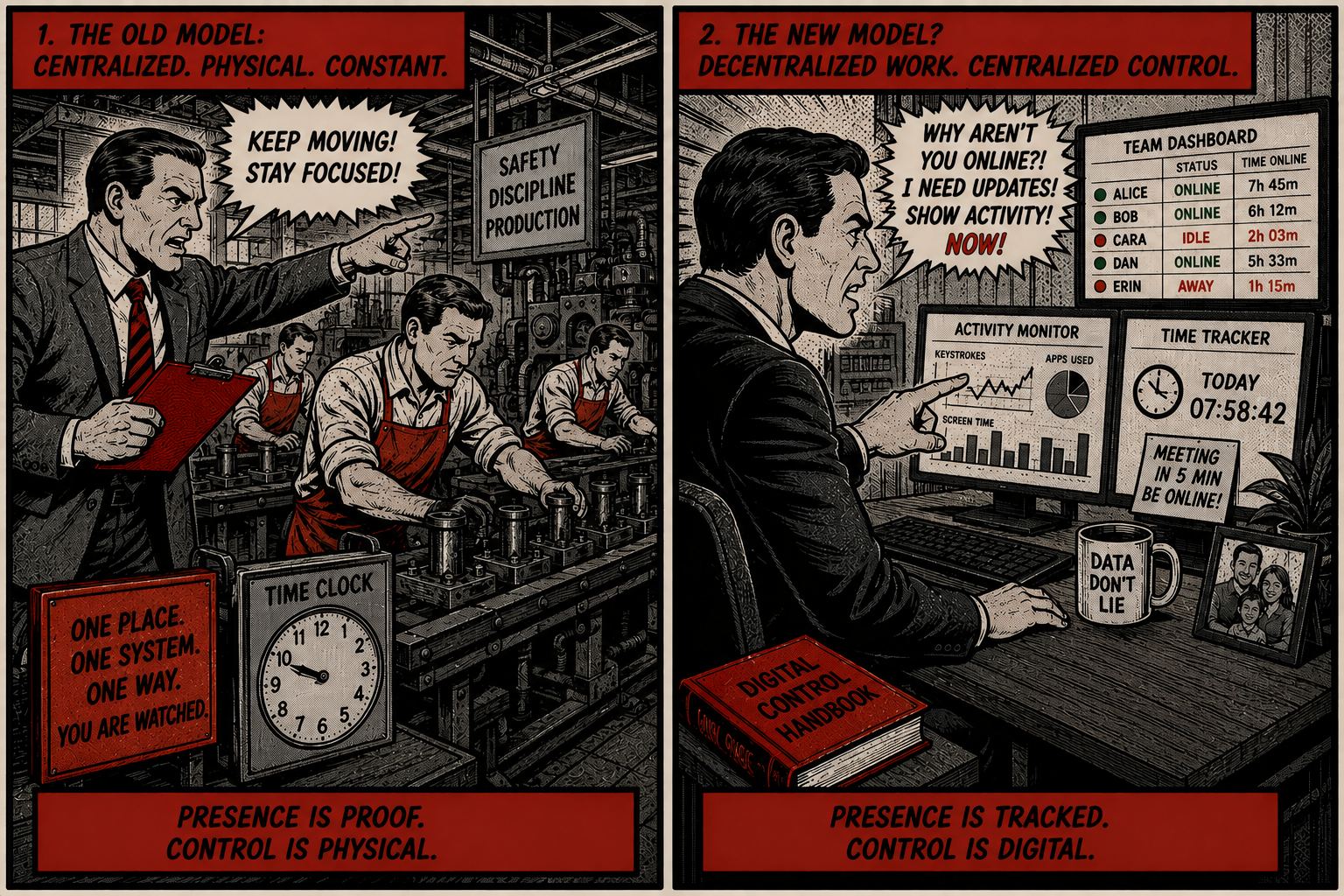
It was built for a completely different era — an era where information was physical, communication was slow, and managers needed workers in the same location to supervise operations directly. The structure of most companies was heavily influenced by factories: centralized spaces, fixed schedules, hierarchical control, and visibility-based management.
Technology evolved. Work evolved. The office did not.
Today, millions of people work entirely on laptops. Communication happens instantly across continents. Teams collaborate in real time from different time zones. Entire companies can operate globally without owning a single physical headquarters.
Yet many organizations still measure productivity through visibility instead of results.
Employees are rewarded for being present rather than effective. Meetings replace execution. Availability becomes more important than outcomes. Companies continue to optimize for control even when modern work increasingly rewards autonomy, speed, and adaptability.
Remote-first companies challenge these assumptions entirely.
They are not simply companies that allow employees to work from home. They are organizations designed around a different philosophy of work — one based on systems instead of supervision, documentation instead of verbal dependency, and results instead of physical presence.
This distinction is critical.
A company can use Zoom, Slack, and Notion every day and still operate with the mindset of a traditional office. Many businesses simply recreated the office digitally, replacing conference rooms with video calls and micromanagement with constant notifications.
True remote-first organizations operate differently.
They are designed to function independently of geography. They hire globally, communicate asynchronously, build processes that scale without physical proximity, and evaluate performance based on output rather than attendance.
The companies that understand this shift gain structural advantages that traditional organizations struggle to replicate: access to global talent, lower operational costs, greater flexibility, faster scaling, and increased resilience during periods of uncertainty.
Remote-first is not a temporary trend created by the pandemic.
It is the natural evolution of knowledge work in a connected world.
And the companies that learn how to build distributed systems correctly will increasingly outperform those still optimized for an industrial-era model of work.
The Office Was an Industrial Era Solution
Most people never question why offices exist.
They simply inherit the system.
Wake up early. Commute to work. Sit inside a building for eight hours. Attend meetings. Reply to messages. Go home. Repeat.
For more than a century, this model became the default structure of work across most industries. Entire generations grew up believing that productivity required physical presence and that companies could only function when people gathered in the same place every day.
But the modern office was not created because it was the most efficient system possible.
It was created because, at the time, there were no alternatives.
In the industrial era, centralization solved real operational problems. Information existed on paper. Communication was slow. Managers needed employees physically nearby to coordinate tasks, supervise operations, and move information between departments. Factories became the blueprint for organizational design, and office culture inherited many of the same principles: hierarchy, control, standardization, schedules, and visibility.
The system made sense in a world where work depended on physical infrastructure.
But knowledge work changed everything.
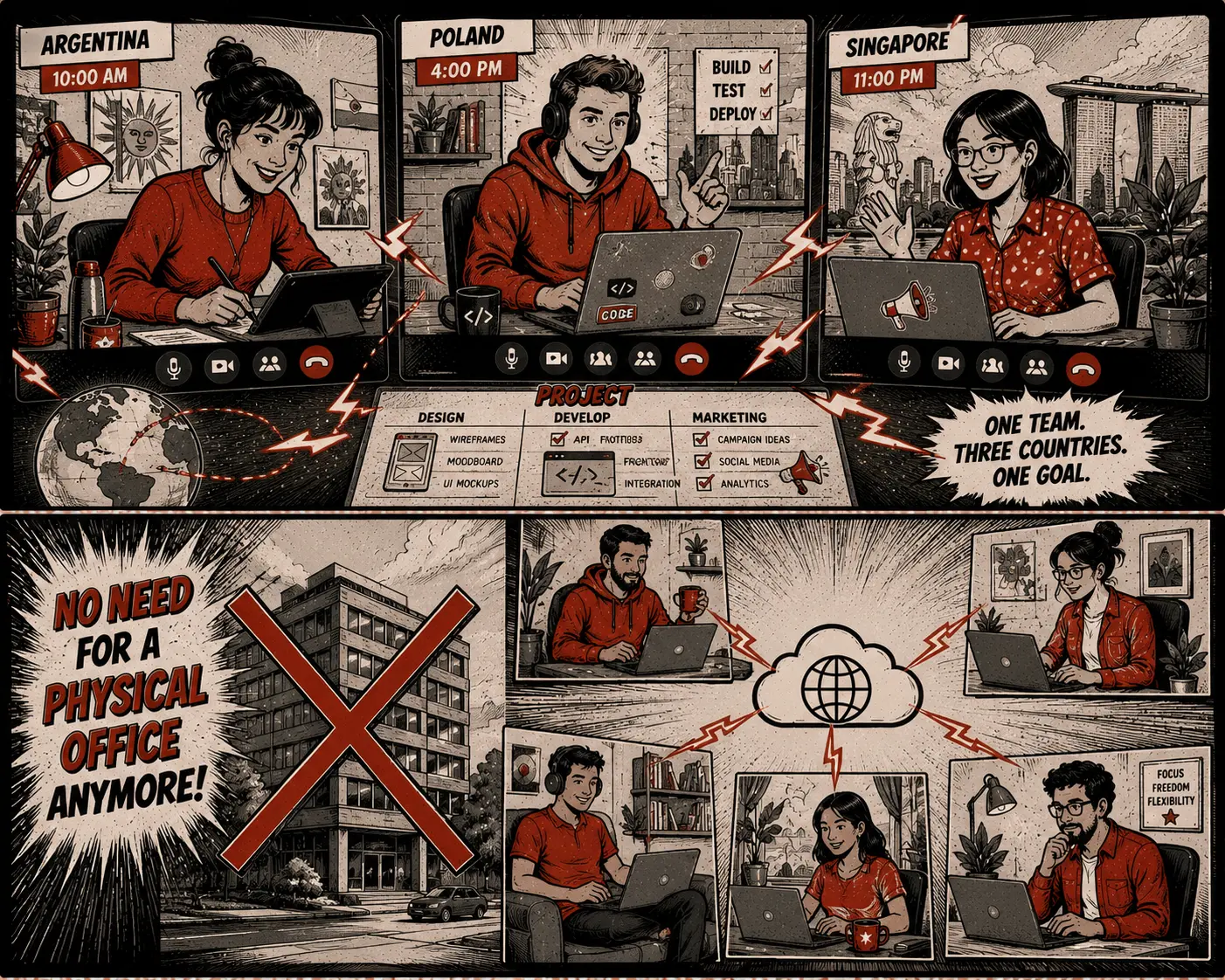
Today, most professionals no longer produce physical goods. Their work lives inside laptops, cloud platforms, digital documents, and online communication systems. A designer in Argentina can collaborate instantly with a developer in Poland and a marketer in Singapore. Entire projects can be managed asynchronously across continents without anyone sharing the same office, city, or even time zone.
The technological constraints that originally justified centralized offices have largely disappeared.
Yet many organizations continue operating with the same management assumptions developed decades ago.
Presence is still confused with productivity.
Managers often feel more comfortable when they can physically see employees working, even if visibility says very little about actual performance. Someone sitting at a desk for eight hours appears productive, while someone working remotely with flexibility is frequently viewed with suspicion, regardless of output.
This mindset created what many companies mistake for work: performative productivity.
Employees learn to look busy instead of creating measurable results. Meetings become symbols of collaboration even when they generate little value. Long hours are rewarded more than efficient execution. Visibility becomes a substitute for accountability.
The office environment itself reinforces these behaviors.
Open offices generate constant interruptions. Endless conversations destroy concentration. Notifications, unnecessary meetings, and spontaneous interruptions fragment attention throughout the day. Many employees spend more energy managing appearances and navigating office politics than producing meaningful work.
In some cases, the commute alone consumes two or three hours every day — time that creates no value for either the employee or the company.
And yet this inefficiency became normalized because it was historically unavoidable.
The problem is not that offices are inherently bad.
The problem is that most companies never redesigned their operating systems after technology fundamentally changed how work could be done.
Instead of rethinking organizational structure entirely, many businesses simply digitized old processes. Emails replaced paper memos. Zoom replaced conference rooms. Slack replaced internal chats. But the underlying philosophy remained the same: centralized control, synchronous communication, and management based on visibility.
Technology evolved faster than management culture.
This is why many traditional organizations struggle when transitioning to distributed work. The issue is rarely the technology itself. The issue is that their systems were originally designed around physical supervision rather than operational clarity.
Remote-first companies operate from a completely different assumption.
They assume that adults do not need constant supervision to produce valuable work. They optimize for output instead of attendance. They design systems that function independently of geography. And they build organizations where information flows through documentation and processes rather than physical proximity.
The shift from office-first to remote-first is not simply about changing where people work.
It is about redesigning the architecture of the company itself.
Remote Is Not a Location
One of the biggest misunderstandings about remote work is the belief that remote simply means working from home.
It does not.
Working from home is a location. Remote-first is an operating system.
This distinction matters because many companies believe they became remote organizations the moment employees started using Zoom, Slack, or Microsoft Teams. In reality, most simply moved traditional office behavior onto digital platforms without redesigning how the company actually operates.
A remote-first company is not defined by where people sit while working.
It is defined by how information flows, how decisions are made, how teams communicate, and how accountability is structured.
In traditional office environments, communication is heavily dependent on physical proximity. Employees solve problems through spontaneous conversations, quick interruptions, informal meetings, and constant real-time interaction. Much of the organization's knowledge exists inside people's heads rather than inside systems.
This creates hidden fragility.
When information is undocumented, companies become dependent on specific individuals. New employees struggle to integrate. Processes become inconsistent. Managers spend large amounts of time repeating instructions and coordinating manually. Growth creates communication chaos.
Remote-first organizations solve these problems differently.
They are designed around clarity instead of proximity.
Information is documented. Processes are written. Decisions are traceable. Responsibilities are explicit. Communication becomes intentional rather than reactive. Teams are structured so work can continue even when people are offline, in different countries, or operating across different time zones.
This is why asynchronous communication becomes one of the foundations of remote-first companies.
Async communication does not mean slow communication. It means communication that does not require everyone to be present simultaneously in order for work to move forward.
Instead of interrupting people continuously throughout the day, remote-first teams prioritize structured updates, documented decisions, organized workflows, and clear ownership. Employees gain longer periods of uninterrupted focus while companies reduce dependency on meetings and constant supervision.
The goal is not to eliminate human interaction.
The goal is to eliminate unnecessary dependency on synchronization.
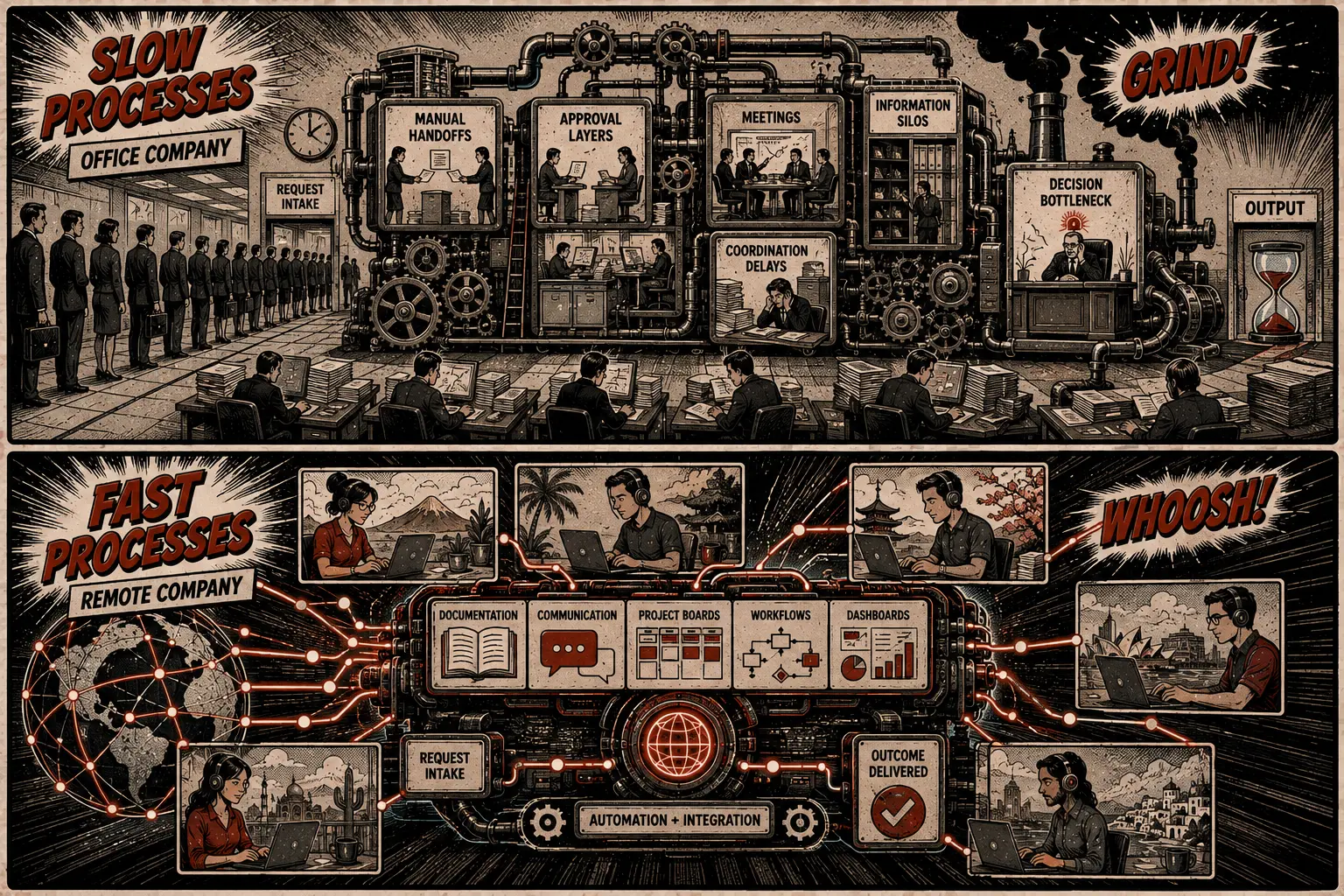
In many office environments, work stops the moment someone is unavailable. Decisions are delayed because the right people are not in the room. Projects slow down because teams rely excessively on meetings to coordinate basic operations.
Remote-first systems reduce this friction by designing workflows that can operate independently of physical presence.
This requires a different management philosophy.
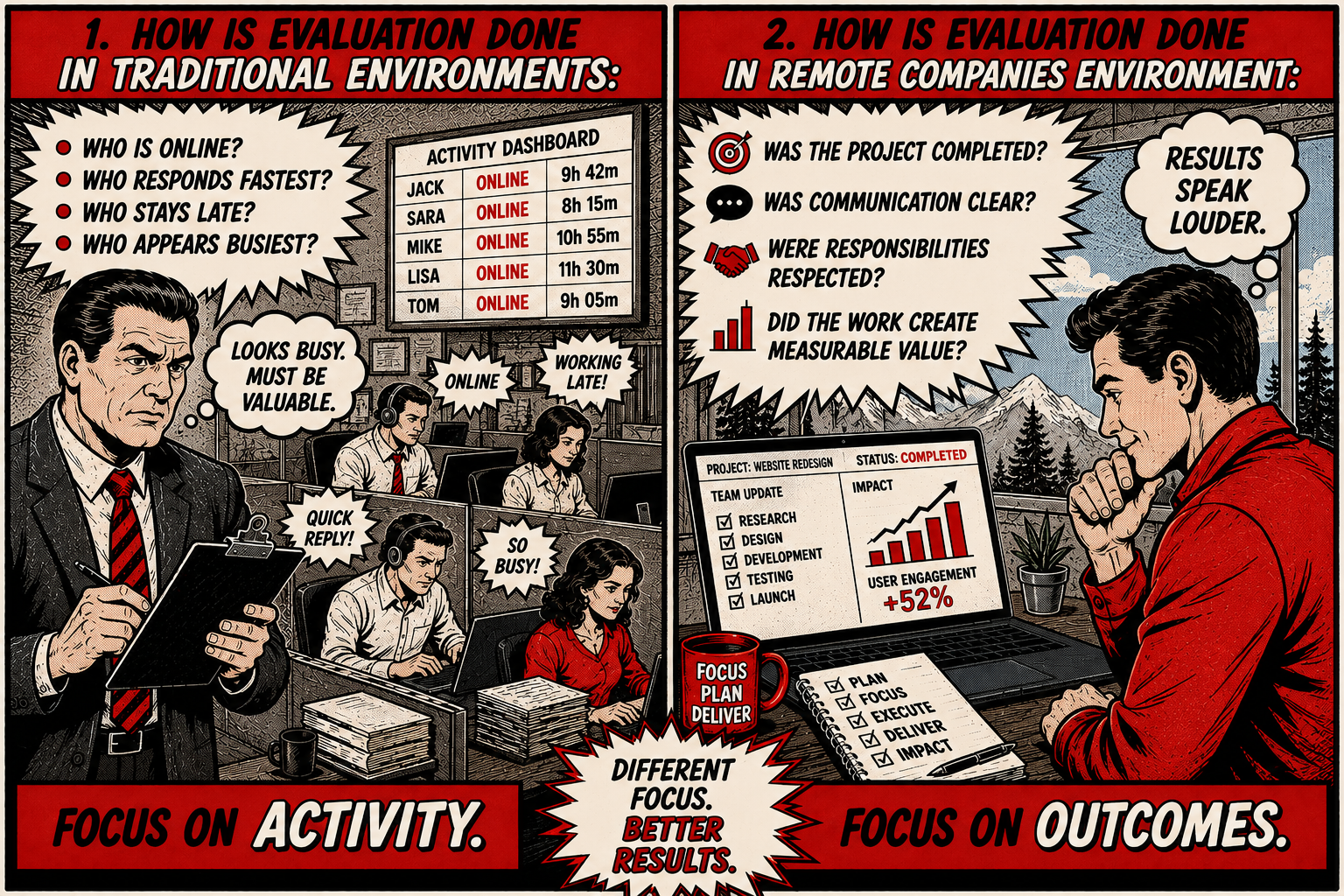
Managers in traditional environments often optimize for visibility:
• Who is online? • Who responds fastest? • Who stays late? • Who appears busiest?
Remote-first companies optimize for outcomes:
• Was the project completed? • Was communication clear? • Were responsibilities respected? • Did the work create measurable value?
This shift changes everything.
Hiring changes. Leadership changes. Evaluation changes. Communication changes. Even company culture changes.
Because culture in remote-first organizations is not built through physical offices or free snacks or team buildings alone. It is built through systems, trust, clarity, consistency, and shared standards of execution.
A company can have employees spread across twenty countries and still operate mentally like a traditional office. If people cannot function without constant meetings, immediate replies, or managerial supervision, the company is not truly remote-first.
It is simply an office without walls.
True remote-first organizations are designed to function independently of geography from the beginning.
Location becomes irrelevant because the system itself no longer depends on physical proximity to operate efficiently.
Offices Without Walls Are Not Remote
When many companies transitioned to remote work, they believed the transformation was complete the moment employees stopped coming to the office.
Laptops replaced desks. Zoom replaced meeting rooms. Slack replaced internal conversations. Digital tools were adopted quickly, and from the outside, the company appeared modern and distributed.
But underneath the surface, very little had actually changed.
The same management structures remained in place. The same communication habits continued. The same dependency on constant supervision survived — only now through screens instead of physical offices.
Many organizations did not become remote-first.
They simply recreated the office online.
This explains why so many companies experienced frustration, burnout, communication overload, and declining morale during their remote transition. The problem was not remote work itself. The problem was that companies attempted to force office behavior into a distributed environment.
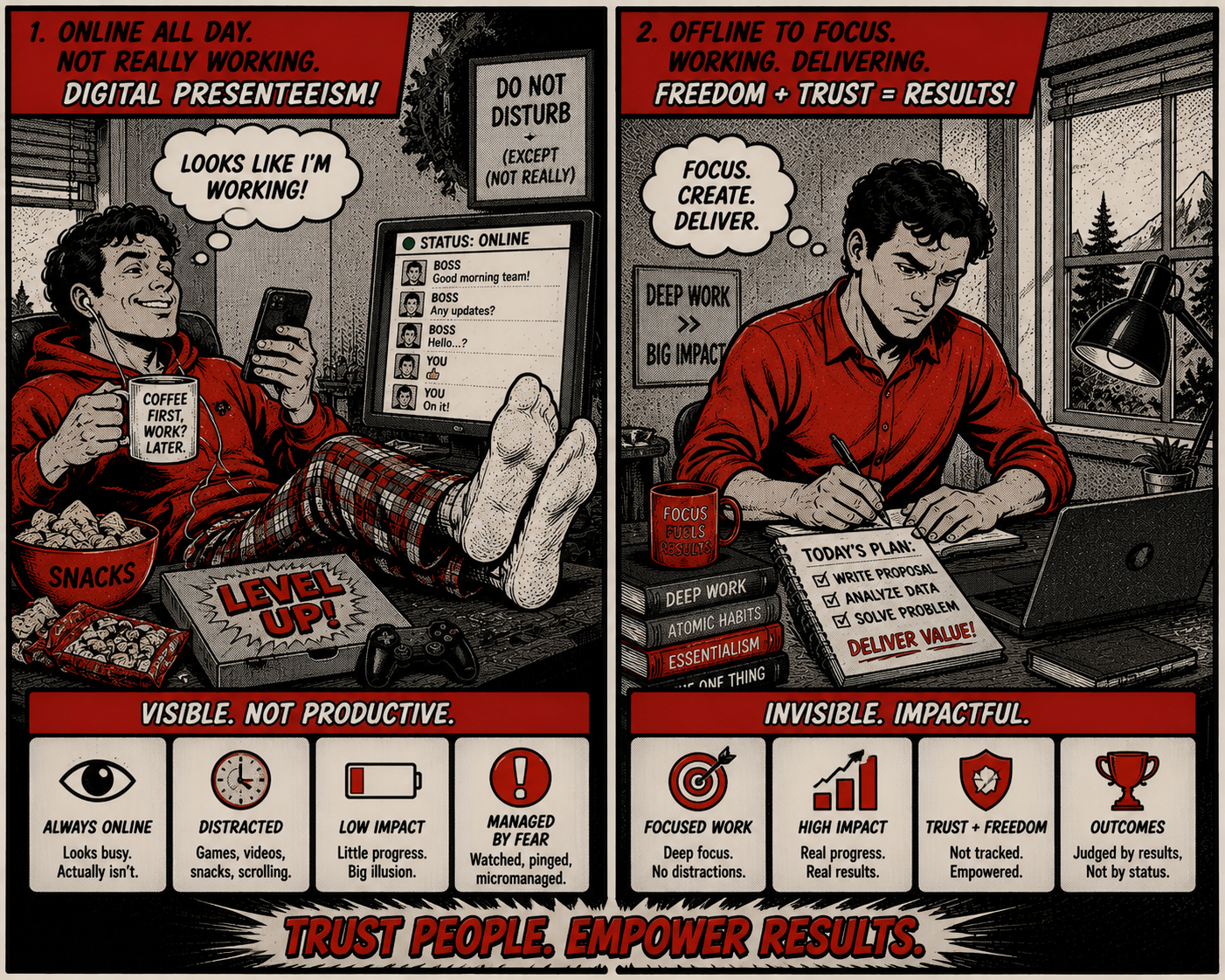
The result was digital presenteeism.
Employees became trapped in endless video calls, expected to remain constantly available throughout the day. Notifications replaced physical interruptions. Managers compensated for the loss of visibility by increasing meetings, status updates, and control mechanisms.
In some organizations, employees spend more time proving they are working than actually working.
A typical fake-remote company often looks like this:
• Slack notifications every few minutes • mandatory camera-on meetings • employees expected to reply instantly • calendars filled with unnecessary calls • managers monitoring online status • decisions dependent on live discussions • no written documentation • no asynchronous workflows.
This environment creates the worst combination possible: the distractions of the office combined with the isolation of remote work.
Deep focus becomes impossible because employees remain permanently reactive. Every notification becomes an interruption. Every meeting fragments attention further. Workdays become filled with communication but produce surprisingly little actual execution.
The irony is that many companies accidentally increase inefficiency when trying to control remote workers more aggressively.
Traditional offices already suffered from excessive meetings and interruptions, but digital environments amplify the problem because communication tools make interruption frictionless. Anyone can instantly message anyone at any moment, creating a culture of permanent availability.
Over time, employees begin optimizing for responsiveness rather than productivity.
Fast replies become more valued than thoughtful work. Visibility becomes more important than results. Teams remain synchronized constantly even when synchronization is unnecessary.
This is not remote-first.
It is office culture translated into software.
True remote-first organizations operate differently because they understand that distributed work requires intentional communication design.
They reduce unnecessary meetings aggressively.
They document decisions instead of repeating the same conversations multiple times.
They encourage employees to protect deep work periods without constant interruptions.
They structure workflows so projects continue moving even when people are offline.
Most importantly, they replace activity-based management with outcome-based management.
In office-centered cultures, managers often develop psychological comfort from physical visibility. Seeing employees creates the illusion of control. Remote-first companies abandon this illusion entirely.
Instead of asking:
• "Is everyone online?"\ they ask: • "Is the system functioning efficiently?"
This creates a profound organizational difference.
A remote-first company trusts systems more than surveillance.
It understands that high-performing professionals do not need continuous observation to create value. What they need is clarity, accountability, proper documentation, and the autonomy to execute effectively.
The companies that fail remotely are often not failing because remote work is flawed.
They are failing because they never stopped thinking like office companies.
Remote as a System, Not a Perk
For many organizations, remote work is still treated as an employee benefit.
Something temporary. Something flexible. Something offered occasionally to improve morale, attract candidates, or reduce office costs.
This mindset fundamentally misunderstands what remote-first actually is.
Remote-first is not a perk added on top of a traditional company structure.
It is a complete redesign of how the organization operates.
A company does not become remote-first because employees can work from home on Fridays. It becomes remote-first when every system inside the business is designed to function efficiently without dependence on physical proximity.
This affects almost every part of the company:
• hiring • onboarding • communication • management • documentation • evaluation • leadership • collaboration • knowledge transfer • performance measurement • culture itself.
Traditional office environments often rely heavily on informal coordination.
Employees learn by overhearing conversations. Managers solve problems through spontaneous meetings. Information spreads through proximity rather than structure. Many processes remain undocumented because people assume they can simply "ask someone quickly."
This model becomes increasingly fragile as companies scale.
The larger the organization becomes, the more communication complexity increases. Teams become dependent on specific individuals. Information silos emerge naturally. New employees require constant supervision to integrate into the company. Decision-making slows down because coordination relies excessively on real-time interaction.
Remote-first organizations solve this by building operational clarity into the system itself.
Processes are documented.
Responsibilities are explicit.
Communication channels are intentional.
Knowledge is centralized and searchable.
Decisions are recorded instead of disappearing inside meetings.
This does not eliminate human interaction. In many cases, it improves collaboration because teams spend less time navigating confusion and more time executing meaningful work.
Remote-first companies are often forced to become better managed companies because distributed work exposes organizational weaknesses immediately.
In office environments, poor systems can remain hidden for years.
Employees compensate manually for broken processes through informal coordination. Managers solve structural problems reactively through constant supervision. Teams survive through proximity even when internal systems are inefficient.
Remote environments remove this safety net.
If communication is unclear, confusion spreads faster.
If responsibilities are undefined, accountability disappears.
If processes are undocumented, operations become chaotic.
Remote-first companies therefore require a higher level of organizational discipline from the beginning.
This is one of the reasons many businesses struggle during remote transitions. They attempt to preserve informal office behavior while operating in a distributed environment that demands structure, clarity, and autonomy.
Remote-first companies think differently.
Instead of optimizing for supervision, they optimize for systems.
Instead of measuring hours, they measure outcomes.
Instead of relying on constant meetings, they rely on documentation.
Instead of controlling every activity, they build frameworks that allow people to operate independently.
This creates a fundamental cultural shift.
Employees are treated less like workers being monitored and more like operators responsible for producing results.
Trust becomes operational rather than symbolic.
Autonomy increases, but accountability increases as well.
Remote-first environments reward clarity, ownership, self-management, and communication quality far more than performative visibility.
This is why remote-first companies often appear unusual to people coming from traditional corporate environments.
There are fewer meetings.
Less managerial supervision.
More written communication.
More autonomy.
More responsibility.
More emphasis on systems instead of personalities.
The company becomes less dependent on physical offices and individual managers to maintain operational stability.
And once a company reaches this stage, remote-first stops being simply a work arrangement.
It becomes a structural advantage.
The Structural Advantages of Remote-First
Remote-first companies do not gain advantages simply because employees work from different locations.
Their advantage comes from designing organizations without geographic limitations.
Once a company stops treating physical proximity as a requirement for collaboration, entirely new possibilities emerge — operationally, financially, and strategically.
These advantages compound over time.
While traditional organizations remain constrained by local hiring markets, office costs, commuting inefficiencies, and rigid organizational structures, remote-first companies can optimize around flexibility, speed, and global talent access from the beginning.
The result is not simply a different workplace.
It is a different type of company.
Access to Global Talent
Talent is distributed globally.
Opportunity is not.
Traditional companies restrict themselves to candidates who live within commuting distance of a specific office. Even companies located in major cities compete inside geographically limited talent pools, often driving salaries higher while simultaneously reducing access to specialized expertise.
Remote-first companies remove this constraint entirely.
A company based in Lisbon can hire a developer in Poland, a designer in Argentina, a media buyer in Egypt, and a customer support specialist in the Philippines — all based on competence rather than geography.
This creates enormous strategic flexibility.
Companies gain access to:
• specialized talent unavailable locally • multilingual teams • native understanding of international markets • broader cultural perspectives • 24-hour operational coverage across time zones.
In many industries, the ability to recruit globally becomes one of the strongest competitive advantages available.
The best candidate for a role may not live in your city, your country, or even your continent.
Remote-first companies understand this naturally.
Office-first companies artificially limit themselves before the hiring process even begins.
Lower Operational Costs
Traditional offices are expensive.
Rent, utilities, furniture, maintenance, cleaning, insurance, office management, commuting reimbursements, relocation packages, and physical infrastructure create enormous fixed costs that scale alongside headcount.
Remote-first organizations operate with significantly lighter infrastructure.
This does not simply reduce expenses.
It changes how capital can be allocated.
Resources that would normally be absorbed by office maintenance can instead be invested into:
• better salaries • performance incentives • technology • talent acquisition • employee benefits • education • international expansion.
Remote-first companies also avoid many hidden inefficiencies created by geographic concentration.
In traditional hubs such as London, San Francisco, or New York, companies frequently pay inflated salaries not necessarily because productivity is higher, but because local living costs are extreme.
Remote-first organizations can often build highly competitive teams with more balanced global compensation structures while simultaneously improving employees' quality of life.
The result is a more efficient allocation of both money and talent.
Deep Work and Focus
Most offices are optimized for interaction, not concentration.
Open spaces, constant conversations, unnecessary meetings, interruptions, and continuous notifications create environments where sustained focus becomes difficult.
Knowledge work, however, depends heavily on uninterrupted cognitive effort.
Writing, coding, designing, strategic thinking, analysis, problem-solving, and creative work all require periods of deep concentration that traditional office environments frequently destroy.
Remote-first companies often perform better because asynchronous communication naturally reduces interruption frequency.
Employees gain greater control over their schedules and can organize work around high-focus periods rather than around office routines.
This creates an important psychological shift: people are evaluated more for what they produce than for how visible they appear while producing it.
The reduction in performative productivity often increases actual productivity.
Instead of spending large portions of the day navigating meetings and office dynamics, employees can dedicate longer uninterrupted periods to execution.
The quality of work frequently improves alongside speed.
Time Zone Leverage
One of the least understood advantages of distributed teams is time zone leverage.
Traditional office companies usually operate inside narrow working windows tied to a single geographic location. Work slows down outside office hours because the organization itself becomes inactive.
Distributed organizations can operate continuously.
A project started in Europe can continue progressing in Asia and later move to North or South America. Customer support can remain active around the clock. Problems can be solved while part of the company sleeps.
This creates operational continuity impossible for many centralized organizations to replicate efficiently.
When designed correctly, asynchronous global collaboration allows companies to move faster without requiring employees to work longer hours.
The company itself becomes geographically fluid.
Organizational Resilience
Centralized companies are vulnerable to localized disruption.
Political instability, transportation problems, natural disasters, pandemics, energy crises, or regional economic shocks can severely impact operations when the entire organization depends on a single location.
Distributed companies are structurally more resilient.
Because teams operate across multiple regions, the organization becomes less dependent on any single office, city, or country. Risk is decentralized naturally.
The COVID-19 pandemic exposed this difference dramatically.
Many traditional companies struggled to maintain operations once physical offices became inaccessible. Remote-first organizations, by contrast, often continued operating with minimal disruption because their systems were already designed for distributed execution.
Remote-first companies do not simply gain flexibility.
They gain antifragility.
They become more adaptable to uncertainty because their operational model is inherently decentralized.
Employee Quality of Life
Remote-first work also changes the relationship between work and personal life.
Commuting disappears.
Employees gain greater autonomy over their schedules, environments, and routines. Parents can spend more time with family. People can live in locations aligned with their lifestyle preferences rather than near corporate offices. Stress generated by traffic, relocation, and rigid schedules decreases significantly for many workers.
This flexibility often improves long-term sustainability and retention.
However, the real advantage is not comfort alone.
The deeper advantage is autonomy.
Remote-first environments allow people to integrate work into life more intelligently rather than organizing life entirely around office requirements.
For many professionals, this creates a healthier and more sustainable relationship with work itself.
And for companies, it creates access to highly talented individuals who would otherwise reject rigid office-centered careers entirely.
Over time, these advantages compound.
Remote-first organizations become faster to hire, faster to scale, more adaptable, more resilient, and often more attractive to high-performing talent than companies still constrained by geography.
But despite these advantages, many organizations still struggle when attempting to implement distributed work.
The reason is simple:
remote-first exposes management weaknesses that traditional offices often hide.
Why Most Companies Fail at Remote
When remote work fails inside a company, leaders often blame distance.
They blame time zones, communication gaps, lack of supervision, or declining collaboration.
In reality, remote work usually does not create organizational problems.
It exposes problems that already existed.
Traditional office environments are surprisingly good at hiding inefficiency.
Employees compensate for broken systems through constant interaction. Managers solve recurring problems manually through meetings and direct supervision. Information spreads informally through conversations, proximity, and repetition.
Because everyone is physically together, companies can survive for years without properly documenting processes, clarifying responsibilities, or building scalable operational systems.
The office masks chaos.
Remote environments remove that mask.
Once teams become distributed, every organizational weakness becomes visible immediately.
Unclear communication creates delays.
Undefined responsibilities create confusion.
Poor documentation creates dependency.
Weak leadership creates operational paralysis.
In many cases, companies discover that their entire organization depended heavily on informal coordination rather than actual systems.
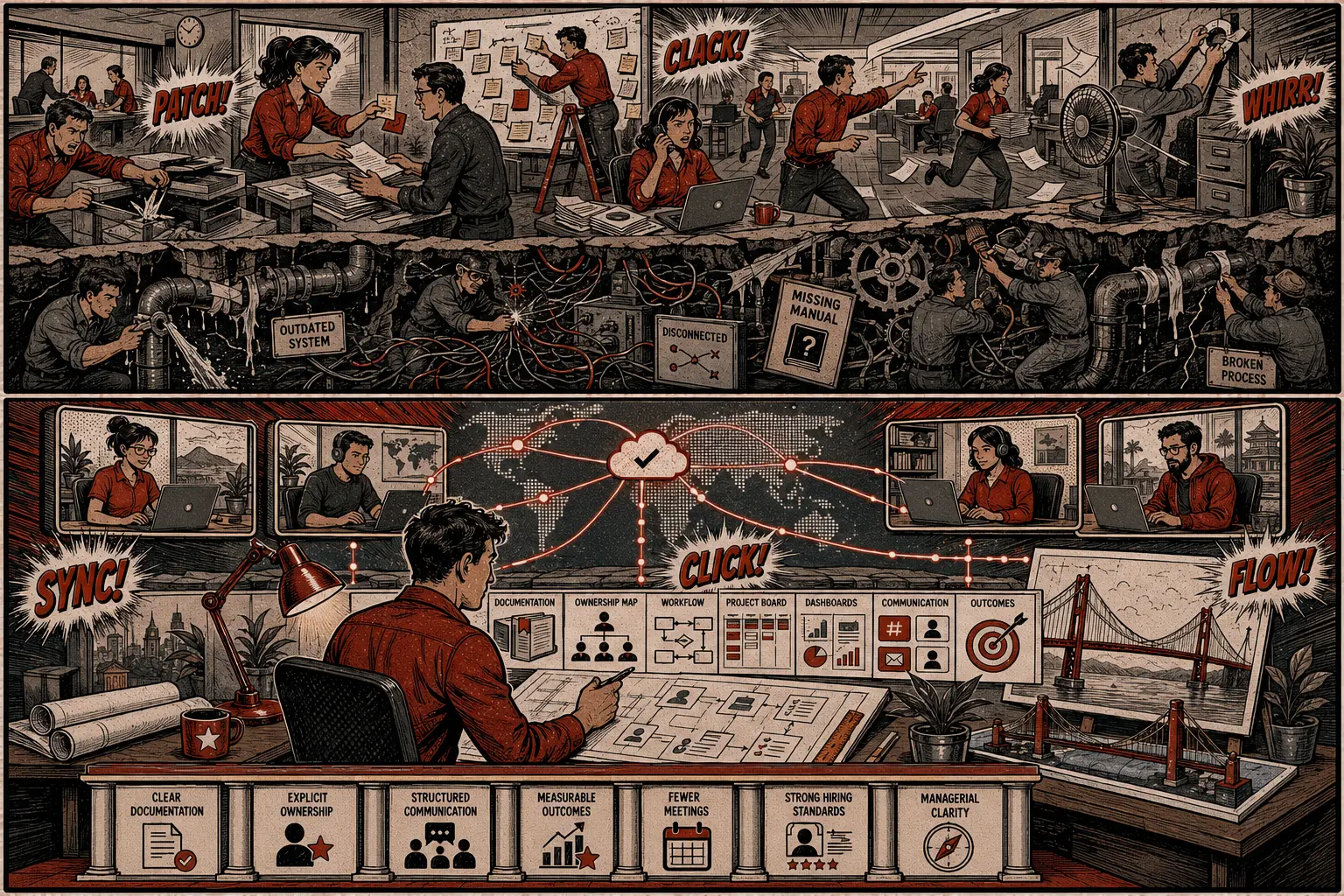
This is why some businesses experience frustration when transitioning to remote work. Employees feel overwhelmed by meetings, managers lose visibility, communication becomes fragmented, and projects begin slowing down.
But these outcomes are usually symptoms of deeper structural issues.
The company was never truly operationally efficient to begin with.
It simply relied on physical proximity to compensate for weak systems.
Remote-first environments force organizations to confront uncomfortable realities:
• Do employees actually understand their responsibilities clearly? • Can teams operate without constant supervision? • Are decisions documented properly? • Is information accessible? • Can projects continue progressing asynchronously? • Are managers creating clarity or dependency?
Many organizations discover the answer is no.
Instead of redesigning their systems, they attempt to recreate office control mechanisms digitally.
This often leads to overcorrection:
• excessive meetings • constant status updates • employee monitoring software • micromanagement through chat tools • pressure for immediate responses • calendar overload.
Ironically, these behaviors frequently reduce productivity further.
Employees become reactive instead of proactive. Focus disappears. Decision-making slows down. Managers spend more time monitoring activity than improving systems.
The company enters a cycle where communication volume increases while operational clarity decreases.
Remote-first companies avoid this trap because they understand a fundamental principle:
distributed work requires stronger systems, not stronger surveillance.
The solution is not more control.
The solution is better organizational design.
This means:
• clearer documentation • explicit ownership • structured communication • measurable outcomes • asynchronous workflows • reduced dependency on meetings • stronger hiring standards • better onboarding processes • greater managerial clarity.
Remote-first companies often appear highly organized not because remote work automatically creates efficiency, but because remote work punishes inefficiency immediately.
In office environments, weak management can survive longer because visibility creates the illusion of coordination.
In distributed environments, results become harder to fake.
This creates an important shift in leadership.
Managers can no longer rely primarily on supervision, presence, or authority. They must learn how to build systems that function independently of constant intervention.
The best remote-first leaders focus less on controlling people and more on removing friction.
They create clarity.
They improve processes.
They reduce unnecessary complexity.
They document decisions.
They build environments where talented people can operate autonomously without confusion.
This is why remote-first companies often develop stronger operational discipline over time than traditional organizations.
The environment itself forces maturity.
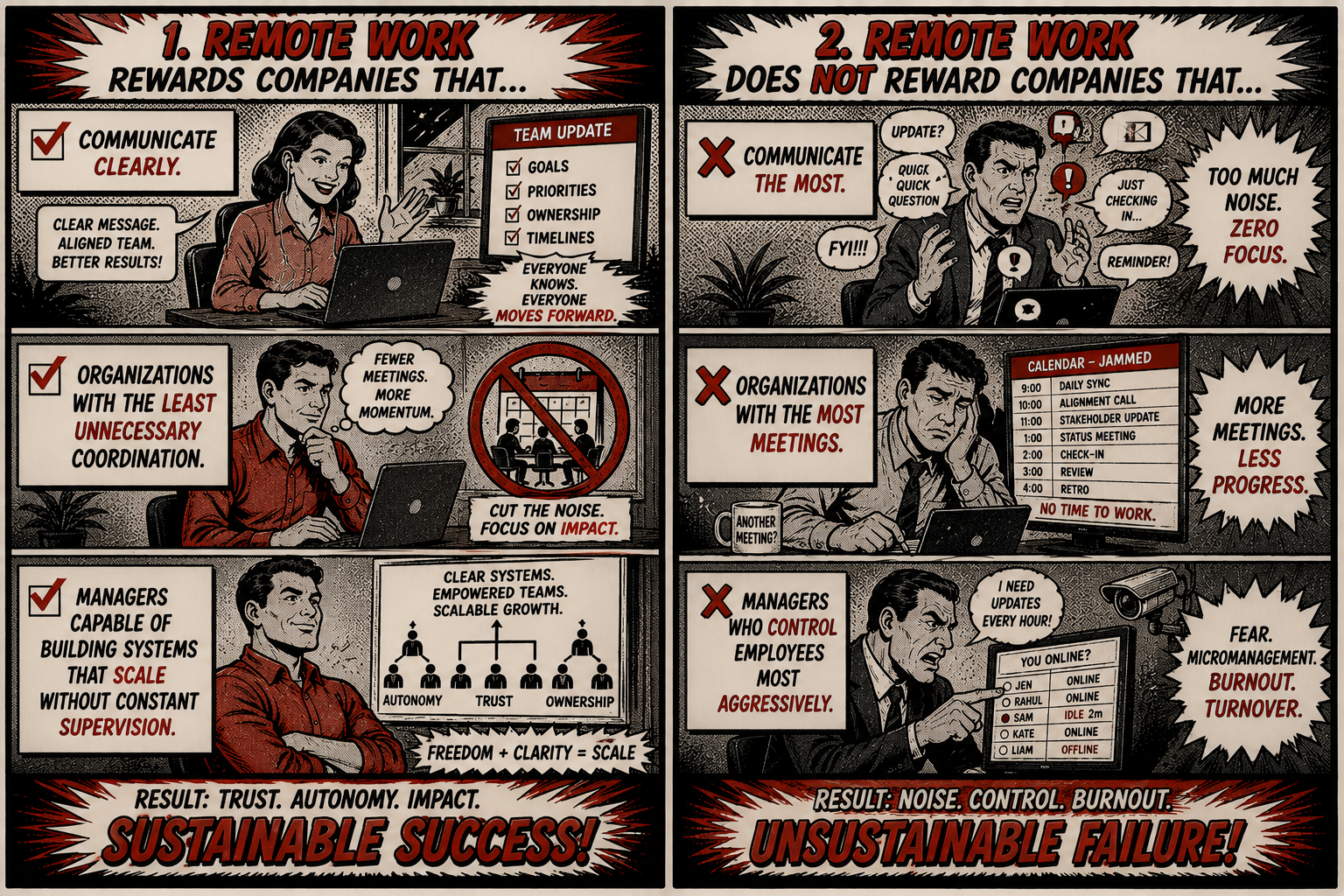
Remote work does not reward companies that communicate the most.
It rewards companies that communicate clearly.
It does not reward organizations with the most meetings.
It rewards organizations with the least unnecessary coordination.
And it does not reward managers who control employees most aggressively.
It rewards managers capable of building systems that scale without constant supervision.
The Numbers Behind Remote Work
Before COVID-19, remote work was still considered a niche model in most industries.
In 2019, only a relatively small percentage of employees worked remotely on a regular basis, especially outside the technology sector. In the United States, Gallup estimated that only 8% of remote-capable employees worked fully remotely before the pandemic, while around 32% worked in hybrid arrangements occasionally. Most employees still worked entirely on-site.
In Europe, remote work adoption was even lower.
According to European Commission and Eurostat data, approximately 5% of EU employees worked mainly from home before the pandemic, while broader forms of occasional telework reached around 10--12% depending on the country and industry. Northern European countries such as the Netherlands, Finland, and Sweden showed significantly higher adoption rates than Southern and Eastern Europe.
Globally, remote work remained concentrated primarily in:
• technology • consulting • media • design • software development • customer support • freelancing ecosystems.
Most traditional corporations still considered physical presence the default model for "serious" work.
Then, in early 2020, the world changed abruptly.
The COVID-19 pandemic triggered the largest forced remote work experiment in modern history.
Within weeks, hundreds of millions of workers transitioned from offices to distributed environments. In the United States, Gallup reported that nearly 70% of remote-capable employees worked entirely from home during the first phase of the pandemic.
Europe experienced a similar transformation.
Countries with stronger digital infrastructure adapted faster, while industries dependent on physical operations struggled to transition. During the peak pandemic years, remote work penetration across Europe increased dramatically, especially in knowledge-based sectors. Eurofound later estimated that remote and hybrid work remained significantly above pre-pandemic levels even after restrictions ended.
The most important result was psychological rather than technological.
Millions of companies discovered that remote work was not only possible, but operationally viable at scale.
Many executives who had previously rejected remote work entirely were forced to admit that productivity often remained stable — and in some cases improved — despite the absence of centralized offices.
By 2023 and 2024, remote work had stabilized into a new global equilibrium.
The world did not become fully remote as some predicted during the pandemic. However, it also did not return to the office-centered model that dominated before 2020.
Instead, hybrid and distributed work became structurally normalized.
In the European Union, Eurostat data showed that by 2023 approximately 22% of workers were working from home at least partially during the survey period, significantly above pre-pandemic levels.
In the United States, Gallup reported that by 2025:
• 55% of remote-capable employees worked in hybrid models • 26% worked fully remotely • only 19% worked fully on-site.
At the same time, global job postings offering remote options increased dramatically.
Research across twenty countries showed that remote job postings quadrupled between 2020 and 2023 and remained structurally higher even after pandemic restrictions disappeared.
But while employees increasingly embraced flexibility, many large corporations began pushing for a return to the office.
Between 2022 and 2025, major companies including:
• Apple • Amazon • Google • Meta • IBM • Goldman Sachs • Tesla • Dell • JPMorgan • Disney,\ introduced stricter return-to-office policies or mandatory hybrid schedules.
The motivations behind these decisions varied.
Some executives argued that:
• innovation improves with physical proximity • mentorship is easier in person • company culture weakens remotely • collaboration becomes slower in distributed environments.
Others were motivated by:
• expensive long-term office leases • declining office occupancy • management discomfort with remote supervision • concerns about productivity • pressure from city economies dependent on office workers.
Several leaders publicly criticized remote work.
Tesla CEO Elon Musk described remote work expectations as disconnected from "real work," while Goldman Sachs leadership referred to remote work as an "aberration" that needed correction.
However, employee reactions were often negative.
Many workers had reorganized their lives around flexibility:
• relocating away from expensive cities • reducing commuting time • improving work-life balance • integrating remote work into family structures.
Mandatory return-to-office policies frequently generated frustration, resignations, and internal resistance.
At Dell, internal reports showed that nearly half of the company's U.S. full-time employees chose to remain remote even after stricter hybrid policies were introduced. Employees who selected remote status often faced reduced promotion opportunities and internal career limitations.
Research also suggested that strict return-to-office mandates sometimes produced unintended consequences.
A large-scale study analyzing companies such as Microsoft, Apple, and SpaceX found that return-to-office policies contributed to the departure of senior employees toward more flexible competitors.
At the same time, fully remote work also revealed challenges.
Some employees reported:
• isolation • weaker social connection • onboarding difficulties • reduced mentorship opportunities • blurred work-life boundaries.
Several companies concluded that fully remote environments were less effective for junior employees or newly hired staff who required stronger integration and training.
As a result, many organizations settled into hybrid structures rather than fully office-based or fully remote systems.
But one thing became increasingly clear:
the world was not returning to 2019.
The pandemic permanently changed employee expectations, hiring practices, and the strategic role of geography in knowledge work.
Even companies attempting stronger return-to-office policies were now operating in a labor market where flexibility had become one of the most valuable competitive advantages in attracting and retaining talent.
Remote work was no longer an experiment.
It had become part of the long-term evolution of modern organizations.
The New Competitive Advantage
For decades, companies competed primarily through capital, distribution, and physical infrastructure.
The strongest organizations were often those with the largest offices, the biggest local presence, the most centralized operations, and the greatest access to regional talent markets.
But the nature of competitive advantage is changing.
In a world where communication is instant, information is digital, and knowledge work can move globally in real time, geography becomes far less important than organizational design.
The companies that adapt to this shift gain advantages that traditional office-centered organizations struggle to replicate.
Remote-first companies are not simply reducing office costs.
They are redesigning how modern organizations operate.
This creates compounding advantages over time.
A remote-first company can recruit globally instead of locally.
It can scale internationally without relocating entire departments.
It can continue operating during local disruptions.
It can build multilingual teams naturally.
It can access specialized expertise independent of geography.
It can optimize for flexibility instead of physical infrastructure.
Most importantly, it can move faster.
Speed increasingly determines competitive success in modern markets.
The ability to hire rapidly, adapt operationally, launch internationally, restructure teams efficiently, and access talent without geographic constraints creates enormous strategic leverage.
Traditional office-first organizations often move slower because their systems remain heavily tied to physical structure:
• local recruiting • office expansion • relocation logistics • centralized management • synchronous coordination • geographic dependency.
Remote-first companies operate with significantly less structural friction.
This difference becomes even more important during periods of uncertainty.
Economic instability, geopolitical disruption, technological acceleration, migration patterns, and changing workforce expectations all reward organizations capable of adapting quickly.
Distributed companies are often structurally more flexible because they were designed for change from the beginning.
The future increasingly belongs to organizations that can operate independently of geography.
This does not mean offices will disappear completely.
Physical spaces will still exist for collaboration, retreats, creative sessions, and social interaction. Human connection remains valuable.
But offices are gradually losing their role as the mandatory center of organizational life.
They are becoming optional tools rather than operational necessities.
This shift changes the balance of power between companies and talent.
In the past, professionals often had to organize their lives around office locations. People relocated to expensive cities, accepted long commutes, and limited personal flexibility in exchange for career opportunities concentrated inside specific geographic hubs.
Remote-first companies reverse this dynamic.
They allow organizations to access talent globally while allowing individuals greater freedom in how they design their own lives.
This creates a broader and more competitive global talent marketplace.
The best companies increasingly compete on:
• operational clarity • speed of execution • flexibility • culture • autonomy • managerial quality • ability to attract exceptional people regardless of location.
In this environment, remote-first becomes more than a work model.
It becomes a strategic philosophy.
Companies built around distributed systems often develop stronger documentation, clearer communication, greater accountability, and more scalable processes because remote environments force organizational discipline naturally.
Over time, this operational maturity compounds into competitive advantage.
The strongest remote-first organizations are not successful because people work from home.
They are successful because they learned how to build systems that scale efficiently without dependence on physical proximity.
This distinction is critical.
The future winners will not necessarily be the companies with the most employees, the most office space, or the largest headquarters.
They will be the companies capable of coordinating talented people effectively across borders, cultures, languages, and time zones.
The internet decentralized information.
Remote-first organizations are decentralizing work itself.
And this transformation is still only beginning.
The Geography of Talent
The transition from office-first to remote-first is not simply a technological shift.
It is a managerial shift.
A cultural shift.
An operational shift.
It requires companies to rethink how they hire, communicate, evaluate performance, share information, and build trust inside organizations no longer dependent on physical proximity.
Some companies resist this transformation because they continue treating remote work as a temporary adjustment or an employee perk.
Others recognize something much larger.
They understand that distributed systems fundamentally change the economics and scalability of modern organizations.
Once geography stops being a limitation, the entire structure of the company evolves.
Talent becomes global.
Teams become more flexible.
Operations become more resilient.
Growth becomes less dependent on physical infrastructure.
And hiring changes completely.
In traditional office environments, companies usually recruit from a relatively small geographic radius around their headquarters. The hiring process itself is constrained by proximity.
Remote-first organizations operate differently.
They can search globally for the best candidate instead of the closest one.
This dramatically expands the available talent pool — but it also creates new challenges.
How do you identify exceptional talent across different countries, cultures, and communication styles?
How do you evaluate remote candidates effectively?
How do you structure interviews, trial periods, and onboarding processes in distributed environments?
And how do you build high-performing teams composed of people who may never meet physically?
These questions become central inside remote-first organizations.
Because once companies are no longer limited by geography, hiring itself becomes one of the most important competitive advantages available.
And that is where the next chapter begins.