 REMOTE FIRST
Culture, Rituals and Remote Activities
How to build culture, trust and momentum without conference rooms: intentional rituals, offsites, team weeks, internal demos and the small repeated moments that hold a distributed company together.
1. Context and problem
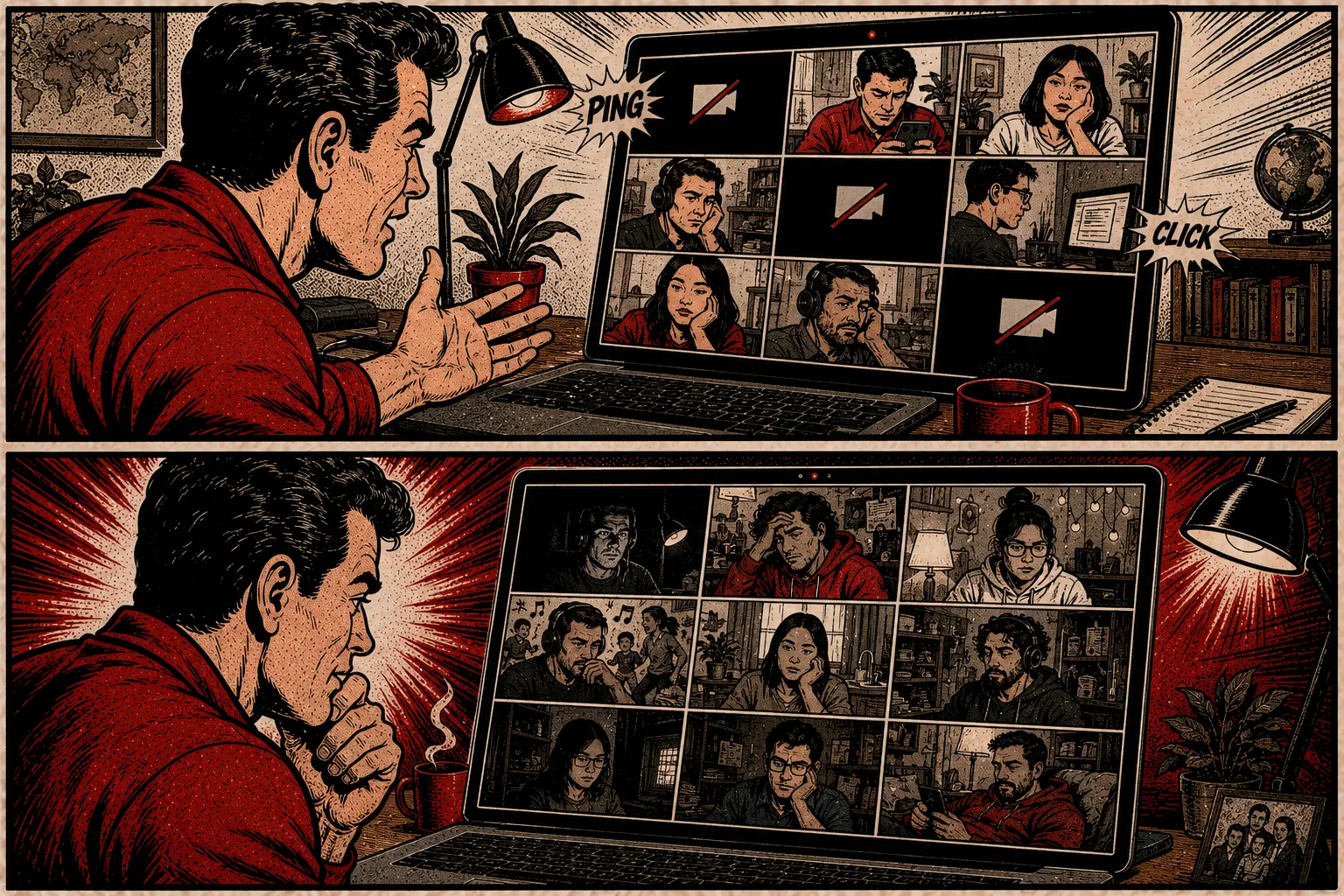
In a fully remote company of around forty people, spread from the UK to the Philippines, the only genuinely synchronous moments are live meetings. Everyone else starts, pauses and finishes the day at the hours that suit them, and the single non-negotiable rule is that timelines are respected, especially where tasks depend on each other.
Before we started Power Breaks, we only met to talk about work. In those meetings I noticed small but revealing details: cameras off, people technically present but visibly looking at another screen, no ideas or feedback offered unless someone asked a direct question. Some colleagues were working from very dark rooms or noisy environments, and when I asked their managers about it, they usually could not answer, because they had never noticed.
If you work remotely, you connect from home, open your tasks, and check KPIs and priorities with your manager. There is no natural moment to talk about how your day is going, what you do after work, or how you actually feel. In an office, coffee breaks and corridor chats create those connections by accident. A remote company has to design them on purpose.
Reflective questions
- Where do people in your company naturally build connections today, and if the honest answer is "nowhere", what does that tell you about what is missing?
- Which early signals, camera off, silence, visible distraction, have you already noticed in your meetings, and when did you last act on one of them?
- How much do you actually know about the physical conditions your colleagues work from every day?
2. When departments finally meet
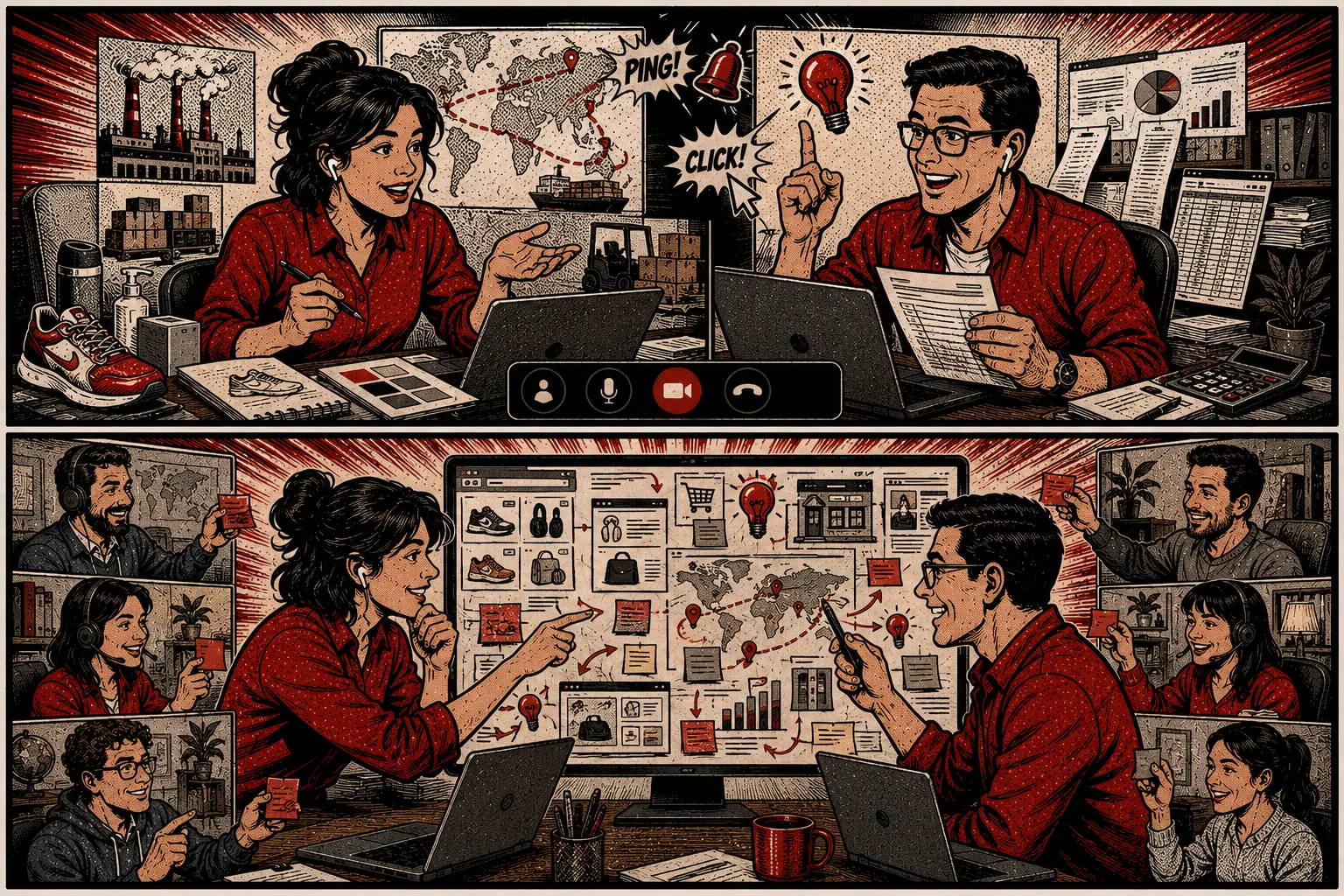
These moments are not only nice to have. When people from different departments finally meet, they ask questions, share doubts, and sometimes discover collaborations that solve company problems faster and more creatively.
Example: discovering collaboration opportunities. Alice is a Product Manager who works with factories, fulfillment, the board and logistics. Michael is the Finance Manager and spends most of his time classifying invoices. In a Power Break built around the Role Swap game, Alice had to solve a finance challenge: decrease shipping costs. Michael appreciated her approach but proposed an alternative, and when Alice asked where the idea came from, he explained he had seen another company doing something similar. That question uncovered a competitor and a set of products worth studying. After the session they created a shared list of competitors to analyze regularly, later opened to other departments. No formal meeting would ever have had that agenda.
Reflective questions
- Which two collaborators from different departments have almost never worked together, and what shared challenge could give them a real reason to connect?
- Which recurring company problem might benefit from an outside perspective coming from another department?
- When an idea like this emerges informally, who is responsible for turning it into something the company keeps using?
3. The purpose of Power Breaks
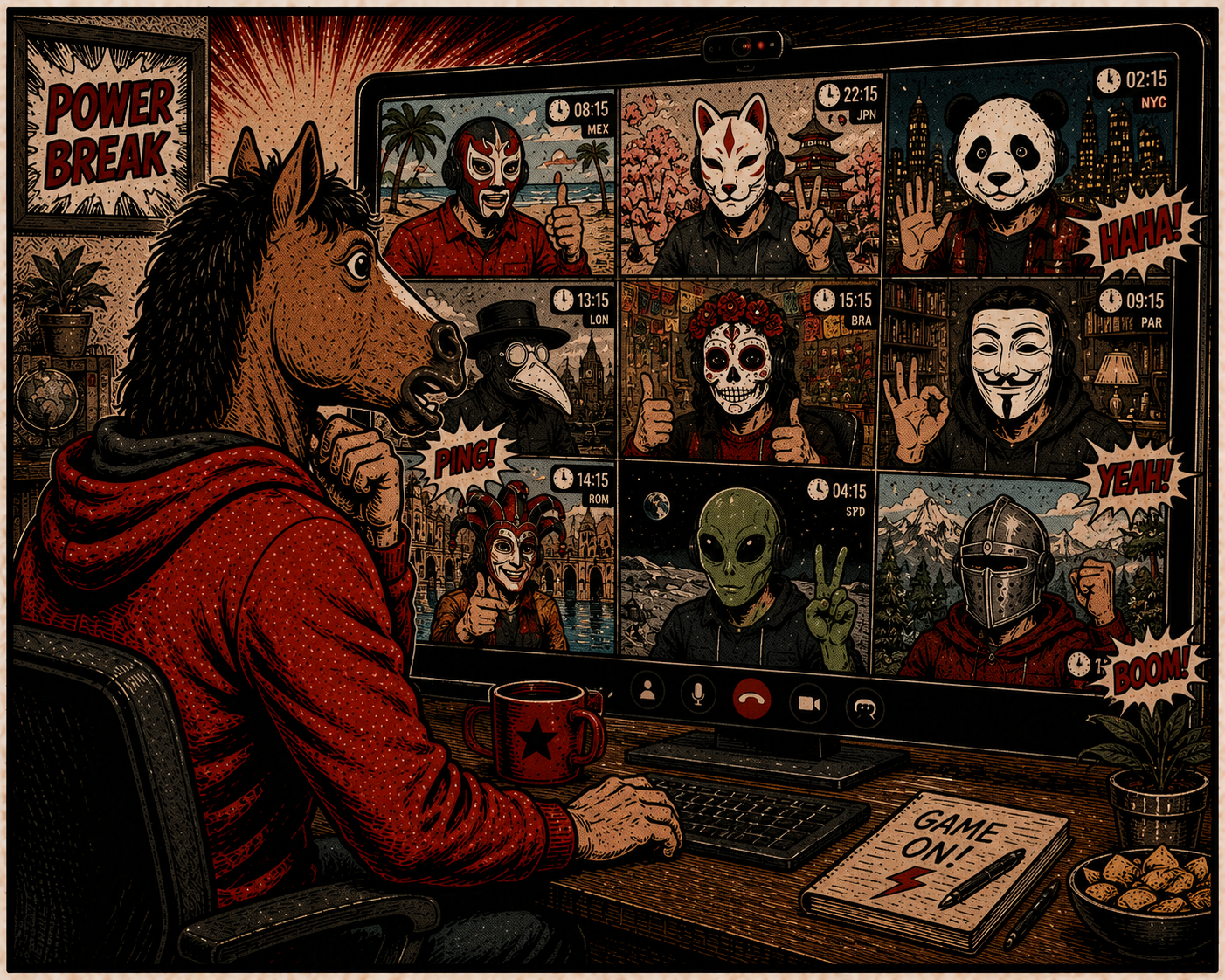
In a fast-growing remote company, many colleagues only interact inside project channels. New joiners in particular say they feel connected to tasks but not to the team. Power Breaks are short, structured moments of human connection that happen during working hours, and their base purpose is simple: put a face and a voice to a Slack profile.
When people know each other beyond a job title, they ask for help more easily, give feedback more respectfully, and resolve conflicts faster. Teams that joined these sessions more often also became more proactive in sharing knowledge in Slack and in cross-team projects. In some cases real friendships formed: two colleagues living in the same country met at an airport during a family trip, another pair spent part of a vacation together abroad.
The format can vary, role plays, online games, a webinar watched together, short personal presentations, interactive workshops, but the objective stays constant: create a context to talk about something other than daily tasks. Run a survey first to understand preferences, and repeat it quarterly so people can rate formats and suggest topics.
During these sessions people take off the mask of manager, specialist or CEO. Colleagues who rarely speak in regular meetings finally tell others about themselves, their family, their country. We have had colleagues from Brazil sharing hidden beaches, someone from Malaysia presenting local dishes, a colleague from Poland explaining Christmas Eve traditions, which sparked an exchange of photos and family recipes in the general channel afterwards.
Reflective questions
- If you had to define one main purpose for your Power Breaks, connection, learning, or diagnosis of team health, which would it be, and would your team name the same one?
- How clearly is the purpose of these meetings explained today, and when did you last check that people understood it?
- What would success look like after six months of running them consistently, and can you measure whether you are moving toward it?
4. Reading people during the sessions
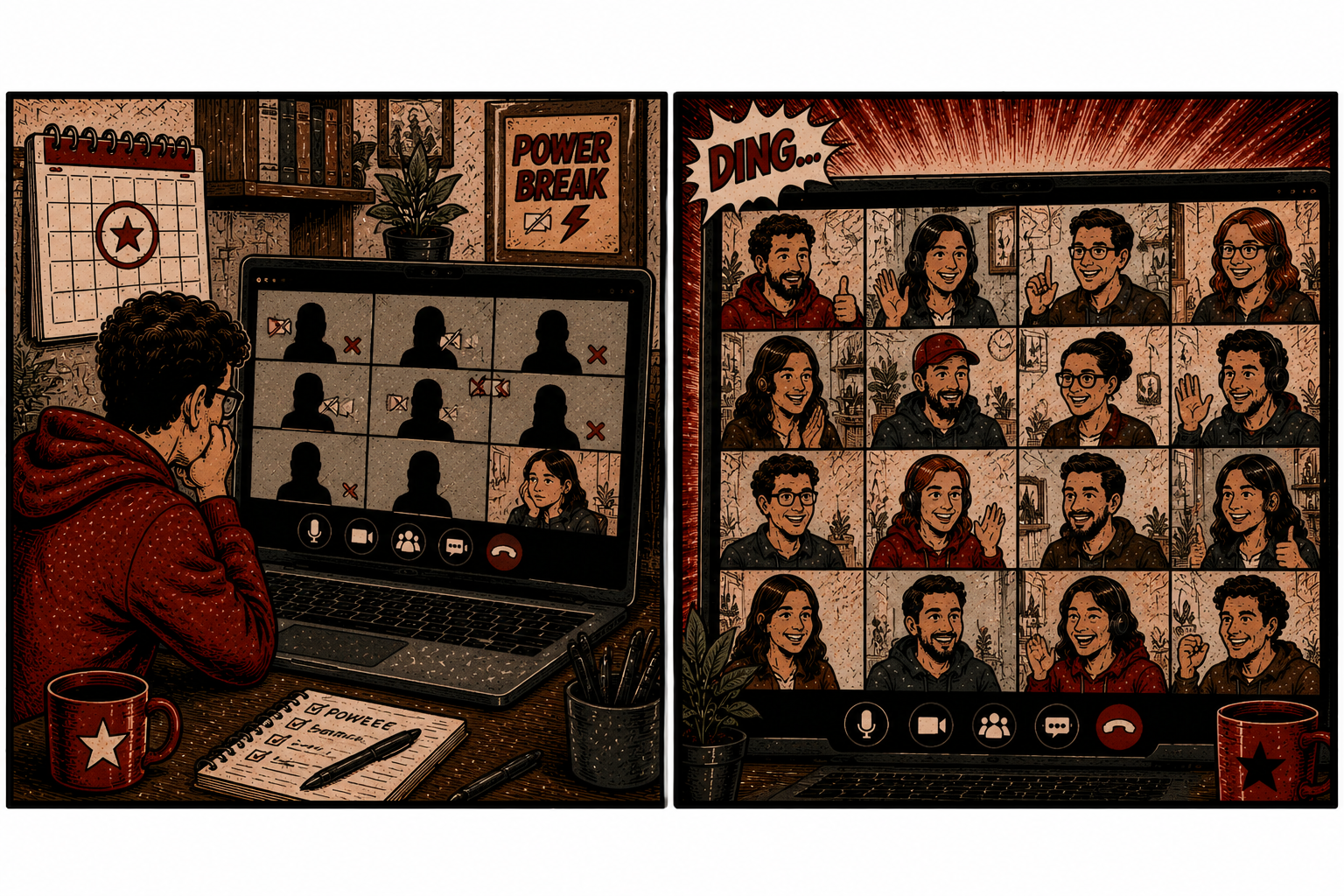
As a People Manager you take care of people's work and of their mood, because the two are connected. A person who feels lonely, ignored or misunderstood will not perform at their best for long, however strong their technical skills are. That is why these sessions are also a way to observe. Is there curiosity to join, or always a reason to decline? Once in the room, does the person participate or stay passive? Do they see the company as a place that pays a salary, or as a community where knowledge is exchanged?
No conclusion should ever rest on a single event, but no event should be forgotten either, because patterns are built from repeated moments. Take notes: over time they help you identify future mentors and managers, spot people who would benefit from extra support, and feed a broader evaluation alongside performance data and the person's own perspective.
Reflective questions
- What do you observe during informal sessions today, and is any of it written down anywhere?
- Which colleague have you judged on a single moment rather than on a pattern?
- How would you use these observations to support someone, without ever turning them into a hidden performance file?
5. Designing and running the meetings
We hold these meetings every Friday with different people, so that each person participates once per month. We experimented before landing there: fully voluntary sessions, bi-weekly slots, ad-hoc meetings run by team leads. Twice a month took too much of everyone's time, and once every two months created a gap too long for continuity. A fixed weekly slot combined with one participation per person per month is the balance that worked.
Because we work across several time zones, the Friday slot rotates every quarter, so the same group is never always the one joining very early or very late. One topic usually stays active for a full month, which lets people from different groups continue the discussion asynchronously in Slack. At the end of the four rounds I share a short summary in the general channel, consolidating what emerged across the groups.
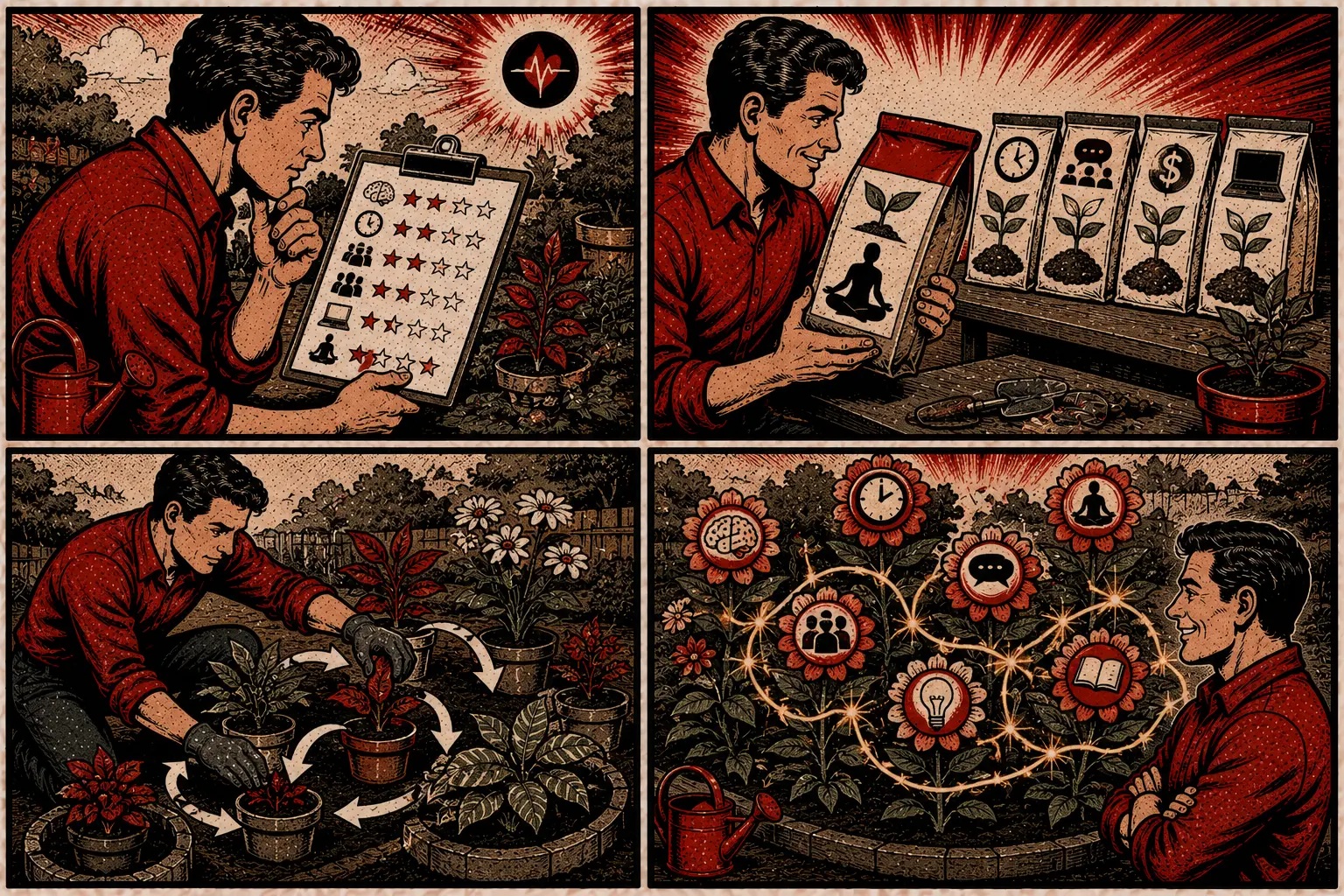
Example: choosing the topic. In one round of one-on-ones I asked people to rate a list of options from 1 to 5: financial advice, a meet-up event, time management with an internal expert, handling difficult situations with an external expert, online presence, and stress management. Stress management scored 3.8 and time management 3.7, so I booked a therapist for the first and an internal expert for the second. The ratings told me not only what people were curious about, but where their pain points were during a period of fast growth.
Once the topic is set, I build groups of four to six people who do not usually work together, mixing seniority and departments so everyone has at least one familiar face and at least one new one. Groups change every session, holidays and days off are checked in advance, and calendar invites go out early enough for people to adjust their schedules. The announcement in Slack is not just the invite: it explains the purpose of the month's topic and what to expect, which lowers the anxiety of colleagues who are less comfortable in social settings.
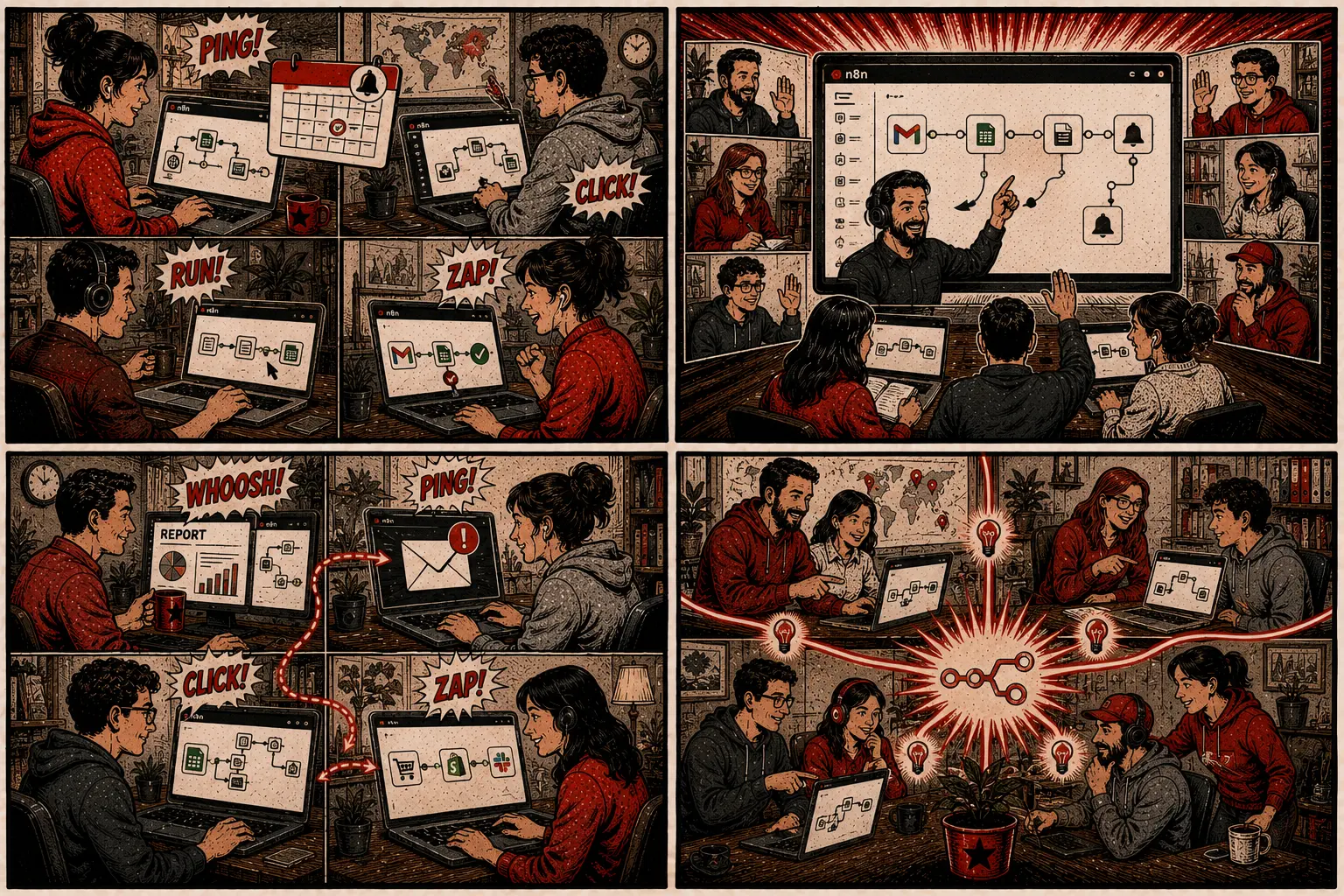
Example: preparing the team. For a Power Break on the n8n automation platform we invited an external expert and asked everyone to test the tool beforehand, even with a trivial workflow. Afterwards several colleagues built small automations for their daily work, from report generation to notifications for order issues, and we used the session to identify automation champions in different departments.
Reflective questions
- Do you have a recurring structured format for informal connection, or are these sessions the first thing dropped when the week gets busy?
- Across time zones, group sizes, frequency and follow-up, which element of your setup is currently the weakest?
- Which single design decision, a fixed slot, rotating groups, collecting topic suggestions, could you commit to before the next round?
6. Formats and games
Each format has a specific goal, from creating personal connections to improving cross-department collaboration and cultural awareness. These are the ones that worked best for us.
- Share Your Hobby, colleagues connecting from different parts of the world present their passions. One session covered stones and the energy they are believed to carry, another a favourite writer. Because the room is international, no round is ever the same, and the one constant is respect: people are sharing a personal part of themselves with near-strangers, so jokes and mocking have no place.
- Role Swap Game, groups from one department read and solve a realistic scenario belonging to another, then discuss it with the department that actually lives it, which votes from 1 to 5 on how applicable the proposal is. When you are inside a problem every day it is hard to see alternatives; people watching from outside often bring fresh ones.
- Role Swap, managerial version, a manager plays the underperforming collaborator and the collaborator leads the difficult conversation. The collaborator gets to demonstrate managerial skill and to model how they would want to be treated; the manager learns which phrases feel supportive and which feel demotivating. It turns a private conversation into a safe learning moment for everyone.
- GeoPower, we guess locations on geoguessr.com, then compare real country sizes on thetruesize.com. It is entertaining, and it also gives everyone a clearer mental map of where colleagues write from and where customers live.
- Guess Who, fun facts collected during one-on-ones and interviews become a company-wide guessing game. It is playful, and it quietly rewards the people who pay attention to the human side of their colleagues, not only to their tasks.
Reflective questions
- Which of these formats would be the most realistic to test in the next four weeks, given your team size and setup?
- Which game best matches your current challenge, silos between departments, lack of empathy across roles, or simply low energy?
- Who in your team would enjoy designing and hosting one of these formats instead of only attending it?
7. Cultural respect and inclusion
Whatever format you pick, the room decides how it plays out. When a company includes people from many cultures, discovery happens constantly and discussions open easily, because there are simply more questions to ask. In companies where everyone shares a country and a language, shared references make the games funnier and the environment more intimate. Both work, as long as you know who is in the room.
The main point of attention is respect. What is acceptable in one country can be offensive in another, so dark humour and jokes touching religion or politics are out. We once worked with an email marketer who, for religious reasons, did not want to work with companies selling alcohol, and that single piece of information shaped how we designed toasts and drink-related topics. We also avoid careless shortcuts, such as mixing up neighbouring countries when talking about a colleague's nationality.
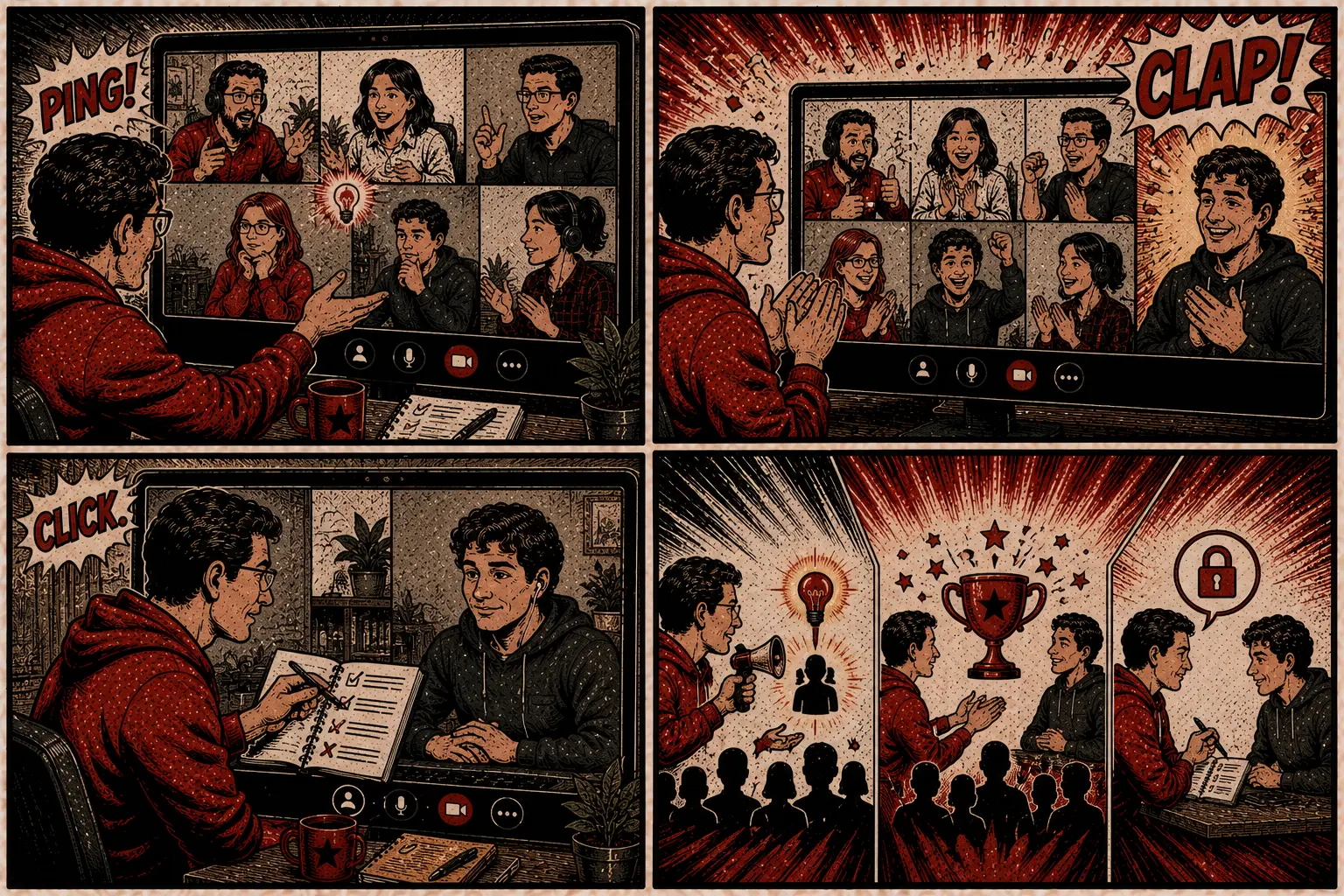
For everyone to feel included, invite people to speak directly instead of waiting for volunteers, because the quietest colleagues often have the most interesting things to say. And keep one principle in mind: congratulate in public, correct in private. If something said during a session goes against company values, take note and address it one-on-one afterwards.
Reflective questions
- Which cultural or religious sensitivities exist in your team, and have you asked directly or are you assuming?
- Who tends to stay silent in your sessions, and what would it take to invite their opinion without putting them on the spot?
- How do you handle a comment that clashes with company values, in the moment, or privately afterwards?
8. Participation, resistance and KPIs
The two core KPIs are participation rate and satisfaction rate. When I introduced Power Breaks, roughly half the company was curious and the other half sceptical, and since participation was presented as voluntary, some people simply did not show up without telling me. Several managers were among them. I had to explain more than once that leaders are watched: if a manager skips the session, the team will too. Over about a year participation moved from roughly 70% to 98%, and the clearest sign of success was people asking for more sessions and volunteering to design them, one Power Break on team management was entirely built and hosted by the collaborator who had proposed it.
I address absences in one-on-ones. Even if participation is not formally mandatory, I do look at who joins and at how they join, meaning no other screens and no phones. A Power Break is one hour of work per month spent with colleagues, prepared with a lot of time and care, so skipping it without a valid reason is, in practice, a lack of respect. The remaining sceptics who still avoid the session or attend passively are usually the same people who prefer to work alone and share little, often treating the company as just another client. Because success is not only completed tasks but also knowledge shared and ideas generated, this test is worth running in the first weeks of a collaboration.
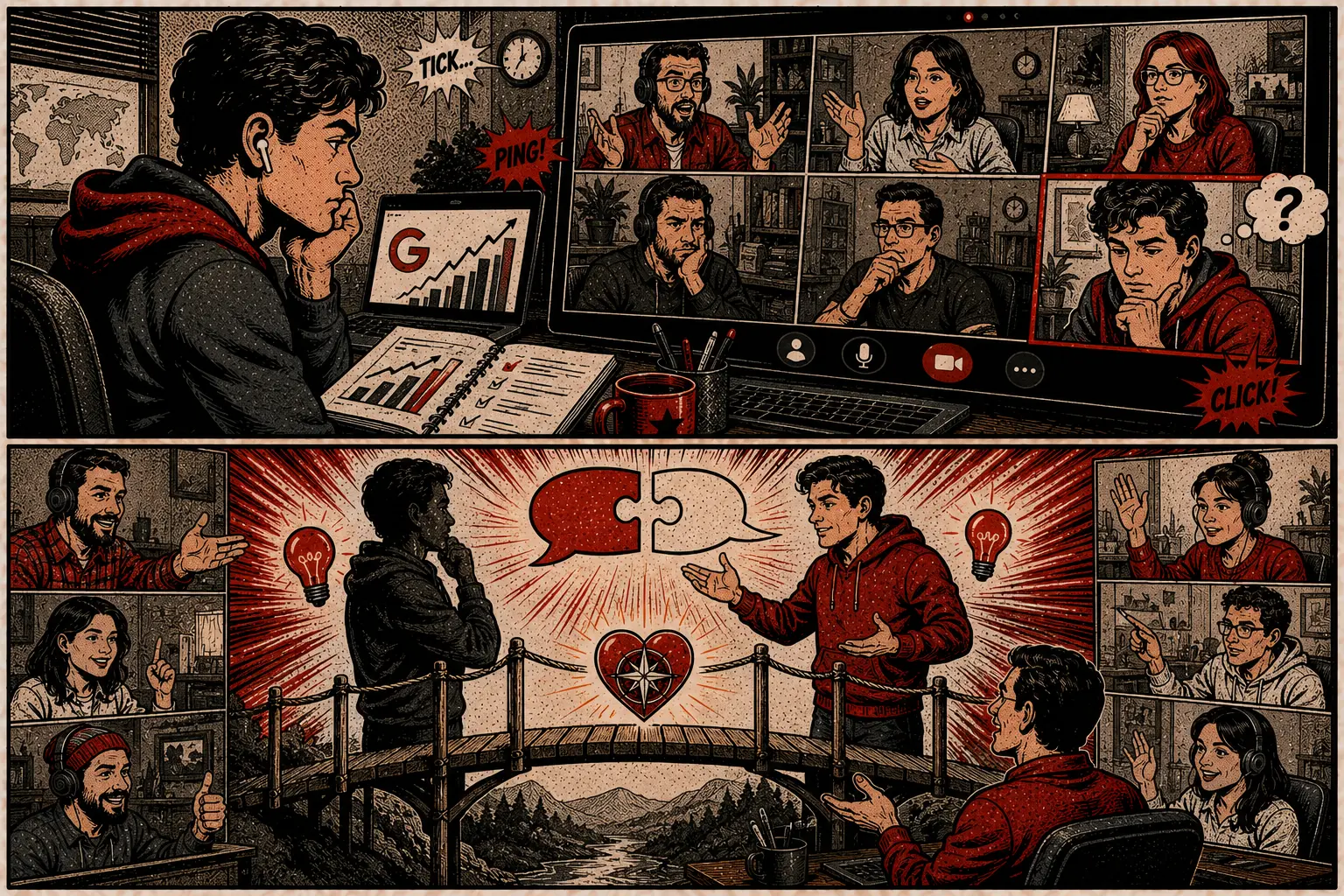
Example: shyness versus disengagement. George is a media buyer whose department hits its goals every month, yet he almost never speaks in team meetings. It looked like disengagement. During a Role Swap session he was given a managerial challenge: understand why someone in your team is not collaborating. He answered with remarkable maturity and empathy, describing that kind of person as a "shy talent". A follow-up conversation confirmed it: he was not indifferent, he was uncomfortable speaking in front of others. The team started inviting his opinion directly, and over time he began to speak up in regular meetings too.
Example: the no-show pattern. Through 2023, James avoided Power Breaks first by not joining, then by regularly taking holiday on the exact Friday he was scheduled. In a one-on-one I described the pattern and asked about it; he had a fixed personal commitment at that hour. I raised it with his manager, who was unaware, and we discussed whether those recurring hours were acceptable. In another case a collaborator told me directly that Friday is his department's busiest day because of weekend preparation, and that feedback pushed me to explore moving Power Breaks to another day during certain periods. Not every absence is resistance, some are logistics you can remove.
Reflective questions
- Which two or three KPIs would convincingly demonstrate the value of these meetings to your leadership, and can you produce them from data you already have?
- When someone repeatedly skips or passively attends, do you address it with genuine curiosity, or accept low engagement as a personality trait?
- Do your managers attend consistently, and what message is their behaviour sending to their teams?
9. Retention and hidden signals
Beyond participation, the business impact showed up in retention, which improved by around 20% since we started, helped by inviting people in during their testing and onboarding phase. Those who fit feel engaged quickly; those who refuse from the very beginning are already showing how much they intend to invest in the company. People do not stay only for a salary, they stay for the people they work with.
These sessions also surface hidden issues, and that should be one of their goals. While playing, people relax and say more about what worries them. Watch the relationship between manager and collaborator: are they comfortable with each other, does it look like they speak often, is the collaborator confident enough to joke, does the behaviour change when the manager is absent? Asking direct questions with prepared answer options, or a 1-to-5 scale, generates the most honest answers and gives you a starting point for a deeper private conversation.
Example: the double side of Power Breaks. We ran a session with a therapist whose topic was burnout prevention. Her questions, which I later reused in one-on-ones, revealed that some people were stressed because tasks and dependencies were unclear, others were confused about priorities, and others did not feel part of the team. That was never the agenda; the conversation moved there because the space felt safe. This kind of information must never be used to punish anyone, only to help people work and feel better.
Reflective questions
- If these sessions worked well for twelve months, what change in retention or cross-department collaboration would you expect, and have you written that target down?
- What have you learned about a manager-collaborator relationship by watching them outside a work meeting?
- Where do sensitive insights go once they emerge, and who guarantees they are used to help rather than to judge?
10. Experts and learning
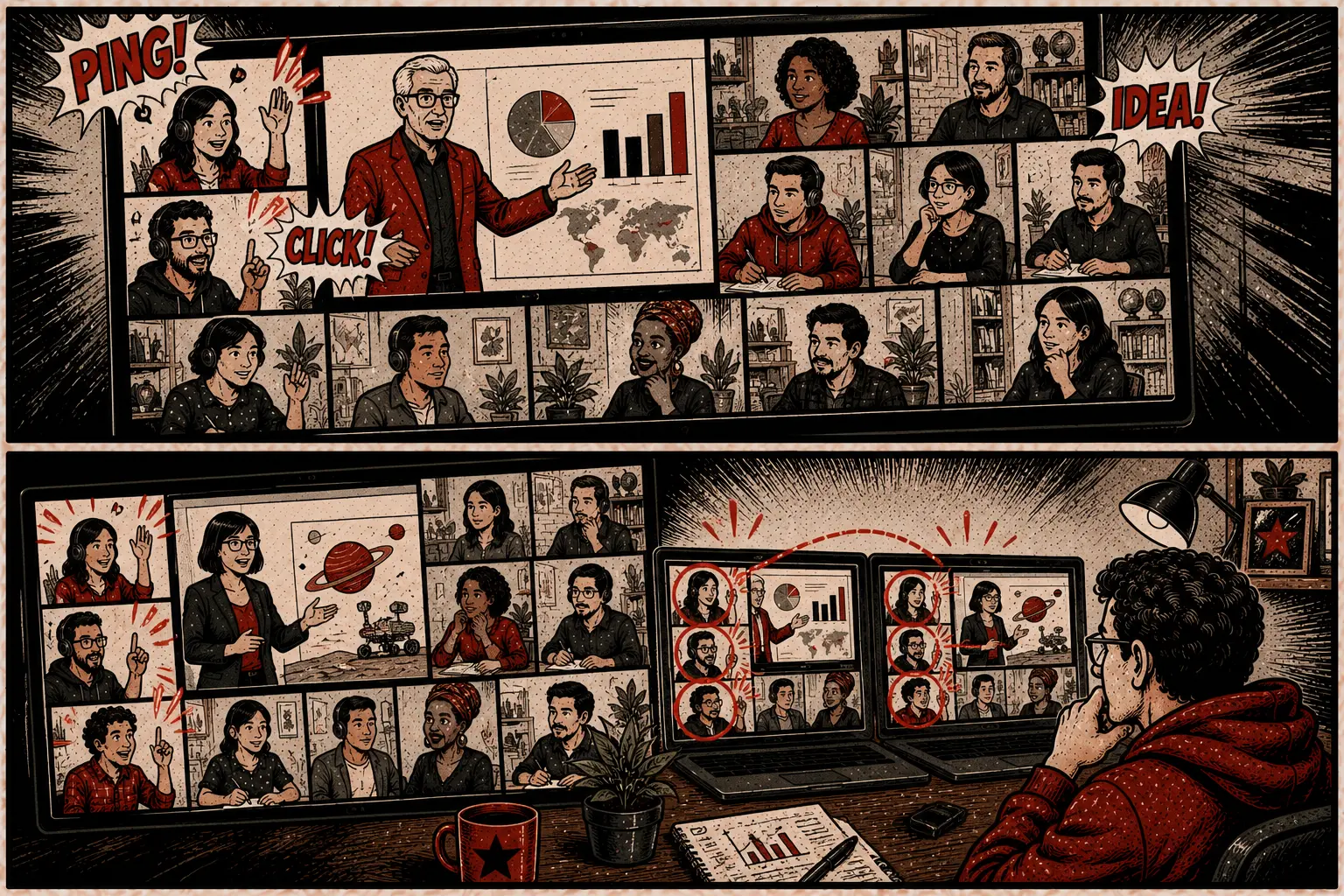
After a year of Power Breaks, I started asking every collaborator what kind of sessions they wanted. Several said they would like to learn something with an external expert rather than only play, so I asked everyone to rate areas of interest, financial advice, communication, wellbeing, productivity, and contacted experts for the highest-rated topics.
When briefing an expert, explain the size of the group, the type of company and the format, because in most cases the same session has to run several times with different groups. Large groups lose attention and leave no room for questions, so smaller groups with more sessions per month work better. In a few cases I changed expert after the first meeting, because it was clear they were not confident explaining the topic or answering questions. Calibrating after a test protects the quality of the experience.
The atmosphere in expert-led sessions is different: people mostly listen and ask questions rather than co-create. Interestingly, the most active participants were not always those most interested in the topic, they were the people who are always present and vocal anyway. Someone who considers Power Breaks a waste of time will stay passive even when the subject is genuinely useful to them.
Reflective questions
- Which topics would your teams most like to explore with an external expert, and have you asked recently, or are you guessing?
- What specific signals would tell you an expert-led session is worth repeating, beyond a general sense that people seemed engaged?
- What balance between playful formats and structured learning does your team actually want, as opposed to what is comfortable for you to facilitate?
11. Implementation and what comes next
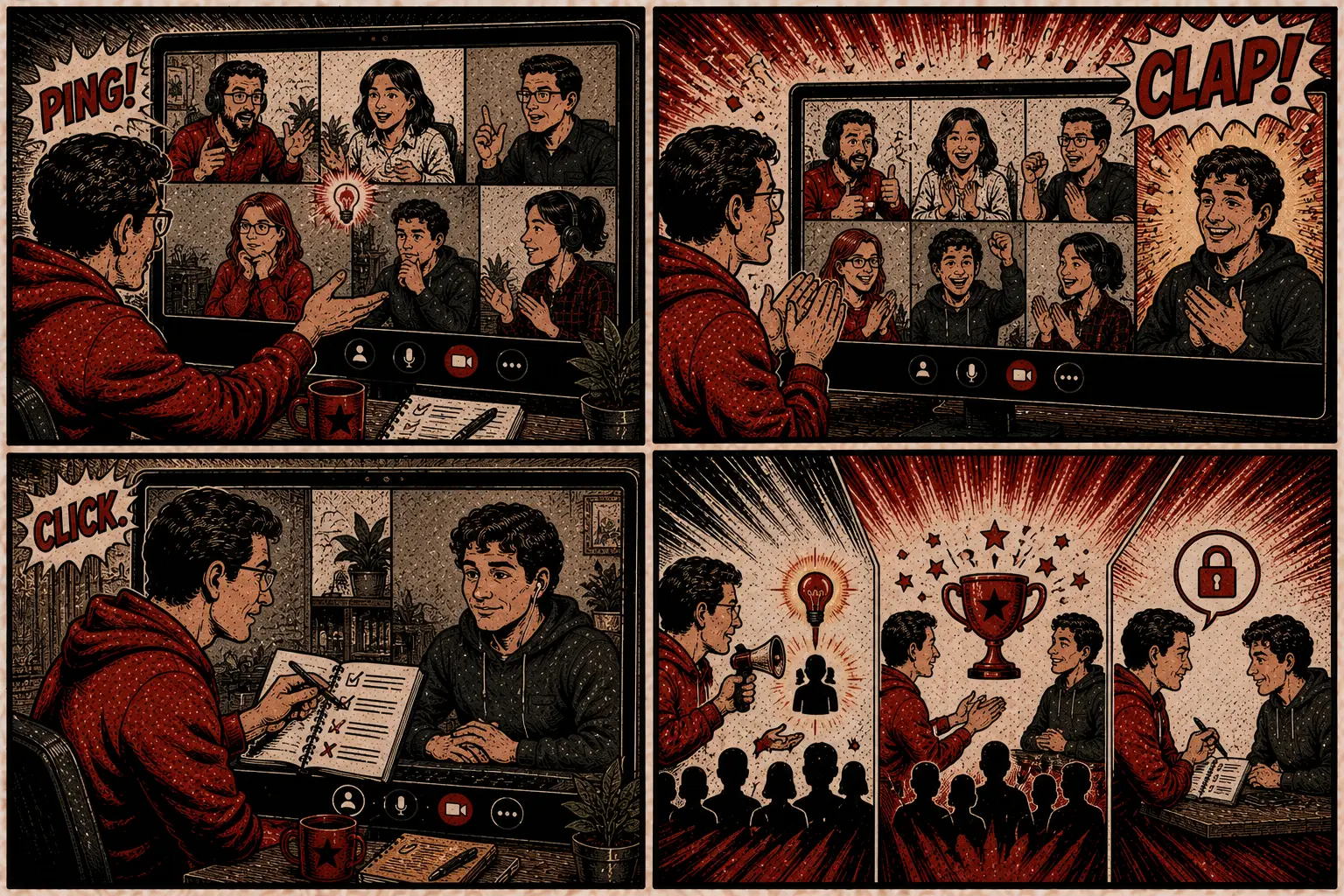
We run the sessions on Zoom and usually record them, especially the learning ones, so they can be shared afterwards. Short clips of the best or funniest moments become internal posts, which lets people who missed the session benefit from it and keeps the initiative visible.
Logistics matter more than they look. Invitations go out at least two weeks in advance, taking public holidays and days off into account. First a message in the common channel announcing the topic and who joins when, then a calendar event with the Zoom link attached. At the start of the week I post a reminder tagging the people joining that Friday, and another short reminder the day before, which sharply reduces no-shows. If someone is missing when we start, I message them privately and wait a maximum of five minutes. If someone joins with the camera off, I write privately and, when appropriate, invite them gently to turn it on, while staying flexible with people who told me in advance they cannot.
After each meeting I send a short survey covering the quality of the time spent, the clarity of the expert when there is one, the person's own engagement, and whether they would join again, always with an open field for comments, which is usually where the most valuable insights are. AI helps here too: transcriptions can be analysed to see who spoke more or less, to ask how facilitation could improve, and to surface moments you missed while focusing on something else.
Looking back at the formats we have tried, game-based and competition-based activities are consistently the most appreciated, so the Role Swap Game and similar games stay. Among expert sessions, the automation expert did a good job but attracted less active participation than expected, while the therapist working on burnout created a space where people spoke openly without being asked. That is the direction worth expanding: human topics, wellbeing, stress, emotional resilience, open doors to deeper conversations and stronger connections. Newer generations are the most open to these meetings, precisely because they feel the absence of a physical office more strongly.
Reflective questions
- What is the simplest logistics setup, tool, invitation, reminder sequence, you could implement in the next 30 days without turning it into a project?
- Who should own the logistics and the follow-up: HR, a People function, a culture squad, or rotating volunteers?
- If you committed to one experiment next quarter inspired by this chapter, what would it be, and who would you bring in to design it?