 REMOTE FIRST
Chapter 07
Retention, Exit and Off-boarding
Why endings deserve as much care as beginnings, how to read the signals before someone leaves, how to turn exit interviews into a real source of learning, and how to protect the relationship, the team and the brand.
1. Why off-boarding matters
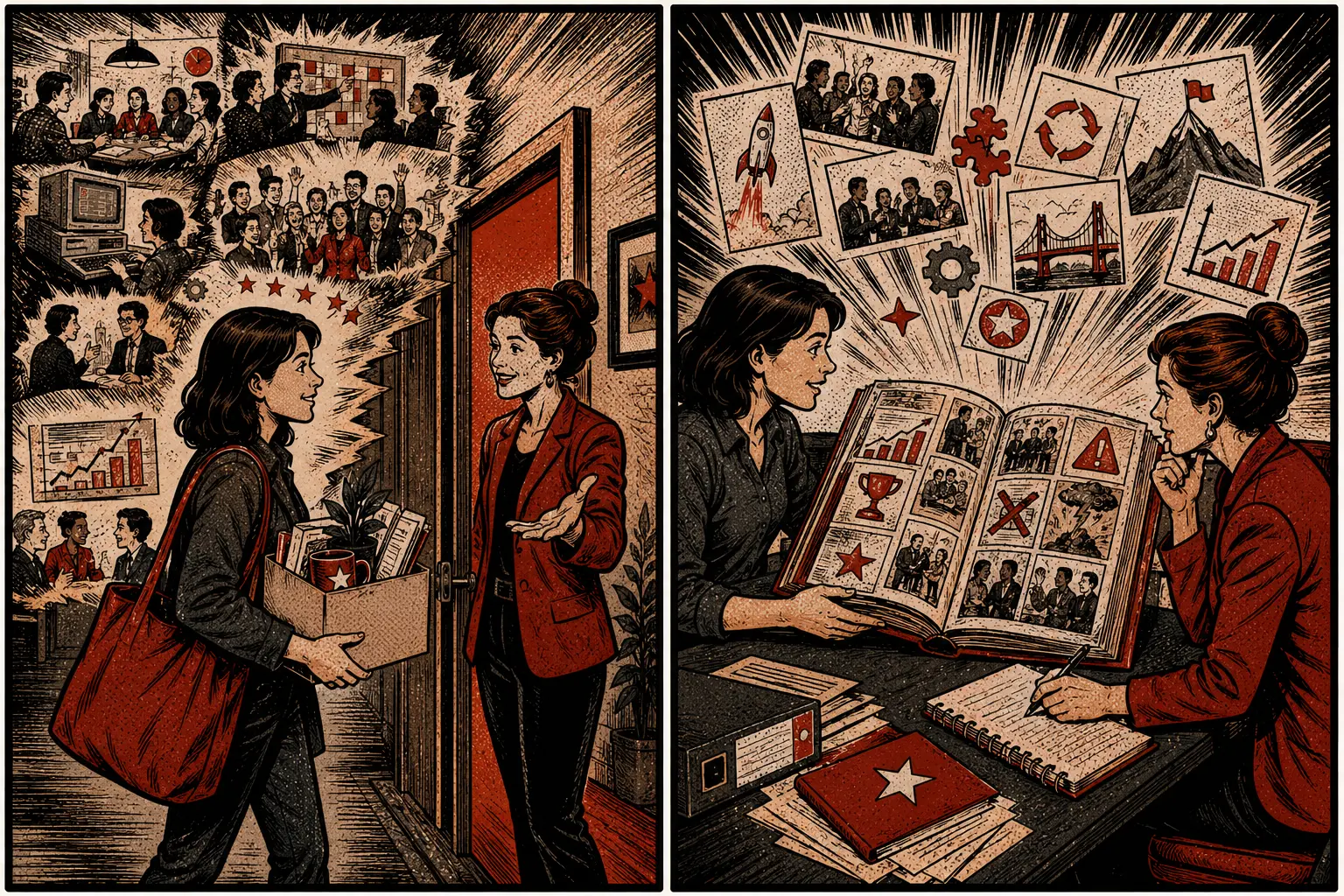
Off-boarding is the last stage of a person's career in a company, or at least of a specific role, and it deserves the same care and intention we reserve for welcoming someone on board. We are not just closing a contract; we are closing a relationship, and relationships are a core asset in remote-first organizations. It is not an administrative step but a closing ritual, where knowledge, trust and reputation are all at stake at the same time.
It is also a unique moment to collect everything that happened during someone's path with us. People who leave have often seen different phases, managers and priorities, and they can tell us what worked, what did not, and how the company changed over time. If we skip this stage because "they leave next month anyway", we lose one of our most powerful feedback channels and we treat the end of a collaboration as a formality instead of a learning opportunity.
Some people hesitate to be honest because they want to keep the door open for future collaboration. Our responsibility is to create a safe space and make it explicit that their perspective helps the company grow and is not read as a personal attack. Collaborators who joined before the current leadership are real gold: they remember more than the board, because they lived the consequences of every decision. This is also the moment to understand something we rarely ask, whether, thanks to this company, the person managed to change or improve their life, professionally and personally.
There is a human argument too. They are already losing a job and a daily structure, and they may not have been emotionally prepared for it. Leaving someone with only negative feedback at the very end is unfair. At the very least they should be free to speak their truth and clarify whatever needs clarifying with their manager or with the board, without fear of retaliation or judgement. When we allow that, we discover blind spots in our processes, our communication and our culture that are almost impossible to see from the inside. Off-boarding is not damage control; it is a last, generous act of listening.
Reflective questions
- Looking back at the last people who left, what should you absolutely keep as it is, and what should you change for the next person in that role?
- Was there a specific moment when each of them started thinking about leaving, and what could you have done differently at that time?
- Do you know whether the people who left your company improved their professional life while working with you, or have you never asked?
2. The branded job and the reputation loop

In a remote-first economy, the job itself becomes a product that people buy with their time, energy and professional identity. Candidates often know nothing about the company's country, culture or founders; what they see is a landing page, a job post and a list of reviews. They build trust exactly the way they choose an Airbnb apartment or an Amazon product: by reading other people's experiences. Every interaction with a candidate or a collaborator is part of an invisible customer journey that will later be translated into stories, ratings and informal recommendations.
This is why it helps to think in terms of a branded job. A branded job is not only a salary and a list of tasks; it is a coherent experience made of expectations, rituals, communication style, tools and growth opportunities. It includes how quickly we answer messages, how feedback is given, how conflict is handled, how promotions are communicated and how exits are managed. If we invest so much energy in branding our products, we should do the same for the experience of working with us, because that experience decides who applies, who accepts and who stays long enough to make a difference.
Designing a branded job does not mean staging a fake perfect culture. The goal is not to manipulate reviews but to build an environment fair, transparent and consistent enough that most people leave with a story they are not ashamed to tell. In practice this means minimizing surprises, being clear about limits, and admitting mistakes when they happen. When people feel treated as adults, even a difficult decision like ending a collaboration can be understood as respectful rather than experienced as betrayal.
The emotional dynamics of public feedback matter here. When candidates receive an offer, the first thing they do is check reviews: do they pay on time, how do they treat people, what do ex-employees say? Happy people rarely write reviews spontaneously; unhappy ones almost always do, especially if they feel ignored at the end. If we leave someone alone in their frustration, we increase the chance that they take their revenge in the only place where they still have power. A structured off-boarding, where the person feels heard and informed, often turns a potential rage review into constructive feedback, or at least into silence.
People remember the beginning and the end of an experience, not every detail in between. The people manager can at least make the end a good memory, and use that last conversation to remind the person of what they built together: the courses, the projects, the meetings, the in-person gatherings.
Reflective questions
- If this role were a product on a marketplace, what would you want people to write in their reviews after one year of working with you?
- Looking at how you treat people from hiring to off-boarding, where is the biggest gap between the experience you promise and the one you deliver?
- What is one concrete change you could make next month that would improve the story people tell about working here, even if they later decide to leave?
3. Retention and career path
Ideally we do not spend all our time on off-boarding. In a healthy remote-first company most energy goes to retention: making the experience meaningful, sustainable and aligned with each person's career path, so that exits are the exception rather than the norm. Retention in this sense is not a separate activity; it is the thread that connects hiring, development, recognition and off-boarding into one coherent journey.
One practical tool is asking managers to rate, every month, the risk of leaving for each person, green, yellow or red, in a simple shared table where they briefly justify the colour. The justification is the point: it forces managers to put into words a feeling they would otherwise carry around without noticing. Many managers have doubts about a teammate every couple of months and never record them, so the pattern stays invisible. A monthly rating turns those scattered impressions into data the company can actually work with.
If someone stays red for three consecutive months, that is a signal, not a verdict. Either we act to retain, redesigning the role, offering a new project, changing the manager relationship, or we consciously accept that it is time to help them move on. What we should not do is let a red stay red indefinitely and call it normal.
Retention is not keeping people at any cost. It is making sure that staying is a good decision for both sides, in terms of motivation, performance and long-term sustainability. When career progression is designed together rather than improvised at the last moment, the risk of sudden resignations drops sharply. The company offers options and clarity; the person brings their ambitions and their constraints to the table.
Reflective questions
- For each person in your team, do you clearly know their current motivation level and what they want to learn or change in the next six to twelve months?
- Looking at your last three months of one-on-ones, how many conversations were about long-term growth, and how many only about tasks and problems?
- If someone is at red risk for three months in a row, what specific options do you put on the table: redesigning the role, a new project, or planning a timely exit together?
4. Quiet quitting: signals and causes
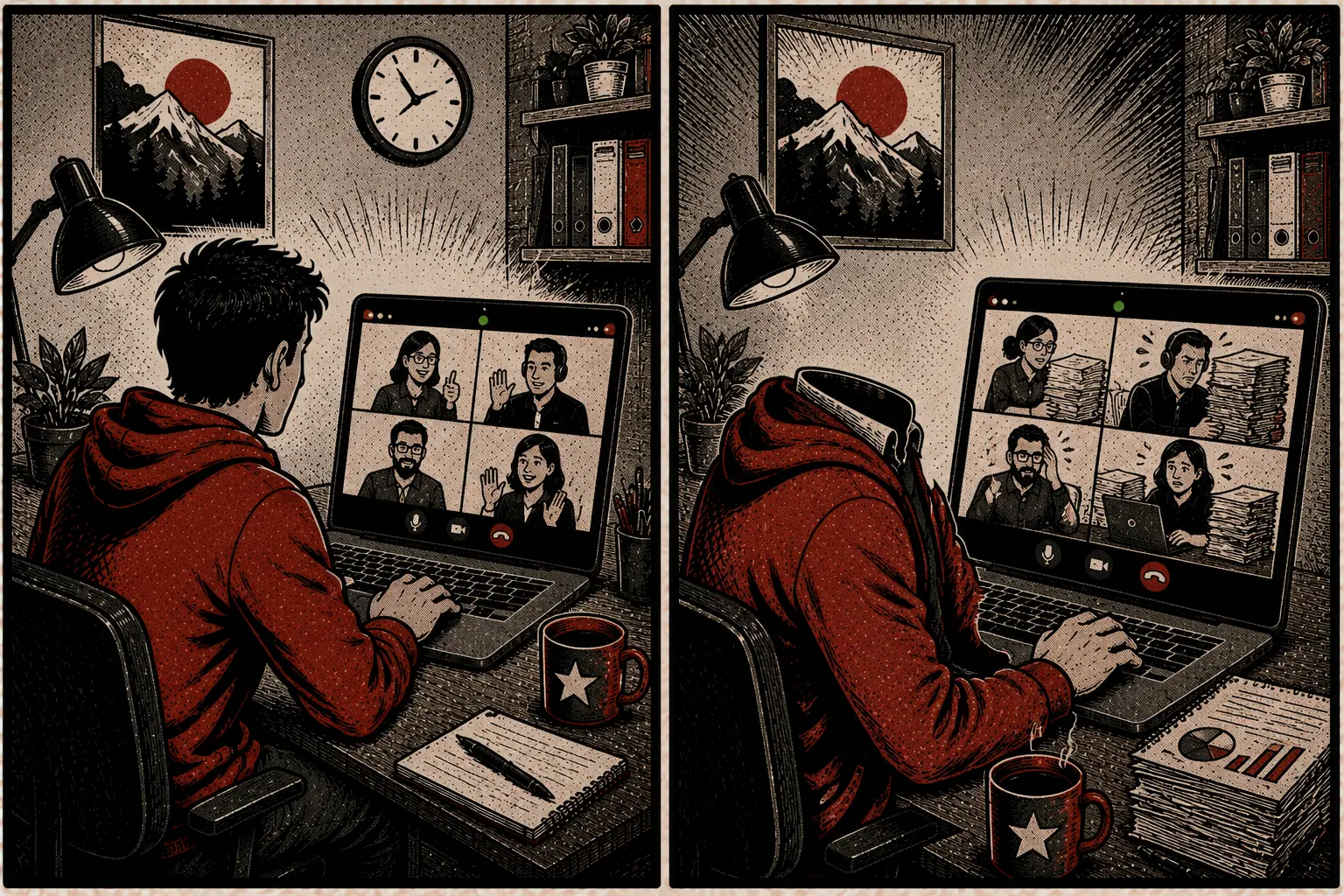
Quiet quitting is the opposite pattern to a clean exit: people stay but stop truly contributing. They do the minimum, disengage emotionally and often pretend to work, especially in remote contexts where output is not closely monitored. It can last months or even years if nobody checks outcomes, KPIs are unclear and honest conversations about expectations never happen.
The cost is not only productivity. Team morale erodes first: others see it, feel it, and slowly adopt the same attitude, because nothing signals that effort matters more loudly than watching low effort go unnoticed. And when the situation finally breaks, the company pays twice, for the months of lost output and for the time and money needed to find and train someone new.
Quiet quitting is usually a symptom of weak processes rather than of bad people: poorly designed performance reviews, missing benchmarks, confusing responsibilities, or no alternative path when a role reaches its natural end. If we know that a role has a healthy duration of around three years, we can plan ahead with lateral moves, promotions, job crafting, temporary projects, training, or, when there is no internal option, a respectful and supported exit.
It is human that someone becomes dissatisfied with what they are doing, and it will happen in any company. What is not acceptable is treating it as business as usual. Dissatisfaction should be monitored, named and addressed, because behind every quiet quitter there is usually a question nobody asked in time.
Reflective questions
- Which people in your team are currently delivering the minimum, and how long has that been true without an honest conversation about it?
- Do your KPIs and review cycles make disengagement visible within weeks, or could someone coast for months before anyone noticed?
- For roles in your team that have a natural duration, what alternative path have you already designed before the person starts looking outside?
5. The exit interview as a ritual
When off-boarding is unavoidable, the exit interview is the core ritual. It is not a bureaucratic formality but a structured conversation with a double goal: to give feedback to the person and to collect feedback for the company. Both directions matter, and skipping either one turns the meeting into theatre.
Treated seriously, it is one of the few moments where honesty has almost no cost for the person leaving and enormous value for the organization staying. There is no promotion to protect, no review to pass, no manager to please. Treated as paperwork, it produces polite, generic answers that change nothing and confirm to the person that their experience never really mattered.
Making it a ritual means giving it the same predictability we give onboarding: a scheduled slot, a known structure, a person responsible for running it, and a debrief afterwards. Rituals are what make difficult conversations possible when emotions are high, because nobody has to invent the format while they are in the middle of it.
Reflective questions
- Do you treat the exit interview as a structured ritual with a clear dual purpose, or does it tend to happen informally and without preparation?
- Thinking about the last two or three people who left, how much of their feedback has actually changed a process, a policy or a management behaviour since then?
- Who in your company owns the exit interview process, and what happens to the notes after the conversation ends?
6. Preparing the conversation
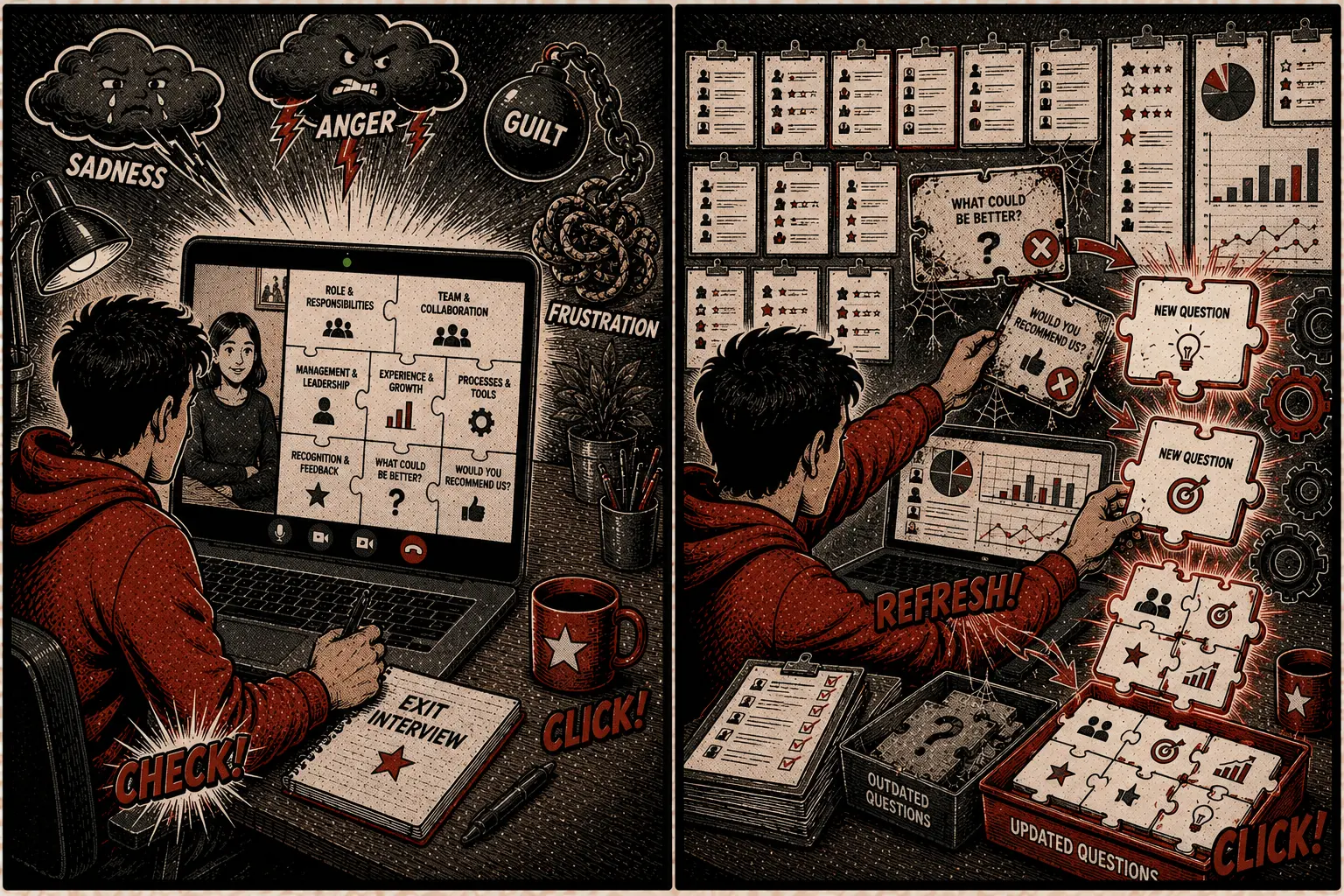
Preparation is crucial. Walking into an exit interview without context is disrespectful and wastes the opportunity. Before the conversation, the people manager or HR should:
- Collect feedback from the direct manager and, when relevant, from colleagues.
- Review performance history, key milestones, and any previous issues or praises.
- Clarify administrative details: last working day, final salary, pending bonuses, vacation balance, equipment return and access removal, double-checked with the person, never assumed.
Preparation shows that the person's story matters, even at the end. We cannot change the beginning of the experience at this stage, but we can design a respectful and intentional ending. Showing that we remember their journey, what they built, what went wrong, what they asked for and never received, helps them feel seen, and it changes the quality of everything they tell us in return.
It is also practical. Doing the research before the meeting means we already have the material to build reports on off-boarded people, so the conversation itself stays a conversation instead of turning into an interrogation. And it prepares us emotionally: exit interviews can be intense, with tears, frustration or relief, and a clear structure helps us stay grounded when the discussion turns unexpectedly personal.
Reflective questions
- Do you systematically review performance history, milestones and unresolved issues before an exit interview, or do you rely on memory and whatever the person raises?
- Is there a checklist you consistently verify with the person for salary, bonuses, vacation balance, equipment and access removal, or are these handled at the last minute?
- What is one preparation habit you can commit to before every future exit interview, at least one week in advance?
7. The standard question set
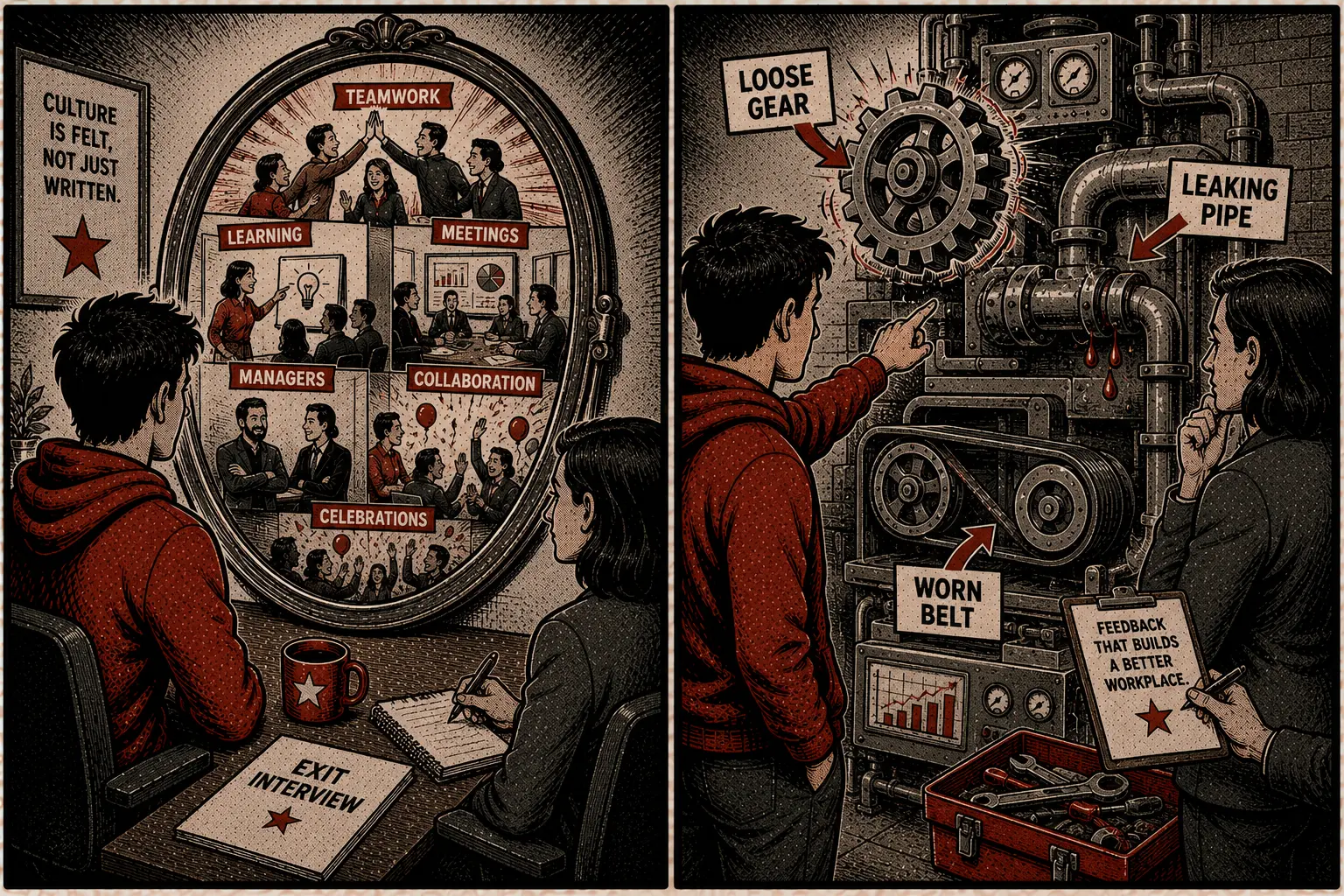
The script needs two variants. When the person chose to leave, ask "What led you to decide to leave the company?". When the company decided to end the collaboration, replace it with "What do you think happened that led us to this decision?". Everything else can stay the same, which is exactly what makes comparison across exits possible.
- "How would you describe our company culture, now that you are leaving?", it shows whether our culture was visible and actually felt, whatever that culture contains.
- "What should we improve, based on your experience here?", people start with a few words, then open up if we ask specific follow-ups.
- "Did you feel you had regular, honest feedback during your time with us?", it reveals how managers really work with their teams, including with the people who are staying.
- "What is the best project you have done here, and what results did it lead to?", it shows whether the person had challenging work and the conditions to perform.
- "Do you remember a moment when you felt particularly supported, or particularly alone?", it prevents us from repeating the same behaviours with people who stay.
Notice that most of these questions are not really about the person leaving. They are about the team that remains: the manager's habits, the clarity of the work, the moments where someone was left alone. The exit interview is the cheapest audit of daily management we will ever run.
Reflective questions
- Do you have a written question set for exit interviews, with both variants ready before the conversation is scheduled?
- Which of your current questions consistently produce uninformative answers, and what would you replace them with?
- Which question from your last exit interview would be worth asking the people who are still here?
8. Emotional neutrality and hidden-meaning questions
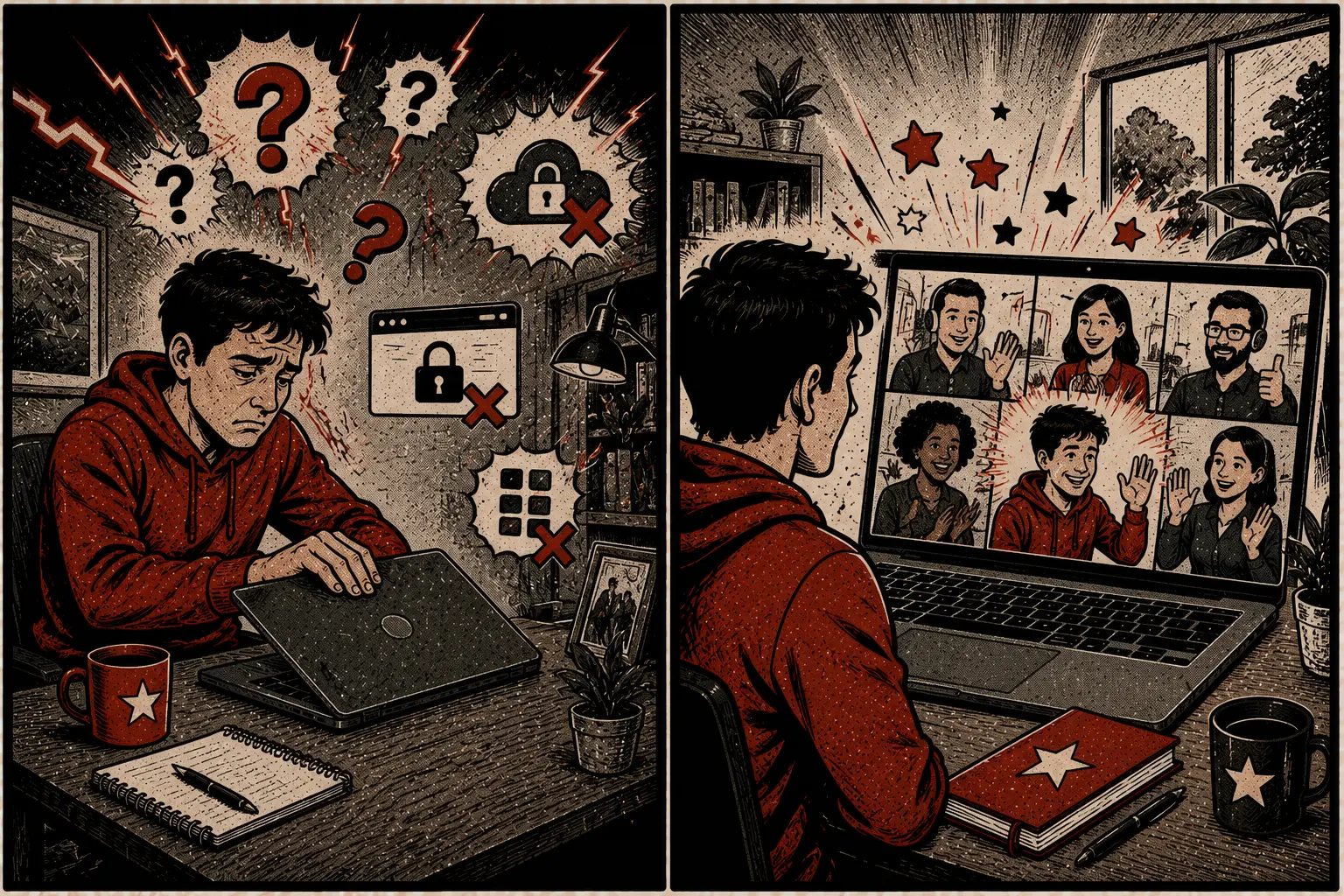
A semi-standardized set of questions has two advantages. First, it protects the process from emotions: when we feel sad, guilty or angry, we can lean on a script and still give and receive honest feedback. Second, it lets us aggregate answers over time and detect patterns statistically instead of relying on the impression left by the last painful conversation.
When we already know there were specific issues, hidden-meaning questions let us explore them from the other side. Instead of trying to confirm our version, we can ask how the person experienced deadlines and priorities, and whether they felt they were clear and respected on both sides. Sometimes we discover that expectations kept changing, or that processes were simply ambiguous, a concrete area to fix, rather than a person to blame.
Questions should be reviewed before each cycle: some become outdated as the company changes, and any question that always receives the same uninformative answer should be removed or replaced. When a question reveals a real problem, reuse it with people who are still here, before that problem pushes someone else out, and give them the chance to speak up while it can still be fixed.
At that point acting becomes crucial, or at least trying to. If we acknowledge a problem and do nothing, the implicit message is that speaking up is useless. And when more than one person mentions the same uncomfortable situation or the same missing resource, that topic deserves its own permanent question in future interviews, so we can tell an isolated case from a pattern.
Reflective questions
- When an exit conversation becomes emotional, do you have a structure to fall back on, or does the outcome depend on your mood that day?
- For the issues you already suspect exist, what hidden-meaning question would let the person describe them in their own words?
- When was your question set last reviewed against how the company actually works today?
9. From answers to data
Standard questions make it possible to turn qualitative feedback into quantitative data: we can code answers, count frequencies and build simple statistics. If after thirty exits seventy per cent of people mention a lack of clarity about career growth, we know exactly where to focus. If different cohorts across years repeat the same pain point, the issue is structural, not temporary.
Data matters only if we act on it. For every recurring theme, ask one question: what is the concrete process change that would address this?
- People say they never met their team in person: plan at least one yearly in-person meetup.
- People say hours are too rigid for remote work: revise policies to introduce negotiated flexibility.
- People say they lack feedback: strengthen review cycles and train managers on feedback skills.
The exit interview is not a confession; it is a design input. Treated that way, the people who left keep contributing to the company long after their last working day, and the ones who stay inherit an organization that was corrected by real experience instead of assumptions.
Reflective questions
- Are exit interview answers stored somewhere they can be compared over time, or do they live in scattered personal notes?
- What is the single most repeated theme in your last ten exits, and what process change have you made because of it?
- Who is accountable for turning exit feedback into a decision, and by when?
10. The three exit scenarios
A mature off-boarding culture recognizes three broad scenarios: the person chooses to leave, the company decides to end the collaboration, or both sides agree it is time to close the chapter. Each one requires a different conversation.
The first is often the most dangerous, especially when unanticipated. Losing a talent costs the money invested in training, the time spent onboarding and integrating them, and the search for a replacement. If the reasons are even partly related to the company or to how the role is designed, an action plan should follow quickly, before others leave for the same reasons. There is also the risk that the person takes others with them: when we intentionally build strong connections, people sometimes want to keep working together elsewhere and leave in pairs or small groups. Here the questions should be as detailed as possible, to separate individual motivations from systemic problems.
In the second scenario, the company should clearly explain what led to the decision and give as much constructive feedback as possible, in a form the person can use to find their next role. Here the company has the advantage of having planned ahead, delegating tasks, redistributing responsibilities, starting the search, and therefore the responsibility to support the person, especially if they worked hard and behaved correctly without reaching the expected results: letters of recommendation, introductions, or simply honest feedback about strengths and development areas. The direct manager should always be involved before the final decision, and the rest of the team informed only after the person concerned, to avoid rumours and unnecessary anxiety.
In the third scenario the exit interview becomes a transition-design conversation. We can co-create the next steps: offer references, introduce the person to another company, invite them back for future collaborations, or help them reframe their experience for their next move. This is particularly relevant for roles with a natural duration, entry-level positions, temporary roles, specialized projects that inevitably end. Discussing timing, communication and handover together turns a potentially painful exit into a mutually respectful transition.
Reflective questions
- For your last unexpected resignation, how long did it take you to understand whether the cause was individual or systemic?
- When your company ends a collaboration, what concrete support do you offer the person, and is it consistent or improvised each time?
- Which roles in your team have a natural duration, and have you ever planned the exit together with the person from the start?
11. Ending well: co-created exits
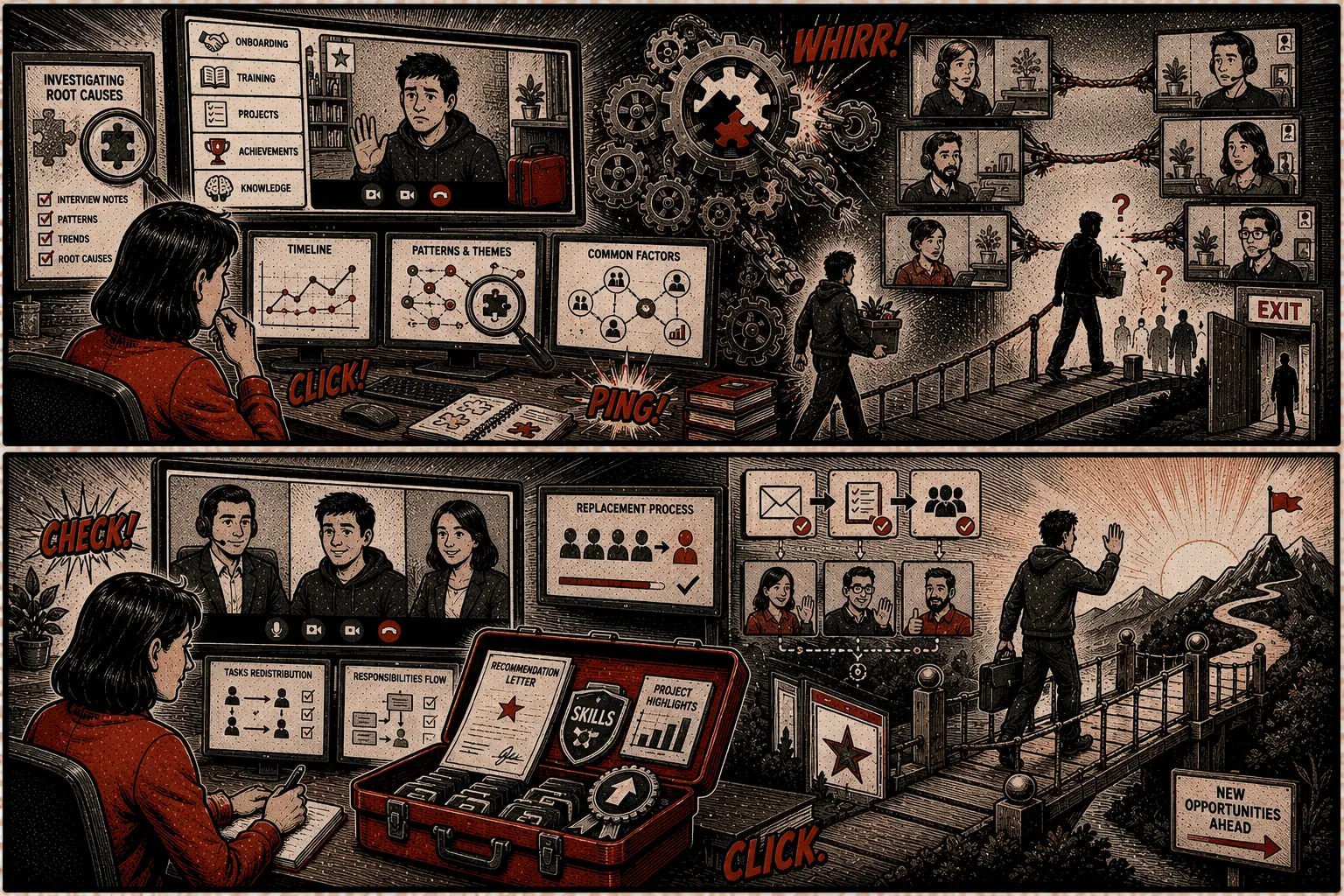
Not all exits are negative or one-sided. Often leaving is the best step for both sides: the person has outgrown the role, the company cannot offer the next step, or life circumstances changed in a way that makes a different path healthier for everyone. In a world where people look for meaningful experiences and not only wages, keeping someone stuck in the wrong place can be more harmful than helping them move on with clarity, support and dignity.
The common thread across all three scenarios is respect. People are not products; what can be designed like a product is the experience of working with us, including the way the relationship ends. Our job as people managers is to maximize the quality of that experience from the first interview to the last goodbye, and the last goodbye includes listening to why someone is leaving and learning from it.
Ending well does not mean pretending everything was perfect. It means acknowledging reality, recognizing contributions, and closing the loop with honesty and care. Done consistently, it produces something no employer branding campaign can buy: former colleagues who recommend us, come back, or send us the next great person we hire.
Reflective questions
- Looking at your last exit, did you see and address early warning signs in time, or did you wait until an honest conversation was no longer possible?
- If that person described your management style to a friend after leaving, which three words would they realistically use, and are you satisfied with them?
- During their journey, did you consistently offer clear expectations, regular feedback and at least one concrete development opportunity?