 REMOTE FIRST
From Presence to Performance
Why remote reveals the management gaps the office was hiding: the illusion of control, clear responsibilities and KPIs, the right cadence, and evaluation as a dialogue instead of a verdict.
1. Why evaluation matters in remote
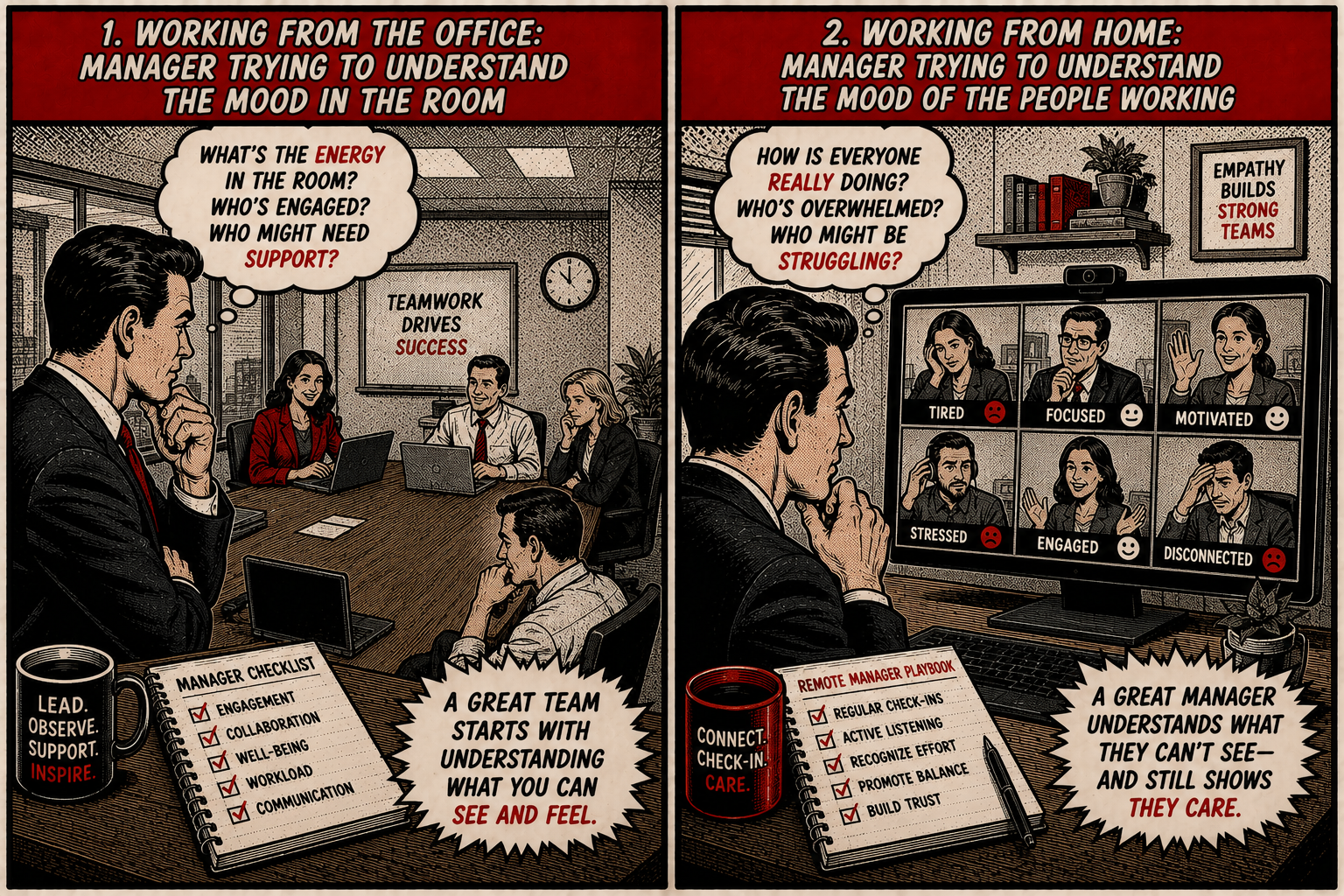
If you have ever managed a team in a physical office, you probably felt in control, not because you truly were, but because you were constantly exposed to signals that made it feel that way. You could see who showed up, hear the texture of conversations, and sense when energy in the room shifted. Ambient context gave you a rough read on how things were going, without any real system behind it.
In a remote environment all of that disappears at once, and companies that keep operating on impressions end up making decisions based on the memory of how someone used to show up in a room. Remote does not create these problems, it reveals them. Unclear roles, missing measurable outcomes, inconsistent feedback, and managers who were never really equipped to manage: the office was doing enough of that work for them. The right response is not to figure out how to manage people remotely, but to build the people-management system you should have had all along.
Reflective questions
- Do I have a structured system for staying informed about team performance, or am I still relying on informal signals that no longer exist?
- Which performance challenges on my team existed before remote work but were previously masked by physical presence?
- What is one structural gap remote has surfaced that I can commit to closing this quarter, rather than managing around it?
2. The illusion of control
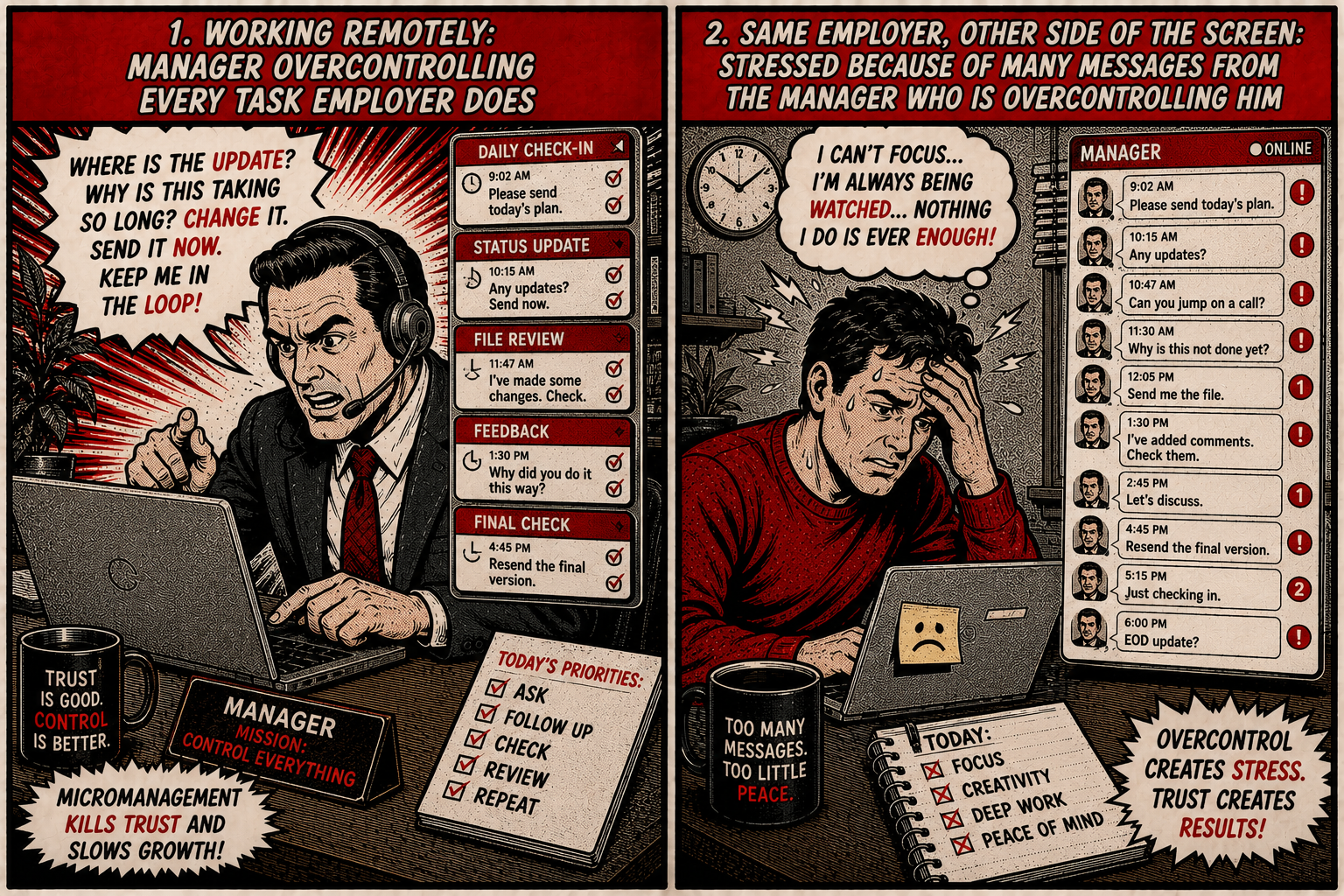
When visibility disappears, companies usually fall into one of two extremes, and both are damaging. The first is over-control: strict time tracking, constant monitoring, continuous requests for updates. The result is loss of trust, micromanagement, and a team demotivated not because the work is hard but because they feel watched rather than supported. The second extreme is the opposite: no monitoring, no clear expectations, total freedom without guidance, which sounds generous but produces inconsistency, confusion, and issues that surface far too late.
Both reactions come from the same root problem, not knowing what is actually happening, so the solution is not to pick a point between them, but to build something genuinely different. Over-control is a response to your own anxiety, not to real evidence. Stepping back entirely often confuses trust with absence, leaving people without structure and yourself without information. Recognizing which direction you naturally lean is the first honest step.
Reflective questions
- Which specific behaviors suggest I have fallen into one of these two extremes?
- Which over-control habit of mine is most likely reducing team autonomy, even if it feels justified?
- What is one minimum structure I can put in place within two weeks for a team member who currently has none?
3. From presence to performance
In a traditional office, evaluation is often implicit, being present gets equated with working, and participation gets equated with productivity. In a remote environment that assumption collapses, and only one thing remains: results. It no longer matters where or when someone works, because if results are not there, the system breaks regardless of how available someone appeared to be. This is a shift from control to responsibility, from presence to performance, from intuition to data, a cultural change, not a technical one.
Making that shift is harder than it sounds. Most evaluation habits are built on presence-based logic even when managers believe they are focused on output. You may think you are assessing someone on their results, but if your impression is shaped by how quickly they respond to messages or how visible they are during the day, you are still running a presence-based model with a results-based label on it. Meanwhile, some of your strongest contributors may be quietly delivering excellent work without drawing attention to themselves, systematically undervalued in a system that still rewards visibility.
Reflective questions
- Which team member might I be undervaluing because they are less visible, and which might I be overvaluing for the opposite reason?
- Is my management philosophy genuinely built around responsibility and performance, or still shaped by presence-based habits?
- What is one concrete way I can shift my evaluation criteria this month from availability signals to outcome signals?
4. What actually needs to be built
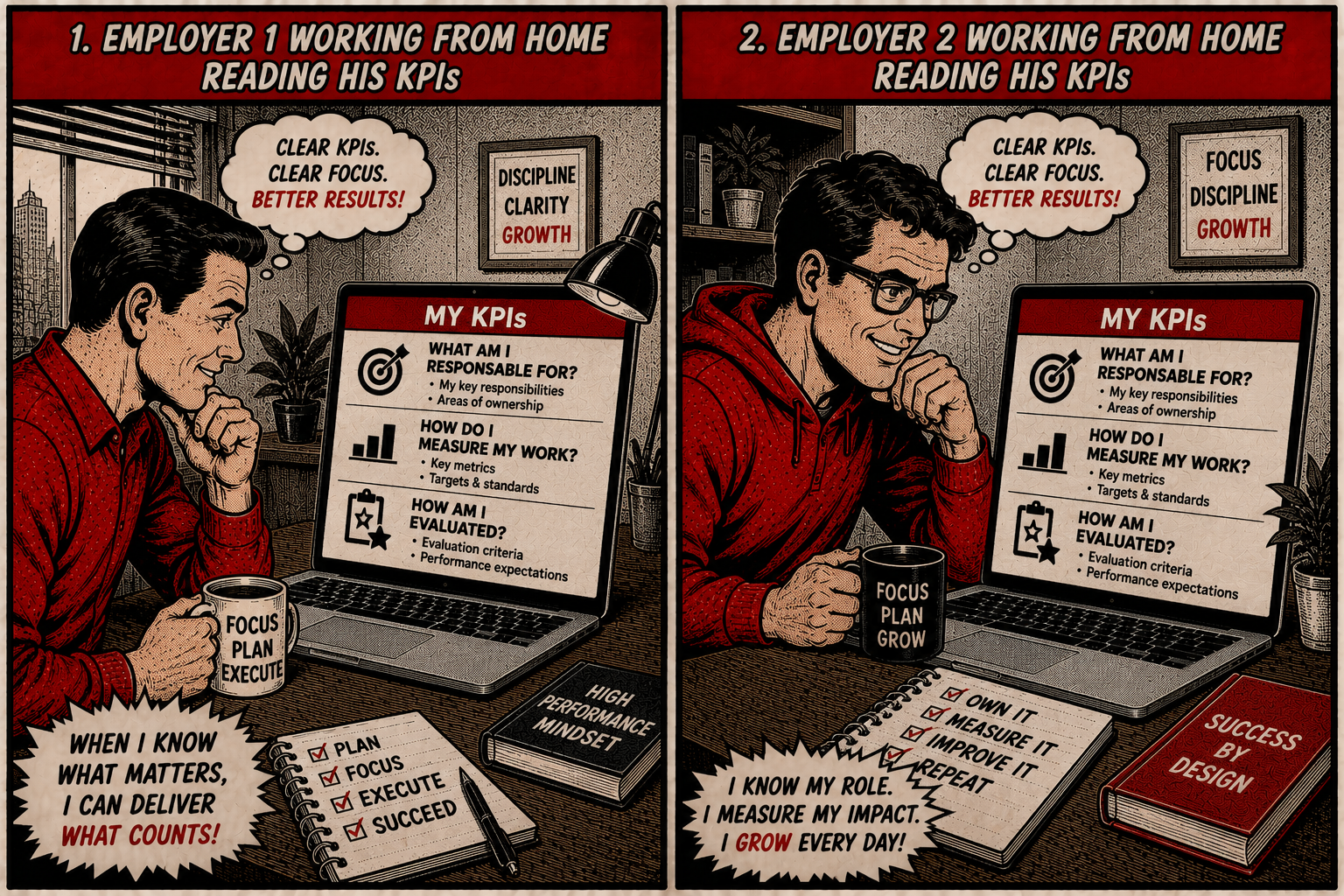
Many organizations respond by adding tools, more software, more dashboards, more processes, hoping technology alone will replace what the office used to provide. It won't. Tools without a system are just noise, and adding more of them without clarity about what you are trying to measure only creates the illusion of progress. A performance evaluation system is not built on tools, it is built on three fundamental elements: clear responsibilities, explicit expectations, and a regular review cadence. Without these, everything else is just a way of tracking things nobody has agreed matter.
Every role needs concrete responsibilities that leave no room for ambiguity. Instead of "manage client relationships," you need specifics: handle onboarding calls, respond to client requests within a defined timeframe, ensure specific deliverables are completed on schedule. Once responsibilities are clear, translate them into measurable outcomes, number of completed tasks, response time, delivery deadlines, quality indicators. They just need to exist, and they need to be agreed upon before the evaluation happens rather than invented after. When all three elements are in place, evaluation stops feeling like a judgment call and starts functioning as a shared reference point.
Reflective questions
- Have I invested more in tools or in the underlying system those tools are supposed to support?
- For each role on my team, can I answer in one sentence what the person is responsible for, how I measure that, and what triggers a corrective conversation?
- Which of the three foundational elements, responsibilities, expectations, or cadence, is the weakest across my team right now?
5. Documentation and structured onboarding
In a remote environment, clarity cannot rely on verbal communication, everything that matters must be documented, including role expectations, workflows, key processes, and performance indicators. Without documentation those things exist only in individual memories where they drift, get reinterpreted, and eventually cause conflict. Documentation is not about creating bureaucracy, it is about making sure that what you both think was agreed is actually what was agreed. The initial phase of a collaboration is where the system matters most, because this is when habits, assumptions, and patterns get established, and once established, they are hard to change.
A proper evaluation system starts from onboarding, which means a clear document that includes the tasks assigned to the new hire, the expected outputs, the timelines, and the evaluation criteria. Most onboarding processes are informal, new hires get access to tools and general explanations, but rarely a structured path, which leaves expectations unclear and evaluation subjective. In the absence of physical presence, visibility must be built intentionally: tracking tasks, reviewing outputs, and having regular check-ins from the very beginning, not to control, but to understand. Your role is not that of a supervisor but of an interpreter of performance, and you can only interpret what you have built a system to surface.
Reflective questions
- What important expectation on my team currently exists only in verbal form, and what risk does that create for consistency?
- For the last person I onboarded, did I give them a structured path with clear deliverables and feedback checkpoints, or general orientation?
- What is one document or structured first-month plan I can prepare now, so the next person joining enters with full clarity from day one?
6. Frequency and cadence
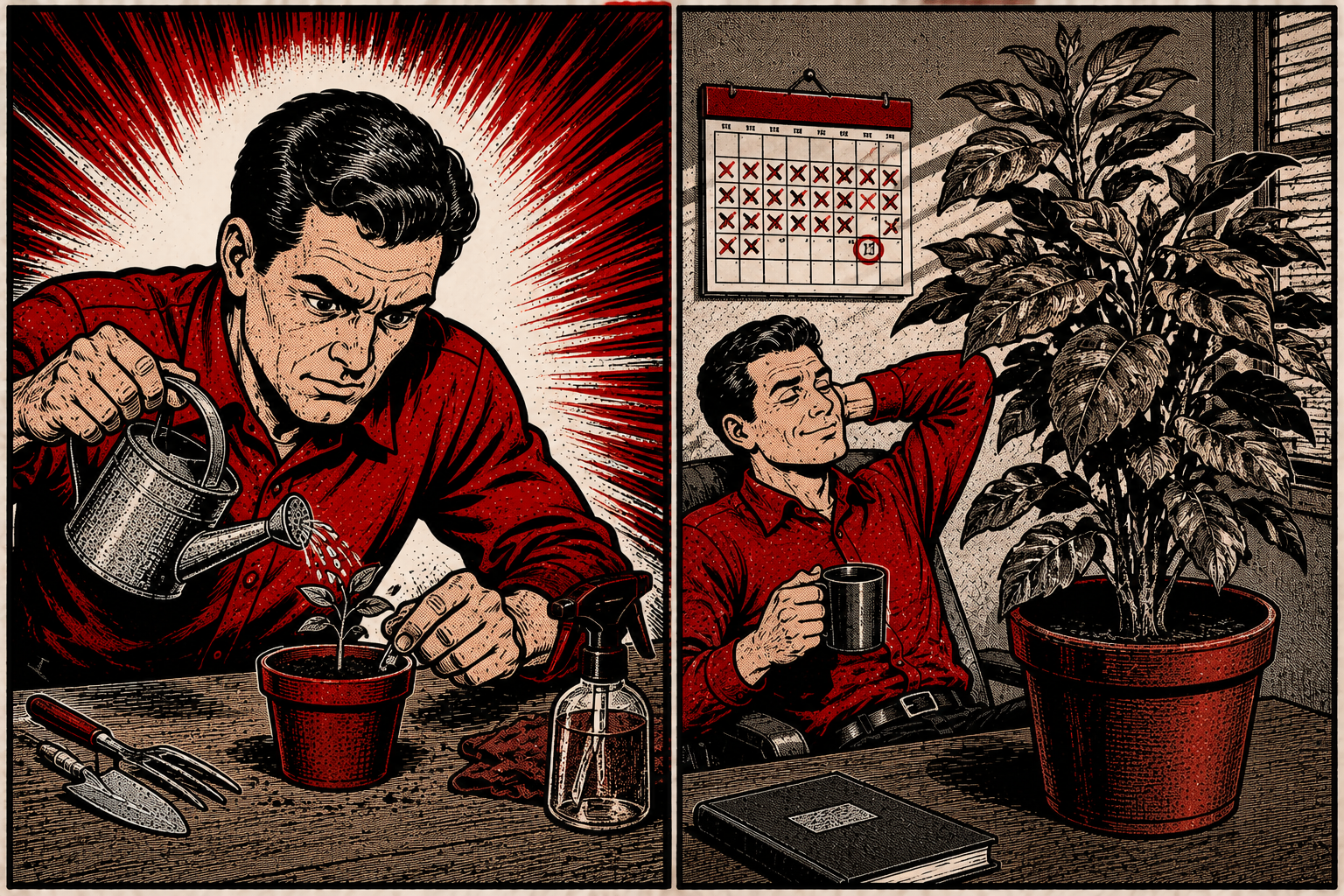
Evaluation is not just about what you measure, it is also about when you measure it, because the timing of feedback determines whether it lands as useful information or as a delayed verdict that no longer connects to the work it describes. During the initial phase of a collaboration, frequency must be high, especially in the first three months, when misalignments are still small enough to correct with a short conversation. The trial period should include structured evaluation moments, a check-in after two weeks, a formal review at the end of the first month, and a comprehensive assessment before the end of the trial. Many companies rely instead on a single decision point at the end, but by then most useful signals have already occurred.
Once a collaborator is stable, monthly reviews typically become the right cadence, frequent enough to catch drift, spaced enough to allow real work to happen between them. But there is a common misconception: evaluation does not happen during a specific meeting. It is a continuous process, and the scheduled review is simply the moment when observations gathered over time are organized, discussed, and turned into decisions. A system only works if it is applied consistently, skipping reviews creates gaps, gaps become drift, and drift becomes performance problems much harder to address than the small deviations that produced them. There is also a temptation to over-engineer the system with too many metrics and too many tools; a good evaluation system is simple enough to be applied consistently by every manager, every month, without shortcuts.
Reflective questions
- Does the frequency of my evaluations match the phase of the collaboration, high during onboarding, steady later, or is it uniform regardless of context?
- Do I treat evaluation as an ongoing process supported by scheduled reviews, or as an event that happens only when a review is on the calendar?
- Is my current system simple enough to be applied consistently, or does its complexity mean it gets skipped?
7. The manager as translator and preparer
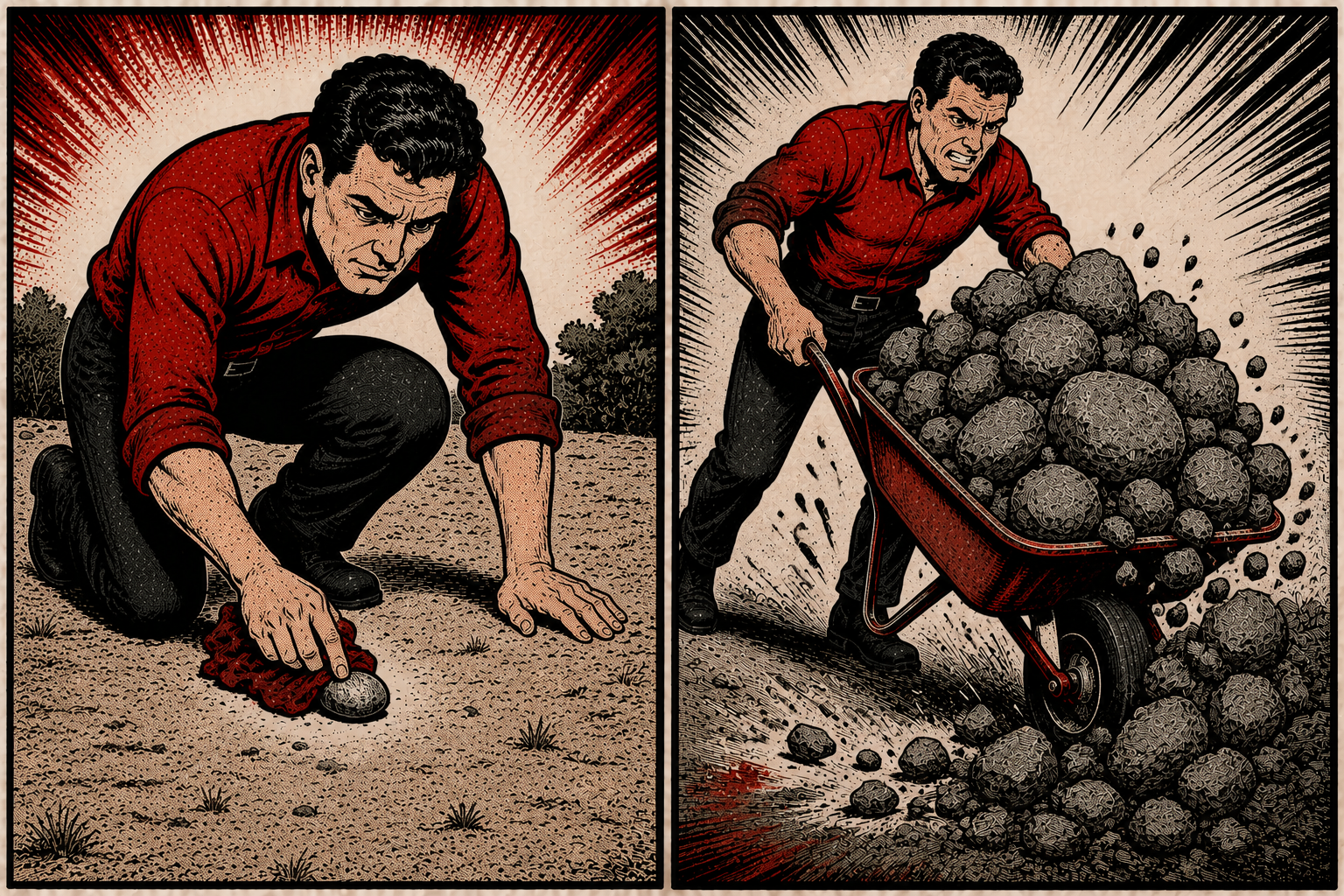
One of your most important roles is to translate expectations into actionable guidance, turning company objectives into specific behaviors, decisions, and outputs a collaborator can work toward. Every collaborator needs feedback, not occasionally but continuously, because feedback is the mechanism through which expectations become clearer and behaviors adjust toward the outcomes the company needs. When feedback is absent, collaborators either assume everything is fine and drift in a direction that may not match your expectations, or they become anxious about performance without knowing what would resolve that anxiety.
A monthly evaluation should never be improvised. You prepare by reviewing the collaborator's KPIs, revisiting notes from previous reviews, and identifying specific examples that illustrate both strengths and areas for improvement. Evaluation should not be driven by emotion, because temporary frustration or enthusiasm distorts assessment and produces feedback that reflects the moment rather than the pattern. When evaluation is inconsistent, unprepared, or emotionally driven, collaborators learn that performance conversations are unpredictable events to endure. When it is prepared, specific, and grounded, they learn it is something they can actually engage with and influence.
Reflective questions
- Which collaborator is most likely operating with a different understanding of expectations than I have, and what feedback have I not yet delivered that would close that gap?
- How much time do I typically spend preparing for a monthly review, and does that preparation include revisiting KPIs, past notes, and specific examples?
- What is one preparation habit I can commit to, such as a fifteen-minute pre-review checklist, that would make my reviews more consistent regardless of my mood?
8. From responsibilities to KPIs and compensation
In many organizations, responsibilities, performance metrics, and salary exist as three entirely separate structures that evolve independently, with no formal mechanism connecting them. This creates predictable inconsistencies: people with similar roles earn very different salaries, high performers are paid the same as low performers, and expectations tied to compensation remain unclear enough that no one can explain them with confidence. Responsibilities must be translated into measurable indicators, a well-defined responsibility like "manage client relationships" is functionally useless as an evaluation criterion until it becomes something observable: response time, client retention rate, satisfaction scores. KPIs serve as a bridge between what is expected and what is actually delivered.
Compensation should not be based on historical decisions, negotiation skills, or informal internal comparisons, when it is, the link between effort and reward breaks down. Instead, it should reflect the level of responsibility a person carries, the complexity of their role, and the impact they have on the organization. Performance should influence compensation, not because this requires constant salary changes, but because without a visible link between the two, the incentive structure weakens. In practice, progression is linked to performance in a documented, traceable way: when someone takes on increased responsibility and delivers at a higher level, that shift is reflected in their compensation over time. Increases should be supported by documented performance data, because that kind of evidence creates consistency across decisions and protects you from the quiet resentment that builds when people suspect the process is arbitrary.
Reflective questions
- Do responsibilities, performance metrics, and salary decisions feed into each other coherently, or are they effectively managed by different people using different criteria?
- Could a thoughtful observer look at my team's pay structure and explain the differences in performance terms, or would some decisions be difficult to justify?
- What is one step I can take before my next review to share the evaluation criteria explicitly with each collaborator in advance?
9. Applying the system to new hires first
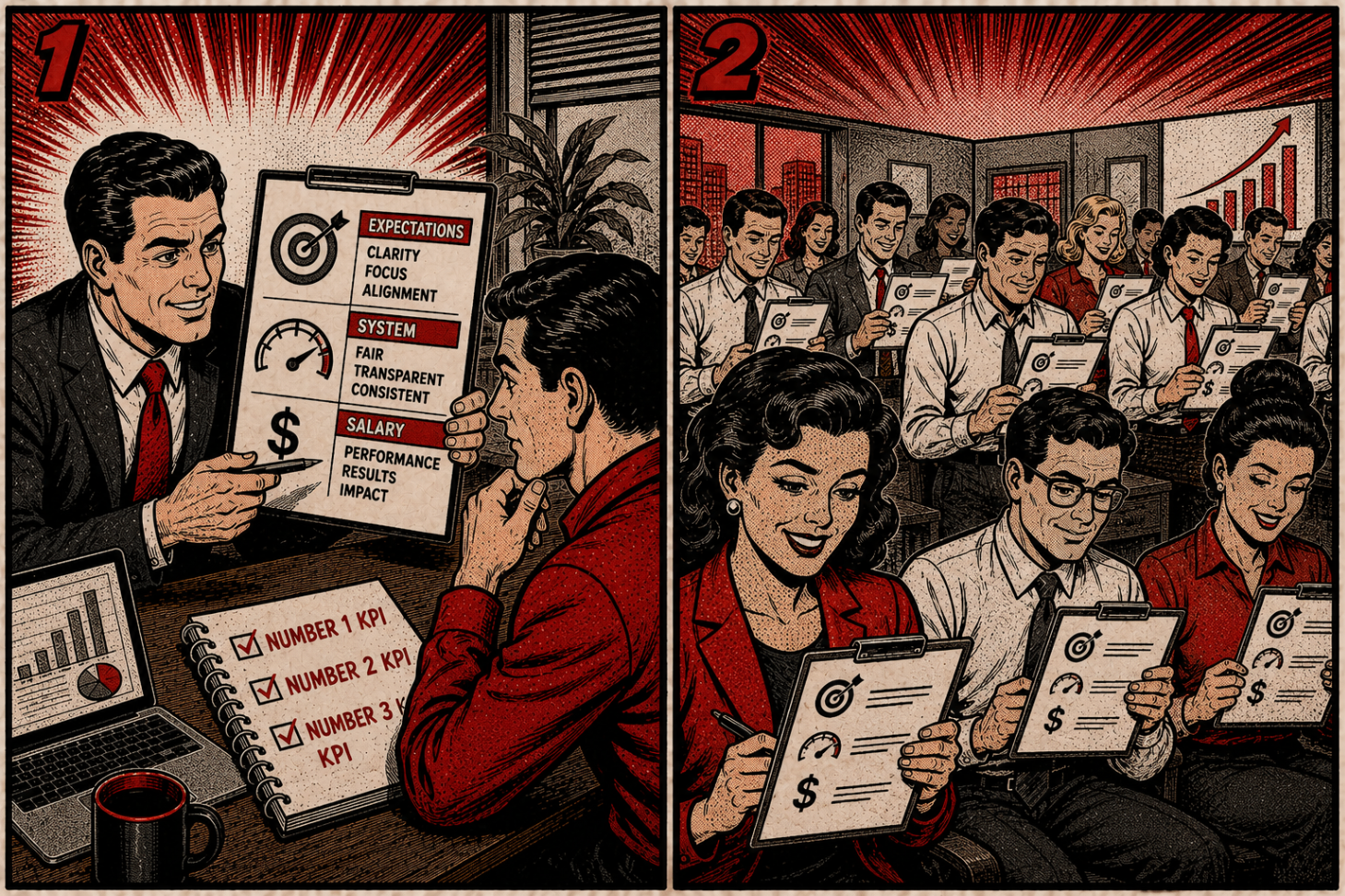
Implementing a structured performance and compensation system across an existing team is difficult, because people are already accustomed to how things work and any change is likely to feel disruptive. Starting with new hires allows you to test the structure, refine it based on real use, and build a track record of consistent application before extending it to the rest of the team. Compensation communicates priorities in ways that are more legible to your team than almost any other signal, which means that when new hires enter under a clearly explained model, the rest of the organization begins to see what fairness and consistency actually look like in practice.
Clarity should exist from the very start of a collaboration, not because it eliminates all friction, but because it dramatically reduces the friction that comes from ambiguity, the friction that has nothing to do with the work itself and everything to do with unspoken assumptions. You play a key role in explaining how performance connects to compensation and what is expected at each level. While structure is important, excessive complexity creates confusion: a compensation model that requires an internal explainer to be understood is a model that will not be trusted. Responsibilities, KPIs, and compensation must evolve together, when a role changes and the other two do not follow, the system stops matching reality.
Reflective questions
- Is there a structured, documented performance and compensation model that new hires enter into, or does each new hire receive an ad-hoc arrangement?
- Is the connection between performance and compensation explained clearly and in writing during onboarding, or left to individual interpretation?
- What is one element of a structured system I could apply to the next new hire as a pilot, without changing the arrangements of current collaborators?
10. Evaluation as a dialogue

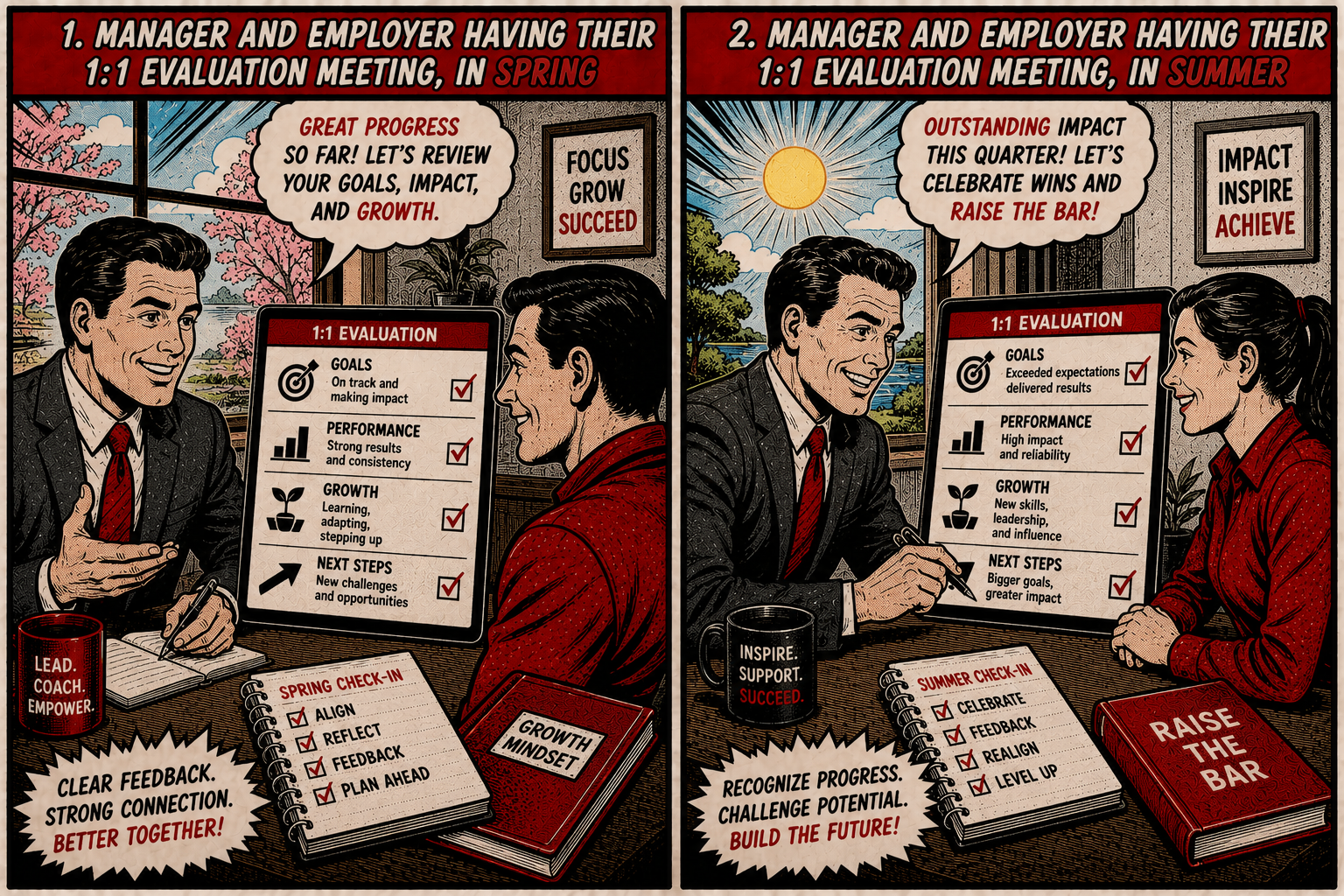
When evaluation is controlled only by you, the information you work with is inevitably incomplete, you see the outputs but not always the obstacles, the results but not always the context. A review should function as a conversation, not as a report, both parties speak, both parties listen, and both parties clarify until the picture that emerges reflects a shared understanding rather than a one-sided conclusion. Many of the problems that affect team performance are not visible from the outside, unclear instructions, conflicting priorities, inefficiencies in processes, and because they are invisible to the manager, they persist and compound. Shared reviews bring these issues to the surface.
One of the most damaging situations in a performance relationship is surprise, a collaborator who genuinely believed they were performing well suddenly receives negative feedback, or a manager who discovers a serious problem only when it is too late to address cleanly. When reviews function as confirmation of an ongoing conversation rather than as the primary vehicle for delivering assessments, the dynamic shifts from reactive to proactive. For this to work, the collaborator must feel genuinely safe to speak. You set the tone: if you react with defensiveness the collaborator will stop sharing openly; if you respond with curiosity and structure, the quality of feedback improves significantly.
To avoid randomness, shared reviews need to follow a consistent structure, one both sides understand in advance, typically including a review of past performance, a discussion of challenges, an opportunity for feedback on processes and management, and an explicit alignment on next steps. The quality of a review depends almost entirely on the quality of the questions asked: open-ended, specific, and actionable questions produce real information, while generic questions produce generic answers. Feedback from both sides should be documented, because without a written record, patterns become invisible and conversations lose their continuity from one cycle to the next.
Reflective questions
- In my monthly reviews, how much of the speaking time belongs to me versus the collaborator, and does that ratio reflect a genuine conversation?
- Could any collaborator on my team genuinely be surprised by the feedback they would receive in their next formal evaluation?
- What is one documentation habit I can commit to, a shared review note, a follow-up list, a status update on prior commitments, that would make the process visibly compound over time?
11. Continuous feedback and monitoring

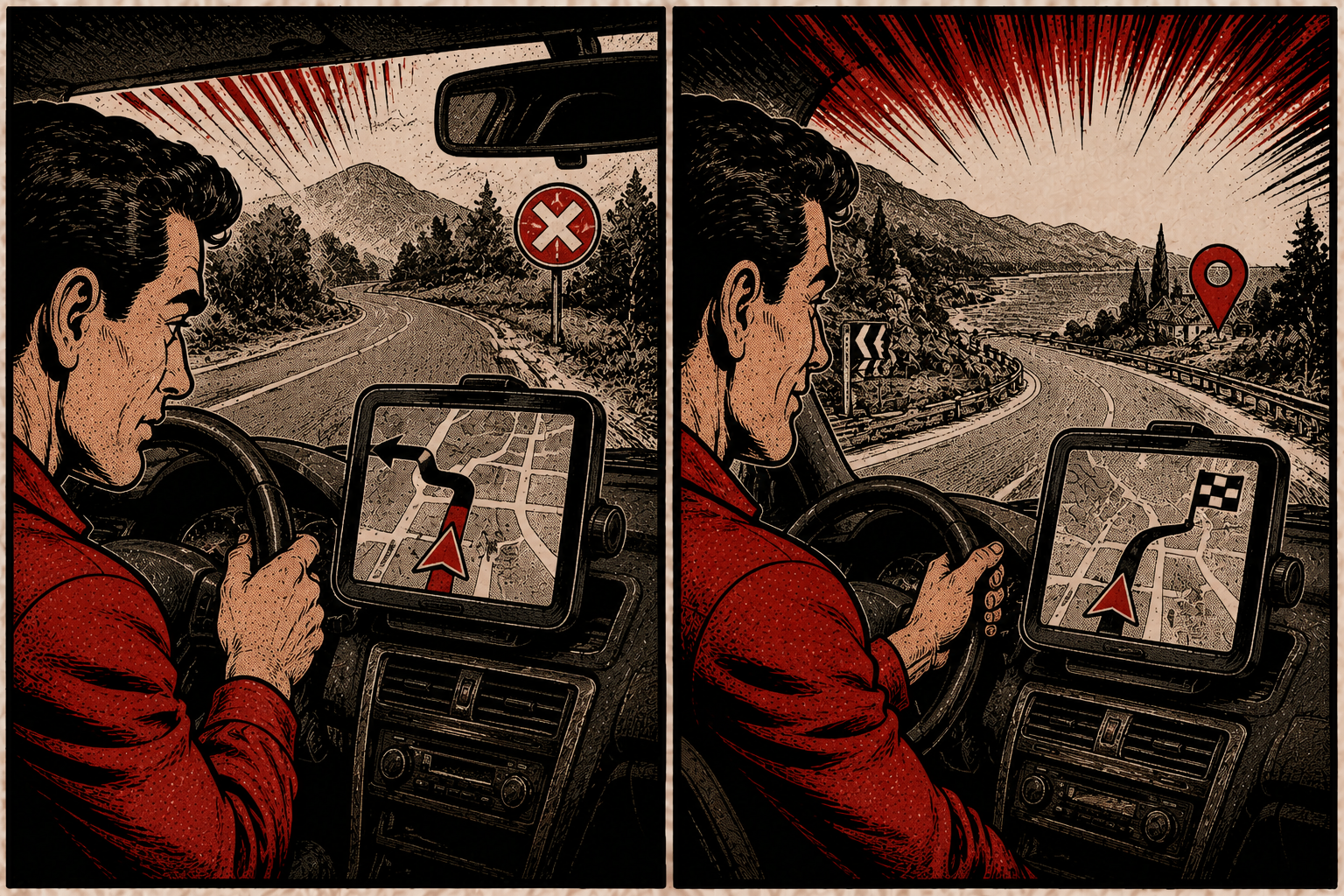
If feedback happens only once per month, issues accumulate, small mistakes grow into larger problems, and correction becomes progressively more difficult. The monthly review was never designed to carry the full load of performance management; it was designed to be the formal layer on top of a much more frequent, much lighter feedback rhythm that catches things early. Continuous feedback fills the gap between formal reviews by providing quick corrections, short clarifications, and real-time adjustments as work actually happens, a brief message sent the day a task is completed lands very differently than the same observation delivered three weeks later in a scheduled meeting.
Monitoring provides visibility, and in remote environments visibility does not come from physical presence, it must be created deliberately through systems: task tracking, progress updates, and activity signals that give you a reliable picture of how work is flowing. Monitoring is often misunderstood as surveillance, when its actual purpose is to understand how work flows: identify bottlenecks, detect inefficiencies, support decision-making. Used correctly, it tells you where someone is stuck before they have to ask for help. Time tracking sits in the same category: applied incorrectly it becomes oppressive; applied correctly it becomes informative. Time alone is not meaningful, it must be connected to output, quality, and impact before it tells you anything worth acting on.
Continuous monitoring allows early intervention, and the signals worth watching are not always dramatic, delays in task completion, reduced activity, inconsistent output. Most performance problems do not appear fully formed; they develop gradually, through a series of small deviations that are individually easy to explain away but collectively signal drift. The earlier a problem is identified, the lower the cost to fix it. Feedback and monitoring must work together: monitoring provides data, and feedback turns that data into direction. When feedback becomes cultural, expected, welcomed, and acted upon, frequent feedback reduces the need for difficult conversations, because issues rarely have the chance to grow into situations that require formal escalation.
Reflective questions
- Do I have a reliable way to detect when small issues are beginning to accumulate between monthly reviews?
- Have collaborators ever signaled, directly or through their behavior, that they experience monitoring as a lack of trust rather than as support?
- What is one specific type of feedback I tend to postpone that I can commit to delivering in real time this week?
12. Avoiding sudden terminations and evolving the system
One of the biggest failures of performance systems is sudden termination, when someone is let go without ever having received clear feedback about the issues that led to the decision. This is almost always a system failure, not a personnel failure, because it means the mechanisms that should have surfaced problems early either did not exist or were not applied consistently. Every serious performance concern must be communicated, documented, and given the chance to be resolved before a decision is made, which protects both the collaborator, who deserves to know where they stand, and you, because decisions made without a documented history of feedback are difficult to explain and difficult to defend. Consistency is more important than intensity: a system that works regularly, even modestly, is more effective than one applied with great effort sporadically.
As the organization grows, the system must evolve, refining KPIs, improving tools, and adjusting processes to reflect how roles, teams, and business realities have changed. The risk is not usually that managers build bad systems; it is that they build reasonable systems and then stop questioning them, so what worked when the team had three people is still being applied unchanged when the team has twelve. What makes this a system rather than a collection of practices is that each element supports the others: onboarding evaluation sets the baseline that monthly reviews build on; continuous feedback keeps the formal review from carrying more weight than it should; monitoring provides the data that makes feedback specific and credible; shared reviews distribute the ownership that makes the whole thing sustainable. When all components are aligned, performance becomes visible, feedback becomes actionable, and decisions become justified, not a perfect system, but a reliable one.
Reflective questions
- If I needed to part ways with a collaborator today, could I point to a documented history of feedback, warnings, and support that preceded that decision?
- Do I periodically review and update my performance system. KPIs, review formats, monitoring tools, to reflect how roles and the team have changed?
- What is one commitment I can make right now, not a system overhaul, but a single concrete next step, that moves me closer to a state where every performance conversation is grounded in clarity, consistency, and documented evidence?